


Page 19 - Seniors Today - April Issue
P. 19
during his or her lifetime, is given the peace
         of heaven or Jannat or the perdition of hell
         or jahannum. The focus is on ‘afterlife’,
         perhaps a refrain from the belief of rebirth.
         Under the Sanatan Dharma, the central
         belief is in the cycle of life and death or
         punarjanma where rebirth or moksha (or
         release from the cycle of life and birth) will
         be a function of the balance sheet of punya
         (dharmic deeds) and paapa (adharmic deeds)
         – so long as the atonement of the paapa is
         not complete in the same life or succeeding
         lives, one will be reborn and if there is
         an accumulated credit of punya from the
         previous birth, it will pay off handsomely         One of the typical dilemmas we all, as
         in the current birth. Whichever way one            friend or family, face is how to respond
         sees it, the interpretation of a believer and      when a close family or a friend is in the
         the intellectual would be that these tenets        final throes of life or has departed into
         essentially were for ensuring a disciplined        eternity. Given that any suffering of body
         living in a spirit of comity and peace in the      (or for that matter the mind) cannot be
         larger interest of the society and the people.     shared or taken over by anyone else, other
          Some clarification would be in order              than an expression of empathy and lending
         here, lest the topic be seen as morbid. Our        a shoulder or heart, very little can be done.
         behavioural reality is that we see life as a       And the concern is also that anything that
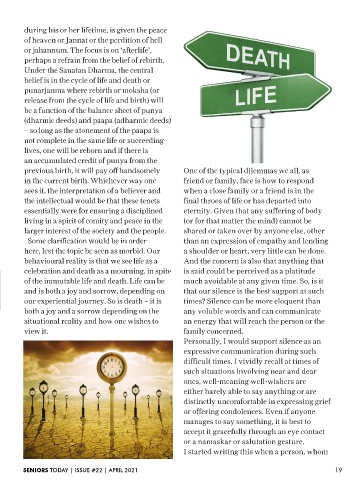
         celebration and death as a mourning, in spite      is said could be perceived as a platitude
         of the immutable life and death. Life can be       much avoidable at any given time. So, is it
         and is both a joy and sorrow, depending on         that our silence is the best support at such
         our experiential journey. So is death – it is      times? Silence can be more eloquent than
         both a joy and a sorrow depending on the           any voluble words and can communicate
         situational reality and how one wishes to          an energy that will reach the person or the
         view it.                                           family concerned.
                                                            Personally, I would support silence as an
                                                            expressive communication during such
                                                            difficult times. I vividly recall at times of
                                                            such situations involving near and dear
                                                            ones, well-meaning well-wishers are
                                                            either barely able to say anything or are
                                                            distinctly uncomfortable in expressing grief
                                                            or offering condolences. Even if anyone
                                                            manages to say something, it is best to
                                                            accept it gracefully through an eye contact
                                                            or a namaskar or salutation gesture.
                                                            I started writing this when a person, whom


        SENIORS TODAY | ISSUE #22 | APRIL 2021                                                              19

