






Why your gut, heart, blood sugar and healthy ageing may depend on getting enough of it
There is a nutrient hiding in plain sight.
It doesn’t come in a bottle. It doesn’t need an exotic superfood. And it certainly doesn’t need an expensive “detox” programme.
It is fibre—found in vegetables, fruits, pulses, whole grains, nuts and seeds—and it may be one of the most important components of a healthy diet as we grow older.
Yet many of us don’t eat enough of it.
Fibre is often associated only with avoiding constipation. That is certainly one of its jobs, but it is far from the whole story. Fibre influences the way we digest food, the speed at which glucose enters the bloodstream, cholesterol levels, appetite, and the health of the trillions of microorganisms living in our gut.
In other words, fibre is not simply “roughage”. It is an active part of the way our body and our gut microbiome function.
So, what exactly is fibre?
Fibre is a type of carbohydrate that our digestive enzymes cannot completely break down.
That sounds rather uninteresting. In fact, it is precisely what makes fibre useful.
Instead of being rapidly digested and absorbed like many refined carbohydrates, fibre travels through the digestive system, where different types perform different jobs.
Some fibres absorb water and form a gel-like substance. Some add bulk to stool. Some are fermented by our gut bacteria. Some help slow digestion and the absorption of nutrients.
And this is why it is more useful to think of fibres, rather than one single substance called fibre.
Two broad types—and several different jobs
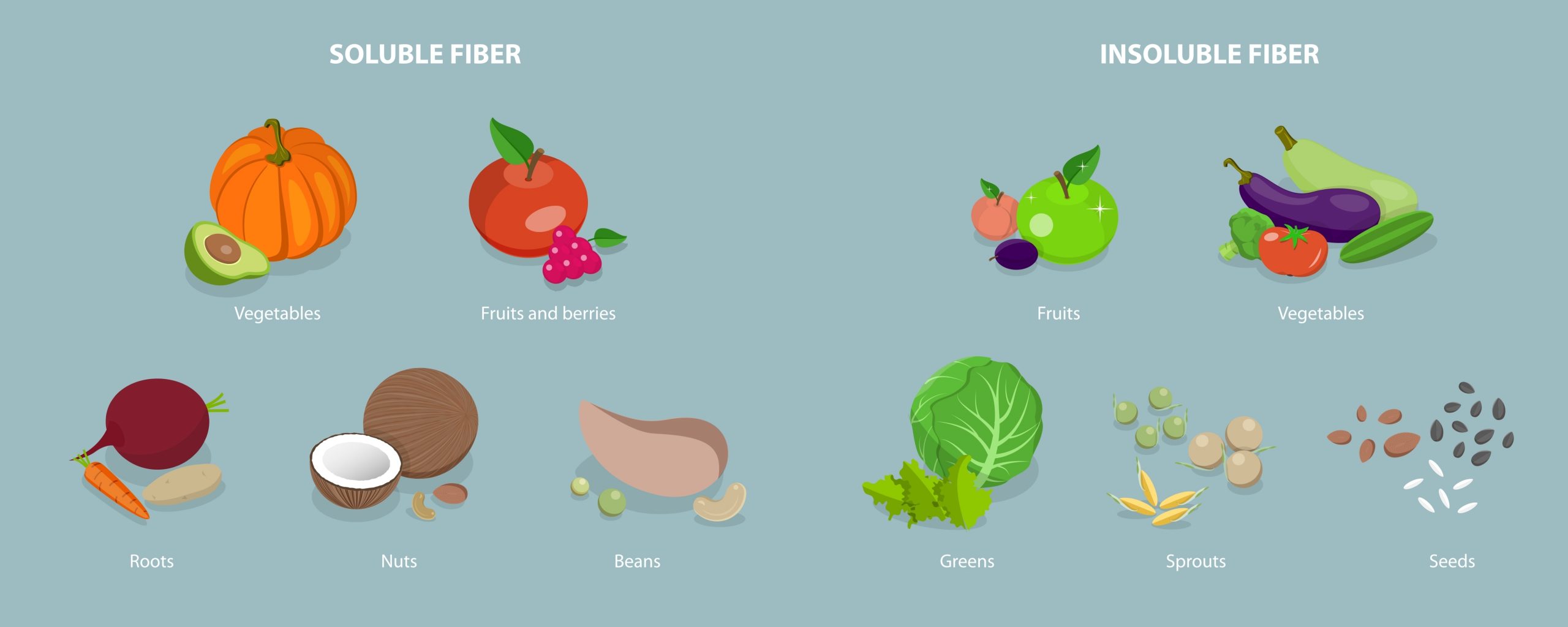
Soluble and viscous fibre
This type of fibre can absorb water and become gel-like in the digestive tract.
It is found in foods such as:
- Oats
- Barley
- Beans and lentils
- Apples
- Citrus fruits
- Guava
- Some vegetables
- Psyllium
Viscous fibres can slow digestion and glucose absorption. Certain types can also help reduce LDL (“bad”) cholesterol.
Insoluble fibre
This fibre does not dissolve in water. It contributes bulk to the stool and can help food move through the digestive tract.
Whole grains, wheat bran, vegetables, nuts and the skins of many fruits provide substantial amounts.
But there is another important category.
Fermentable and prebiotic fibres
Certain fibres are used as food by beneficial microorganisms in the colon.
When gut bacteria ferment some of these fibres, they produce substances called short-chain fatty acids, including acetate, propionate and butyrate.
These compounds are increasingly recognised as important messengers between our gut microbiome and the rest of the body.
So when we eat fibre, we are not feeding only ourselves. We are feeding our gut microbes too.
What can fibre actually do for you?
- Keep the digestive system moving
This is the benefit most people know.
Fibre adds bulk to stool, while some fibres hold water, helping produce softer and easier-to-pass stools.
For older adults, this can be particularly useful because constipation can become more common with changes in diet, activity, fluid intake and medication use.
But remember: fibre works best alongside adequate fluid intake and physical activity.
Simply adding large amounts of fibre to a low-fluid diet is not a good strategy.
- Help regulate blood sugar
Fibre-rich foods generally take longer to digest and can slow the movement of glucose into the bloodstream.
Viscous fibre can be particularly useful because it slows digestion and absorption.
This doesn’t mean that eating a bowl of oats or a serving of beans “lowers blood sugar” in a magical way. Rather, replacing refined, low-fibre foods with fibre-rich foods can contribute to a healthier overall eating pattern and more gradual glucose responses.
For someone managing diabetes, the entire meal still matters—including portion size and the amount and type of carbohydrate.
- Help manage cholesterol
Certain soluble fibres can bind substances involved in cholesterol metabolism and increase their elimination from the body.
The liver then uses cholesterol to make more bile acids, helping reduce circulating LDL cholesterol.
This is one reason foods such as oats, barley, beans and psyllium have attracted considerable scientific attention.
Again, fibre is not a substitute for prescribed cholesterol medication when medication is medically indicated.
It is part of the dietary picture.
- Feed your gut microbiome
Your large intestine is home to an enormous community of microorganisms.
What you eat influences which organisms thrive.
A diet rich in a variety of plant foods provides different fibres and other compounds that can support a more diverse gut ecosystem.
This is one reason nutrition researchers increasingly emphasise dietary diversity, rather than focusing on a single “superfood”.
An apple gives you something different from a bowl of dal.
A handful of nuts gives you something different from a serving of cabbage.
A variety of plants means a variety of fibres.
- Help you feel satisfied
Fibre-rich foods tend to be more filling. Vegetables, fruits, pulses, whole grains, nuts and seeds can add volume and texture to meals without requiring large amounts of food.
This can make it easier to regulate overall food intake.
For anyone trying to maintain a healthy weight in later life, this is useful because the goal should not simply be to eat less.
It should be to eat nourishing food that satisfies you.
How much fibre do you need?
For many adults, a practical target is around 25–30 grams of fibre a day, although individual requirements vary according to age, sex, energy intake and other factors.
The problem is that many people don’t come close to this.
And there is an important lesson here:
Don’t try to go from 10 grams to 30 grams overnight.
A sudden increase can result in bloating, gas, abdominal discomfort or changes in bowel habits.
Instead, increase fibre gradually.
Add one fruit.
Add another serving of vegetables.
Eat dal more regularly.
Replace some refined grains with whole grains.
Add nuts or seeds.
Then build from there.
The Indian plate already has plenty of fibre—if we use it
One of the best things about increasing fibre in an Indian diet is that we don’t need to reinvent our cuisine.
We already have:
Dal.
Rajma.
Chole.
Moong.
Sprouts.
Vegetables.
Leafy greens.
Guava.
Papaya.
Oranges.
Apples.
Whole grains.
Nuts.
Seeds.
The challenge is often that our modern diet has become increasingly dependent on refined foods.
White bread instead of whole-grain bread.
Refined flour instead of whole grains.
Fruit juice instead of whole fruit.
A small amount of vegetables alongside a large serving of rice or roti.
Biscuits replacing fruit or nuts at tea time.
Increasing fibre therefore isn’t necessarily about adding more food.
It can be about changing what is already on the plate.
Your 7-Day Fibre Plan
A simple way to work towards approximately 25–30 g a day
The following is a framework rather than a rigid diet. Portion sizes should be adjusted according to appetite, body size, activity level and individual dietary needs.
MONDAY
Breakfast: Vegetable poha + one guava
Lunch: Two whole-wheat rotis + dal + bhindi + salad
Evening: A small handful of roasted chana
Dinner: Vegetable moong-dal khichdi + cooked vegetables
Fibre focus: Poha, guava, dal, vegetables and chana.
TUESDAY
Breakfast: Oats cooked with milk or unsweetened plant milk + chopped apple + a few nuts
Lunch: Brown/red rice + rajma + vegetable + salad
Evening: Pear
Dinner: Two rotis + mixed vegetables + dal
Fibre focus: Oats, apple, rajma, vegetables and whole grains.
WEDNESDAY
Breakfast: Two vegetable besan chillas + fruit
Lunch: Two rotis + chole + vegetable + salad
Evening: A small handful of nuts
Dinner: Moong dal + vegetables + one or two rotis
Fibre focus: Besan, chickpeas, vegetables and whole grains.
THURSDAY
Breakfast: Vegetable upma + orange
Lunch: Rice + sambar + two vegetable dishes + salad
Evening: Roasted chana or sprouts
Dinner: Two rotis + dal + cabbage/beans
Fibre focus: Sambar, lentils, vegetables, sprouts and fruit.
FRIDAY
Breakfast: Oats + banana + 1 tablespoon ground flaxseed
Lunch: Two rotis + dal + leafy green vegetable + salad
Evening: Guava
Dinner: Vegetable dalia + curd
Fibre focus: Oats, flaxseed, dal, greens, guava and dalia.
SATURDAY
Breakfast: Idli + generous serving of sambar
Lunch: Rajma or chole + rice + salad + vegetable
Evening: Apple or pear + a few nuts
Dinner: Two rotis + mixed vegetables + dal
Fibre focus: Sambar, pulses, vegetables, fruit and whole grains.
SUNDAY
Breakfast: Vegetable dosa + sambar
Lunch: Your regular Sunday meal—but make sure it includes dal, two vegetables and a generous salad
Evening: Seasonal fruit + nuts
Dinner: Vegetable soup + whole-grain toast + a protein source
Fibre focus: Sambar, vegetables, fruit, nuts and whole grains.
The easiest way to remember it
You don’t have to calculate every gram of fibre you eat.
Instead, aim for a simple daily pattern:
1 fruit + 2–3 cups of vegetables + 1–2 servings of pulses + whole grains + a small serving of nuts or seeds.
Do this consistently and you will be well on your way towards a higher-fibre diet.
And try to eat the fruit rather than drink it.
A whole orange contains fibre.
Orange juice contains much less fibre.
A whole apple is different from apple juice.
The physical structure of the food matters.
A word about seeds
Chia and flaxseed have become fashionable—and for good reason. They provide fibre along with other nutrients.
But they are not magic.
You don’t need expensive imported seeds to have a healthy gut.
Ground flaxseed, chia, sesame seeds, pumpkin seeds and nuts can all be useful additions.
A tablespoon sprinkled into oats, curd, a smoothie or a vegetable dish can be an easy way to increase fibre.
If you are not accustomed to them, start with a smaller quantity.
And what about psyllium husk?
Psyllium is a soluble, gel-forming fibre and can be useful for some people, particularly when dietary fibre alone isn’t sufficient.
But a supplement should not become an excuse for a fibre-poor diet.
Food first is usually the better philosophy.
And anyone taking medications should remember that fibre supplements can affect the absorption of some medicines, so they should be taken according to appropriate medical or pharmacist guidance.
The Fibre Mistakes to Avoid
Mistake 1: Increasing fibre too quickly
Your gut bacteria need time to adapt.
Increase gradually.
Mistake 2: Forgetting fluids
Fibre and fluids work together. Unless you have been medically advised to restrict fluids, adequate hydration is important.
Mistake 3: Thinking fibre means bran biscuits
A food marketed as “high fibre” isn’t automatically healthy.
Read the entire ingredient list and nutrition label.
Mistake 4: Taking a fibre supplement and eating no vegetables
A supplement cannot replicate the extraordinary combination of fibre, vitamins, minerals and phytochemicals found in whole plant foods.
Mistake 5: Eating only one type of fibre
Your gut benefits from variety.
Don’t make oats your entire fibre strategy.
One more reason to eat your vegetables
There is growing interest in the relationship between dietary fibre, the gut microbiome and healthy ageing.
Research continues to investigate how the gut microbiome interacts with metabolism, immune function and inflammation.
We should be cautious about claiming that fibre can prevent ageing-related diseases. Nutrition science rarely works that simply.
But the overall evidence is remarkably consistent on one point:
A diet rich in minimally processed plant foods and dietary fibre is associated with better long-term health outcomes.
That is a pretty good reason to put another vegetable on your plate.
Start small. Stay consistent.
You don’t need to wake up tomorrow and completely change your diet.
Start with breakfast.
Add fruit.
Make vegetables non-negotiable at lunch and dinner.
Keep dal in the weekly rotation.
Choose whole grains more often.
Have nuts or seeds in sensible portions.
And gradually work towards your fibre target.
Because healthy ageing isn’t built from one miraculous food or one perfect meal.
It is built from hundreds of ordinary choices made repeatedly.
And fibre may be one of the simplest—and most overlooked—of those choices.
“Feed yourself, and feed the billions of tiny organisms that help you thrive.”