






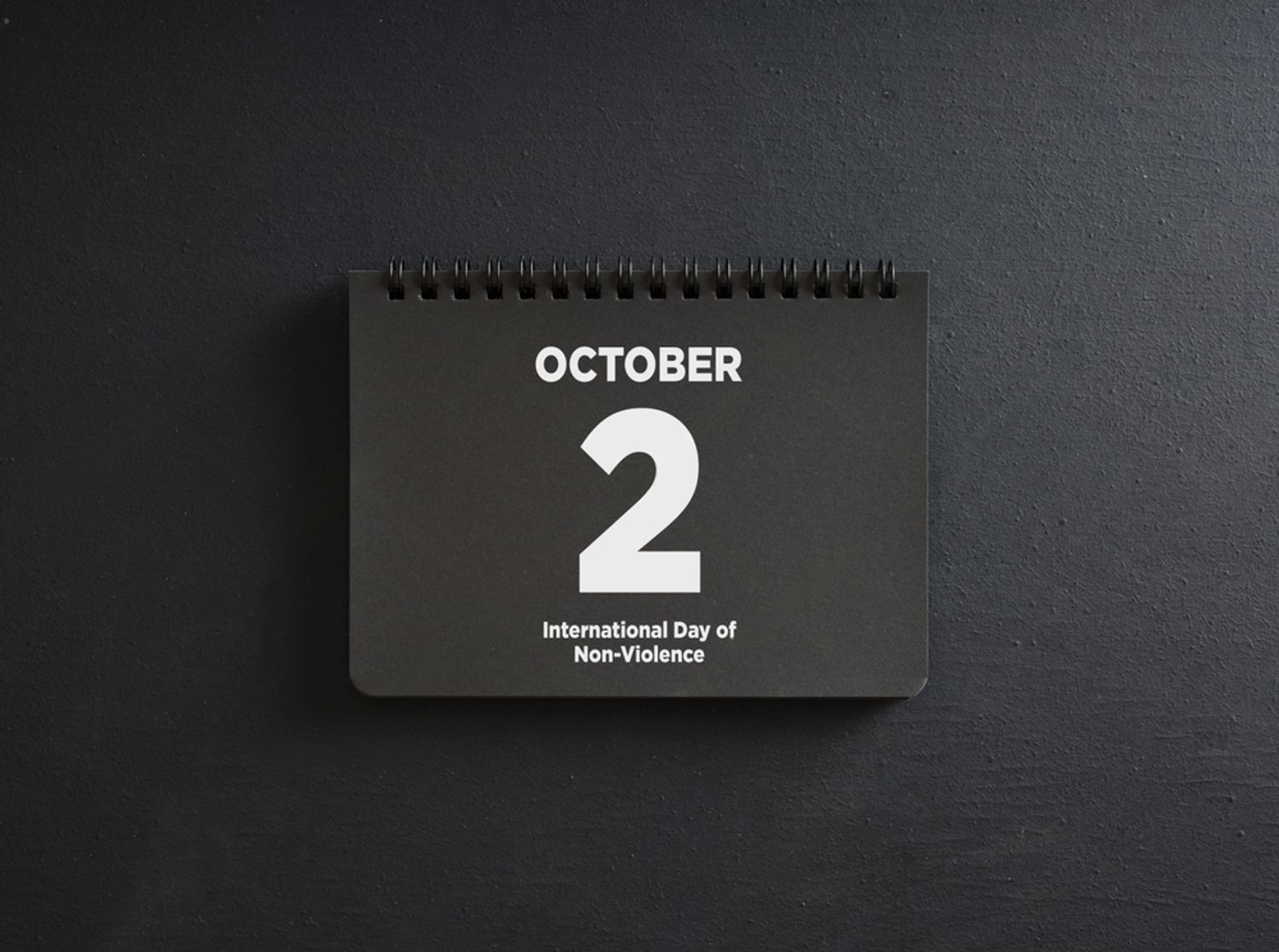
On 2 October, Gandhi’s birthday and the International Day of Non-Violence, we might ask ourselves a harder question than “Do I believe in peace?”: What does peace require of me?
On Gandhi Jayanti, we know the familiar images: the spinning wheel, the walking stick, the quiet figure leading a crowd. They can make non-violence look gentle, almost effortless. Yet Gandhi’s campaigns demanded organisation, sacrifice and the willingness to confront power without surrendering to hatred.
The United Nations chose 2 October, Gandhi’s birthday, as the International Day of Non-Violence. Its purpose is to spread the message through education and public awareness. The date belongs to India’s history, but the question it raises belongs to the world.
United Nations International Day for Non-Violence
What does it mean to be non-violent when you are angry?
It cannot mean pretending that nothing is wrong. Some anger tells us that a boundary has been crossed, a person has been harmed or an injustice has been allowed to continue. The difficult choice is what we do with that anger. Do we use it to make the harm visible and seek change? Or do we use it as permission to humiliate someone else?
That question matters in a family argument as much as it does in public life. You can tell an adult child, “That hurt me,” without attacking their character. You can disagree with a neighbour without turning a dispute into a feud. You can refuse a demand without feeling obliged to be cruel. None of these conversations is easy. They require us to hold on to our own dignity while remembering the other person’s.
And what does non-violence mean when the stakes are much larger?
Across the world, people face war, persecution and displacement. From the safety of our homes, it would be glib to tell them simply to “choose peace”. Peace needs more than kind words. It needs protection for people in danger, accountability for harm, room for dissent and the patient work of negotiation. Non-violence asks us to take injustice seriously enough to challenge it without treating human lives as expendable. As the UN has observed, non-violence is neither inert nor passive.
Secretary-General message International Day of Non Violence
India has a particular reason to examine this ideal honestly. We celebrate ahimsa as part of Gandhi’s legacy. We must also ask how we speak about people of another faith, caste, region or political view. It is possible to admire non-violence in a history book and still pass along a vicious rumour on the phone. The test comes when the person whose dignity we must defend is someone with whom we disagree.
Perhaps age gives us a special role here. Many of us have seen how a careless sentence can live in a family for decades—and how one person’s decision to listen can change the course of an argument. We know that silence sometimes preserves peace, but sometimes protects harm. We know, too, that an apology can be an act of strength.
On 2 October, we might begin with a few ordinary acts: check a story before forwarding it; make room for a difficult conversation; challenge a cruel remark without making another person a spectacle; ask whose voice has been left out. Such acts will not end a war. They can, however, shape the kind of homes, communities and public life in which violence finds either encouragement or resistance.
Gandhiji’s birthday asks more of us than remembrance. It asks whether we can be brave enough to oppose harm, humble enough to examine our own behaviour, and patient enough to keep talking when conversation is hard. That is a demanding idea of peace. It is also one we can practise, beginning today.