






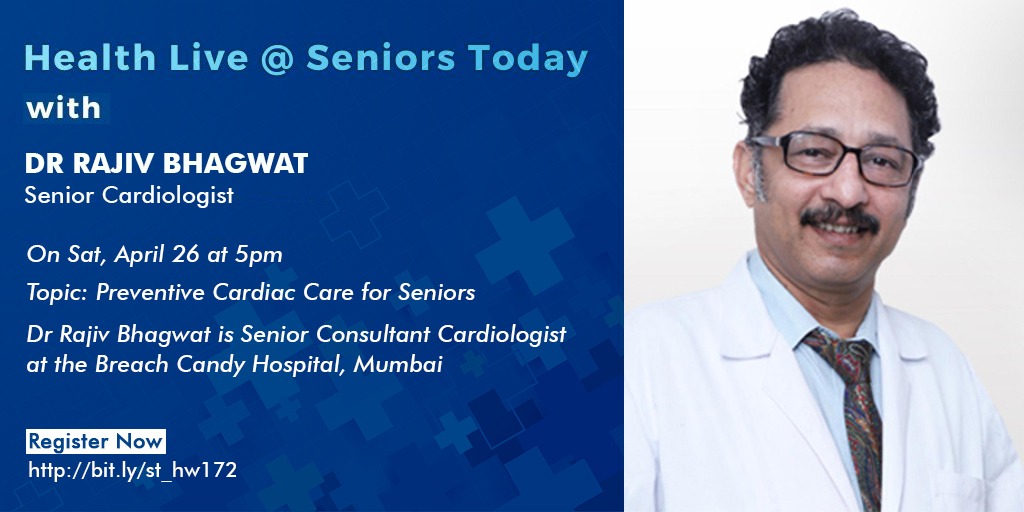
On 26 April, 2025, Seniors Today hosted their weekly Health Live Webinar with a Senior Interventional Cardiologist, Dr Rajiv Bhagwat who spoke on and answered questions about Preventive Cardiac Care for Seniors.
Dr. Rajiv Bhagwat is a highly esteemed Interventional Cardiologist with over three decades of experience, currently serving as a Senior Consultant at Breach Candy Hospital, Nanavati Max Super Speciality Hospital and Lilavati Hospital in Mumbai.
He specialises in advanced cardiac procedures, including Percutaneous Coronary Interventions, Complex Angioplasty, Valvuloplasty, and Transcatheter Aortic Valve Replacement (TAVR). He is an active member of the Indian Medical Association (IMA) and the Association of Medical Consultants (AMC) and the Founder and Trustee of the Bifurcation Club of India Education Trust.
Throughout his career, Dr. Bhagwat has been dedicated to the advancement of interventional cardiology and made considerable efforts towards research and training. Among his significant contributions has been the setting up of the Bifurcation Club of India Education Trust which hosts a globally recognised annual conference on the Interventional Cardiology practice and a world-class training programme for the next generation cardiologists offering exposure to Bifurcation Angioplasty (Y) and it’s complexities.
Dr. Bhagwat obtained his MBBS from Jiwaji University, Gwalior, followed by an MD in General Medicine and a DNB in Cardiology from the National Board of Examinations, New Delhi.
For seniors who have/ are suffering from a cardiac problem, this weeks’ talk is about secondary care. For those who are not suffering from any cardiac issues, these are preventive and primary care and advise.
Primary Care:
People at a high risk for heart attacks include:
- Individuals with a family history of cardiac disease/ heart attack before the age of 55- 60 years. This is a non modifiable risk factor.
- Individuals with diabetes mellitus. This is because of our rich carbohydrate diet and lack of sleep and exposure to sunlight. Lack of physical activity. Diabetes mellitus also has a genetic predisposition. If both your parents are diabetic, there is a 70% chance of you developing diabetes. If one parent is diabetic, there is a 30- 50% chance of the child becoming diabetic in the future.
- Diabetes, if uncontrolled, can lead to heart disease, kidney failure, hypertension, stroke.
- Hypertensive patients
- Smokers and tobacco chewers
- High cholesterol
- Stress
Primary prevention includes:
- Identify your family history
- Identify and correct your lipid abnormalities
- If you are diabetic, identify it on time and keep it under control.
- Treat your hypertension. Your blood pressure control needs to be good
- Quit smoking and chewing tobacco
- Regular and light exercise
Secondary Prevention/ Care:
Secondary prevention includes progression of disease and further episodes in patients/ individuals who have had a heart attack in the past or have undergone an angioplasty. This includes:
- Seeking advice from an expert, cardiologist
- The treatment includes a mixture of medical therapy and interventions
- If you are diabetic, identify it on time and keep your blood sugar levels under control.
- Treat your hypertension. Your blood pressure control needs to be good
- Quit smoking and chewing tobacco
- Regular and light exercise
- Maintain your cholesterol levels
- Right dosage of the medication and frequent examination of a patient with cardiac issues is helpful
Secondary prevention is more challenging. But it also goes a long way in preventing further episodes.
For secondary prevention, it is also very important to control your cholesterol levels. This is because the LDL cholesterol and the triglycerides are the ones which are atherogenic i.e., they bring about plaque formation in the blood vessels and blockages in the arteries.
On an average, your LDL cholesterol levels have to be below 50 mg/dL, especially to prevent formation of new plaques.
Statins are the mainstay treatment for raised cholesterol. Statins are not only helpful in reducing the metabolism of cholesterol but they are also anti-inflammatory for the arteries.