







Deepa Gahlot gives us her pick of love triangles from the last three decades
Romance is in the air in February as Valentine’s Day comes around. But there is unrequited love too, when the object of one’s desire loves another. Romantic Triangles have been a time-tested trope in Hindi cinema, right from Andaz (1949), Chaudhvin Ka Chand (1960), Sangam (1964), Rajnigandha (1974), Silsila (1981), Chandhi (1989) onwards…
A pick of love triangles from the last three decades:
Dil To Paagal Hai (1997):
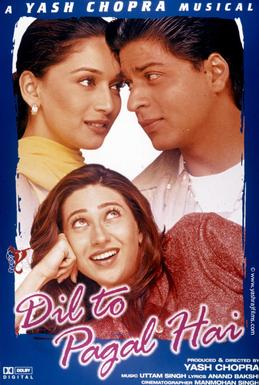
Yash Chopra directed this love triangle in which two women are in love with Rahul (Shah Rukh Khan), who does not believe in commitment. He is directing a stage show and has friend zoned his lead dancer, Nisha (Karisma Kapoor, won a National Award for her performance), who is secretly in love with him. But when the dreamy, romantic Pooja (Madhuri Dixit), who already has strange connection with Rahul before even meeting him, through a tune she had heard, comes into his orbit, he is attracted to her. He casts her in his show when Nisha is injured, so they get closer. But she is engaged to Ajay (Akshay Kumar). The show goes on and the two triangles are sorted. A lot of music and Shiamak Davar’s dances punctuate the film.
Yes Boss (1997):

Shah Rukh Khan played a somewhat seedy character, as the ambitious Rahul, who keeps his lecherous boss Siddharth’s (Aditya Pancholi) affairs a secret from his wife. He even agrees to entice an aspiring model Seema (Juhi Chawla) for the boss. But in the process of getting her to be impressed by Siddharth, he falls for her too. Later, they have to pretend to be married for the sale of Rahul’s ailing mother. In the end, love wins over greed.
Kuch Kuch Hota Hai (1998):
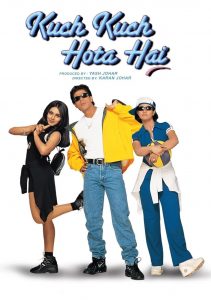
Karan Johar’s debut directorial started as a campus caper, where Rahul (Shah Rukh Khan) and the tomboyish Anjali (Kajol) are best pals. Anjali realizes that she is in love with Rahul, when he falls for Tina (Rani Mukerji), the new girl in college. A heartbroken Anjali leaves and vanishes from their lives. Years later, Tina dies and their daughter decides that she must get her lonely dad reunited with Anjali. By then, she is engaged to Aman (Salman Khan), but when he discovers that Anjali really loves Rahul, he graciously steps back.
Hum Dil De Chuke Sanam (1999):

In Sanjay Leela Bhansali’s opulent romantic tale, Nandini (Aishwarya Rai), the daughter of a classical musician, falls for his student Sameer (Salman Khan), visiting from Italy. When the romance is discovered, Sameer is banished from the home, and Nandini is married to Vanraj (Ajay Devgn). When she tells him she loves another, Vanraj takes her to Italy to reunite her with Sameer. During the journey, she is impressed by her husband’s gentleness, and when they finally meet Sameer, she chooses to return with Vanraj.
Devdas (2002):
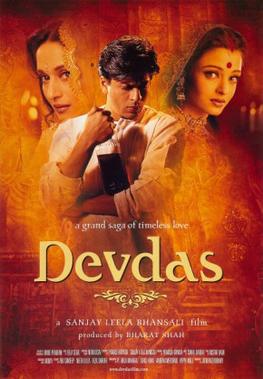
Saratchandra Chattopadhyay’s story about a doomed lover has been adapted for film multiple times, in several languages, but Sanjay Leela Bhansali gave it the full Bollywood blockbuster treatment, with Shah Rukh Khan playing the man who drowns in alcohol his heartbreak at losing Paro (Aishwarya Rai), the love of his life. A courtesan, Chandramukhi (Madhuri Dixit) falls in love with him and looks after him as his health deteriorates, but Devdas’s heart beats only for the now married Paro, and when he is dying he travels to her village, to die at her doorstep.
Kal Ho Na Ho (2003):
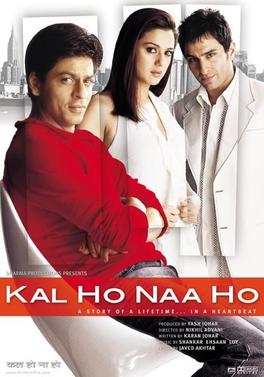
In Nikkhil Advani’s first film as director, set in New York, Naina Catherine Kapur (Preity Zinta) has enough reasons to be depressed and sulky, when Aman (Shah Rukh Khan) and his mother move next door. Her. best friend Rohit (Saif Ali Khan) is in love with her, but as Aman encourages Naina to live life to the fullest, she falls for him. Rohit asks for Aman’s help in expressing his feelings for Naina. To nudge Naina towards Rohit, Aman pretends to be married. In truth, he suffers from a terminal illness and could die soon. Though he loves Naina, he promises to bring her and Rohit together before he passes away.
Barfi (2012):

In Anurag Basu’s, sweet if overblown romantic drama, Ranbir Kapoor played a deaf-mute Murphy—known as Barfi—smitten by Shruti (Ileana D’Cruz), who reciprocates, though she is engaged to be married. Barfi is also loved by his childhood friend, the autistic heiress Jhilmil (Priyanka Chopra). Jhilmil’s greedy father causes problems and manages to separate Barfi and Jhilmil. As Shruti tries to help him, her marriage breaks up; still, she sacrifices her own feelings to reunites the two.
Bajirao Mastani (2015):

The historical romance between the Maratha warrior Peshwa Bajirao (Ranveer Singh) and the Muslim courtesan Mastani (Deepika Padukone), was a lavish period drama directed by Sanjay Leela Bhansali (the triangle seems to be his favourite genre). Priyanka Chopra played his wife, Kashibai, who is stung by the betrayal, but stands by her husband, as he battles invaders and faces conspiracies within the household.
Bareilly Ki Barfi (2017):
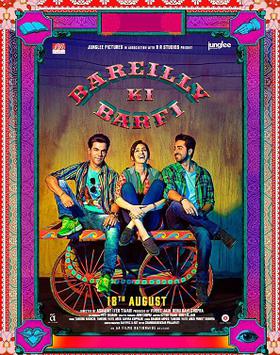
Ashwini Iyer Tiwari’s film, based on Nicolas Barreau’s French novel, The Ingredients of Love, was a funny, quirky film, deeply rooted in small-town charm. Kriti Sanon played Bitti, an independent woman, impressed by a book of a progressive writer. To meet him she seeks the help of Chirag, the printing press owner (Ayushmann Khurrana), who falls in love with her. Because he is unable to reveal that he is the writer, he calls upon his flamboyant friend (Rajkummar Rao) to pretend to be the character. He starts to feel insecure, however, when Bitti grows close to the imposter, and is heartbroken when their wedding is announced. Bitti, of course, has the last laugh!
Param Sundari (2025):

In Tushar Jalota’s cross-cultural romance, Param (Sidharth Malhotra), a Delhi man, who searches for his soulmate through an AI app, which leads him to Sundari (Jahnvi Kapoor), the owner of a homestay in Kerala. She is unaware that he is there to check her out for compatibility. They are totally different, and Param’s ignorance about Kerala annoys Sundari but they end up falling in love. Then her perfect-in-every-way fiancé Venu (Siddhartha Shankar) returns from the US and Sundari is confused between the two.