






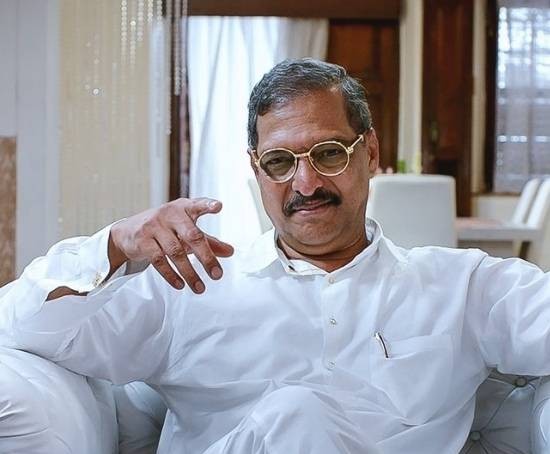
A voice we had heard for decades has fallen silent
There are actors we watch. There are actors we admire. And then there are a few who, somewhere along the way, become part of our own memories.
Nana Patekar was one of them.
For an entire generation of Maharashtrians, his journey was not simply the story of a Bollywood actor. We had known him through the world of theatre, through Marathi cinema, and then watched with a certain pride as that unmistakable Marathi intensity travelled across into Hindi cinema.
On Thursday morning, 8 October 2026, that journey came to an end. Nana Patekar died at the age of 75 after suffering a cardiac arrest at his home in Goa.
And suddenly, a voice we had heard for decades has fallen silent.
He never really “acted”
Perhaps that is what made Nana different.
When Nana spoke a line, it rarely sounded like a line being delivered by an actor. It sounded as though the character had been carrying those words inside him for years and had finally found a reason to let them out.
There was anger in that voice. There was tenderness. There was bitterness, humour, helplessness and occasionally a frightening stillness.
He could say very little and still fill the screen.
Those who grew up watching Marathi theatre will understand this better than most. Theatre teaches an actor to respect the spoken word, the silence between words and the audience sitting only a few feet away. Nana carried that discipline with him even when the theatre was replaced by the enormous screen of Hindi cinema.
His film career began with Gaman in 1978, but it was never a conventional journey to stardom. He did not need to be the handsome hero. He did not need to be the centre of a song. He needed a character worth inhabiting.
And once he inhabited that character, it was difficult to look anywhere else.
From Parinda to Krantiveer
For many of us, Nana’s Hindi-film journey became unforgettable with performances such as Parinda and Krantiveer.
In Parinda, there was menace and vulnerability. In Krantiveer, there was the fury of a man who had been pushed to the edge. His performance earned him the National Film Award for Best Actor. He later received another National Award for Agni Sakshi.
But awards only tell a small part of the story.
What we remember are the moments.
The stare.
The pause.
The sudden explosion of anger.
The voice rising and then, sometimes, becoming quieter than a whisper.
Nana understood something that great actors understand instinctively: you don’t have to shout to make an audience listen.
And then came Uday Shetty
Just when we thought we knew Nana Patekar, he surprised us again.
Welcome introduced him to an entirely new generation as Uday Shetty — the hot-headed, eccentric gangster who could make audiences laugh simply by losing his temper.
It was a remarkable second life for an actor already celebrated for intense dramatic performances.
The same man who could make us uncomfortable in a serious drama could suddenly make us laugh until our stomachs hurt.
That, too, was Nana.
He refused to be imprisoned by the image of the “serious actor.”
But Maharashtra remembered another Nana
For Marathi audiences, however, Hindi cinema was never the whole story.
There was always the Nana who belonged to Maharashtra.
The theatre actor.
The Marathi actor.
The man who could speak the language with a naturalness that did not feel performed.
And later came Natsamrat.
For those who saw Nana as Ganpatrao Belwalkar, the role carried a special poignancy. Here was an actor playing an ageing stage veteran looking back at a lifetime spent performing — a character who had given everything to theatre and then found himself confronting loneliness, memory and the cruel passage of time.
It was difficult not to see echoes of the actor himself in that performance.
An actor playing an actor.
A man looking at a life spent pretending, while speaking some of the most painfully truthful words an audience could hear.
For many senior viewers, Natsamrat was not merely a film.
It was personal.
Because by then we had begun to understand that ageing is not just about growing older. It is about watching the world around us change, watching familiar faces disappear, and discovering that memories sometimes become more precious than possessions.
A life beyond the screen
Nana’s contribution was not limited to acting. He directed Prahaar: The Final Attack and remained connected with theatre and the wider artistic world. His contribution to the arts was recognised with the Padma Shri in 2013.
He was also associated with social work, including efforts supporting farmers and rural communities.
But perhaps his greatest contribution was less tangible.
He made ordinary people feel visible.
The angry man.
The wounded man.
The policeman.
The soldier.
The criminal.
The father.
The old actor.
The eccentric gangster.
The flawed human being.
He did not always play heroes. Sometimes he played people who were difficult to like.
But he made them difficult to forget.
For those who grew up with Nana
Ask someone from our generation about Nana Patekar and they probably won’t begin by listing awards.
They will remember a scene.
A dialogue.
A theatre performance.
A Sunday afternoon film.
A conversation with friends about Parinda or Krantiveer.
They will remember laughing at Welcome.
They will remember the emotion of Natsamrat.
And someone will inevitably imitate that voice.
Because Nana’s voice had become part of popular culture.
Today, we may watch those films again.
We may hear the familiar dialogue and smile.
We may pause when he appears on the screen and experience that strange feeling that comes when an actor we have known for decades suddenly belongs to the past.
That is the peculiar privilege of growing older: our memories are filled with people who helped soundtrack our lives.
Nana Patekar was one of them.
He came from theatre, conquered neither cinema nor audiences in the conventional way, but earned something more lasting — recognition.
He remained unmistakably Nana.
Raw. Intense. Unpolished. Funny. Fierce. Vulnerable.
And unforgettable.
The curtain has finally fallen.
But for those who watched him, listened to him and grew up with him, Nana Patekar will continue to speak.
In the pauses.
In the silences.
In the old films we watch again.
And in that voice that, once heard, was impossible to ignore.