






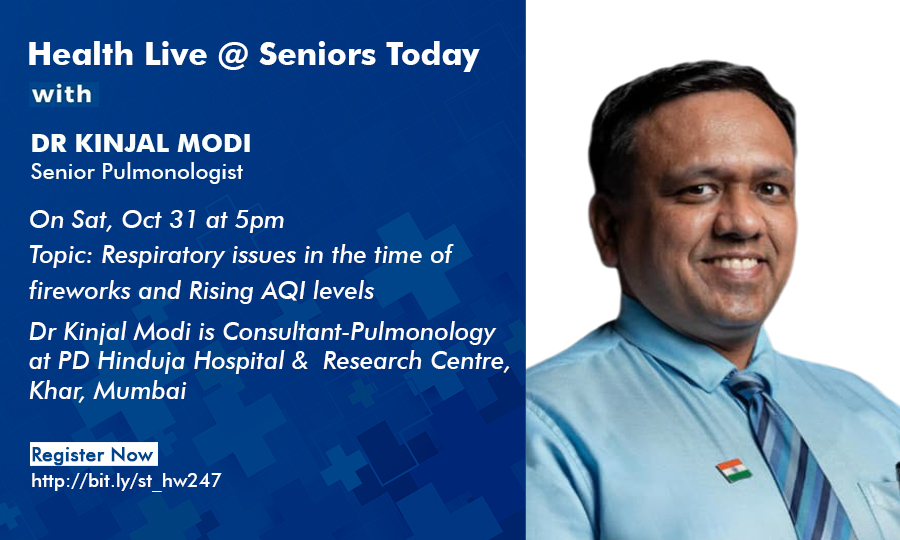
As festive celebrations approach and air quality dips across Indian metros, leading pulmonologist Dr Kinjal Modi discusses particulate matter, indoor triggers, and practical respiratory defense for seniors.
With the festive season underway and temperatures gradually tapering toward winter, the air across major urban centers has grown palpably heavy. From construction dust and traffic fumes to celebratory pyrotechnics, airborne pollutants pose a heightened seasonal risk—particularly for older adults and individuals living with chronic respiratory conditions.
To address these pressing concerns, Seniors Today hosted a dedicated health webinar moderated by Editor Pradyuman Maheshwari, titled “Respiratory Issues Due to Fireworks & Rising AQI Levels”. The session brought in Dr. Kinjal Modi, Consultant Pulmonologist at P.D. Hinduja Hospital, Khar, and other suburban Mumbai hospitals.
Dr. Modi holds an MD in Pulmonary Medicine from Nair Hospital, Mumbai, a DNB in Respiratory Medicine from New Delhi, and has completed advanced Interventional Pulmonology training in Malaysia. A recipient of the Fellowship Award from the American College of Chest Physicians and the HERMES Diplomate from the European Respiratory Society, Dr. Modi is also an avid marathon runner, poet, singer, postgraduate in Hospital Management and Medico-Legal Services, and is currently pursuing his final year in LLB
Here are the key medical insights, practical guidance, and clinical observations shared by Dr. Modi during the interactive forum.
Understanding the Air Quality Index: Beyond the Lungs
The Air Quality Index (AQI) serves as the primary metric for measuring atmospheric pollution, predominantly tracking particulate matter such as PM10 and PM2.5
Dr. Modi clarified a common misconception regarding how air pollution impacts human physiology:
Particle Size and Defense Mechanisms: Larger particulate matter PM10 with diameters ranging from roughly 2.5 to 10 micrometers) is largely trapped by the natural defenses of the upper respiratory tract—nasal hairs, mucosal lining, and cilia
The Systemic Danger of PM2.5: Microscopic particles PM2.5 (and smaller) effortlessly bypass airway filtration, penetrating deep into the pulmonary alveoli and crossing directly into the bloodstream
Multi-Organ Impact: Air pollution cannot be categorized strictly as a pulmonary ailment. Once fine particles enter the circulatory system, they drive widespread systemic inflammation, increasing the incidence of strokes in the brain, vascular complications, and exacerbating metabolic conditions such as diabetes
“Our lungs are like a pious sanctuary or a religious place—you take off your shoes and enter clean. Nothing dirty belongs inside them. While the digestive system has defense barriers to handle diverse substances, the pulmonary environment is delicate; any foreign particulate matter disrupts its milieu and triggers airway inflammation.” – Dr. Kinjal Modi
The Winter Trap: Temperature, Inversions, and Diurnal Swings
Seasonal shifts significantly amplify the physiological effects of poor air quality:
- Smog and Inversion Layers: With cooler weather approaching, lower ambient temperatures and high humidity hold particulate matter and fireworks smoke close to the surface, creating persistent smog rather than allowing it to disperse into the upper atmosphere
- Cold-Induced Bronchoconstriction: Breathing cold, dry air causes natural narrowing of the airways (bronchoconstriction), making breathing laboured for those predisposed to asthma, chronic obstructive pulmonary disease (COPD), or allergic bronchitis
- Diurnal Variations: Respiratory symptoms and chest tightness frequently peak during late-night and early-morning hours due to physiological circadian shifts combined with cooler nocturnal temperatures
The Unseen Threat: Indoor Air Pollution
While public attention remains focused on outdoor AQI readings, Dr. Modi cautioned that the indoor environment can sometimes record pollutant levels up to twice as high as the outdoors
Aerosols and Incense: Traditional festive rituals involving agarbattis (incense sticks), dhoop, and open-flame oil diyas or wax candles produce concentrated volatile organic compounds (VOCs) and dense aerosols in enclosed rooms
Mosquito Repellents: Plug-in chemical vaporizers, mats, and burning coils emit fine chemical aerosols that irritate sensitive bronchial linings throughout the night
Kitchen Fumes and Dust Reservoirs: Deep frying and cooking release particulate grease and smoke, while heavy upholstery, curtains, and uncleaned corners serve as major reservoirs for accumulated dust and allergens
To mitigate indoor pollution, keep ceremonial lamps outdoors or in well-ventilated transitional spaces, ensure proper exhaust ventilation while cooking, and minimize the use of continuous chemical aerosol vaporizers in closed bedrooms
A Physician’s Perspective: Masks, Air Purifiers, and Plants
Navigating commercial solutions requires balancing marketing claims against practical efficacy:
| Intervention | Practical Utility & Medical Verdict |
Masks – Recommended: Standard cloth and surgical masks offer negligible protection against fine PM2.5 particles. Fitted “N95 masks” provide effective filtration and are strongly advised during peak pollution and cracker-bursting days
Air Purifiers – Conditional: Effective only if equipped with a certified “HEPA filter” (which physically traps particles). Technologies based on UV or ionization should be viewed cautiously, as ionization can release harmful radical ions. Furthermore, purifiers only function in tightly sealed rooms where doors and windows remain closed; frequent opening resets the air exchange and neutralizes purification
Indoor Plants – Helpful, but Limited: Certain indoor plants (e.g., snake plants, peace lilies, specific bonsais) support ambient freshness, but they cannot scrub large volumes of dynamic particulate matter on their own
Essential Respiratory Checklist for Seniors
- Pause Morning Walks During Peak Smog: Between Dhanteras and the days following Diwali, refrain from brisk early-morning walks or outdoor workouts in public parks and open grounds when smoke and dew form ground-level smog
- Shift to Indoor Exercise: Substitute outdoor morning walks with gentle indoor stretching, yoga, or compound strolls in the late morning or afternoon once the sun has warmed and dispersed surface air
- Keep Maintenance Inhalers Accessible: Individuals with asthma or COPD should strictly adhere to their prescribed preventive inhalers and keep SOS bronchodilator medications within arm’s reach
- Isolate Living Quarters from Direct Smoke: Keep windows facing street-level fireworks tightly shuttered during evening celebrations
- Seek Early Medical Attention: Do not dismiss persistent wheezing, throat irritation, dry hacking coughs, or breathlessness as routine seasonal cold. Early evaluation by a pulmonologist prevents acute exacerbations