


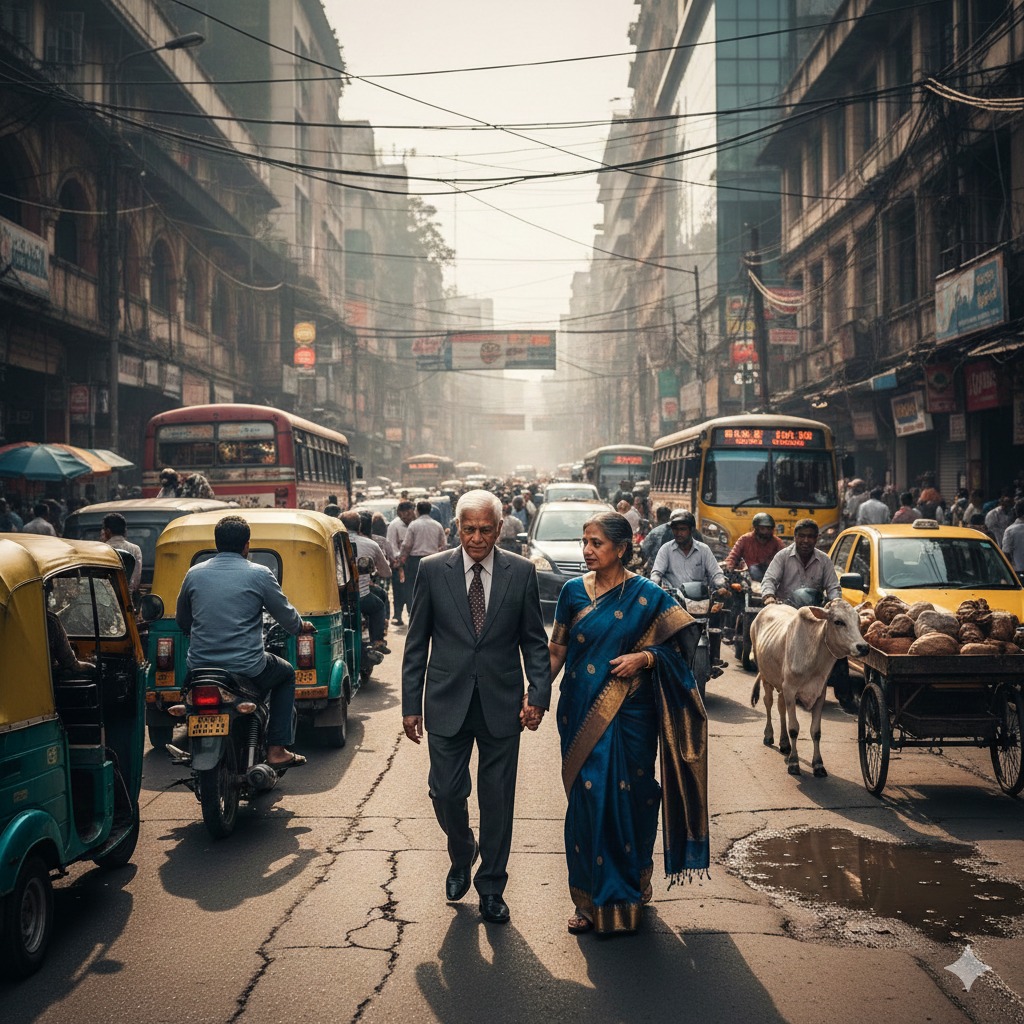
Real progress is measured not in speed, but in how safely our elders walk at dusk, writes Harsh Goenka
India today astonishes the world. Our metros rank among the finest anywhere, our airports leave visitors wide-eyed, our highways glide like runways, and Chandrayaan has filled the nation with pride. And yet, the moment we step onto our streets, this modern, fast-moving, aspirational India suddenly transforms into a chaotic, tangled, unpredictable maze. Above us, rockets soar into space; below us, we struggle to use a simple footpath. This contrast is India’s true paradox, an accelerating nation held back by everyday disorder.
Nowhere is this contradiction more visible than in our traffic behaviour. We treat rules as suggestions meant for others. Two-wheelers glide through red lights as if participating in an experiment. Car drivers believe the horn is an extension of their authority. Pedestrians treat zebra crossings as artistic patterns.. Auto-rickshaws consider intersections as counselling zones to decide life’s biggest problems. And in the middle of this circus stands the traffic police, braving heat, dust, and frustration, perhaps wondering if imparting discipline to India is a mission more complex than sending a spacecraft to the moon.
For older citizens, this chaos isn’t just inconvenient—it can be frightening.
Footpaths, meant for pedestrians, are increasingly becoming open storage spaces for our cities. Flowers, fruits, beauty-parlour boards, parked cars, and racing motorcycles—all jostle for space that should belong to people, especially the elderly who deserve safety and dignity in mobility. In many parts of the world, the footpath is the easiest place to walk. In India, it is often the hardest. Imagine a senior citizen, a pregnant woman, or a schoolchild trying to navigate this mess. That single thought forces us to question our civic values.
Ironically, step into any Indian metro and you see discipline at its finest. Queues, order, courtesy, patience—proof that we can behave like a world-class society. But the moment we return to the streets, the discipline evaporates. A single wrongly parked car or one impatient driver can paralyse an entire neighbourhood. Some traffic jams are so bizarrely shaped, they seem worthy of a competition titled “India’s Most Creative Gridlock.”
Lane driving remains a distant dream. The white lines on our roads look like poetry no one bothers to read. Motorcyclists slip into any crevice between vehicles. Car drivers claim every patch of open space as their birthright. Bus drivers treat lanes as imaginative suggestions. One wonders: if ISRO can land a craft on the moon with flawless precision, perhaps we should hand them the responsibility of managing our intersections too. At least then our traffic might follow logic and mathematics.
Our streets have instead of becoming public spaces, they have become extensions of private activity. Weddings, religious events, protests, morning yoga, parking, marketplaces—everything finds refuge on the road. We take from the streets and we complain about them. This is the contradiction we refuse to admit: we create the disorder we later lament.
But this is not merely a traffic problem, it is a cultural problem.
Countries around the world have transformed their city behaviour through strict laws, heavy penalties, consistent education, and most importantly, civic pride. India, with its diversity and size, cannot rely only on punishment. We need a national movement in civic discipline. Children must learn street culture in school. Media and community groups must repeatedly reinforce awareness. Pedestrians, especially seniors, must be prioritised. And our mindset must shift from “my shortcut” to “our shared space.”
Ultimately, streets reveal a nation’s maturity more than its technology. Our infrastructure is rising to world standards, but our behaviour is lagging far behind. We have shown the world that India can land on the moon; now we must show that India can also walk safely on its own footpaths, especially its elderly.
A country is judged not only by its airports and metros, but by the safety of its crossings, the dignity of its walking spaces, and the discipline of its drivers. True progress is not measured in kilometres per hour, but in the confidence with which a senior citizen can step out for a simple evening walk. When India decides that its streets will be as organised as its space missions, the world will understand that this nation not only knows how to fly—but also how to walk the right path.
And perhaps, on that day, we will realise that real advancement lies not in reaching the moon, but in creating cities where every citizen, especially our elders, can move with respect, ease, and security.