






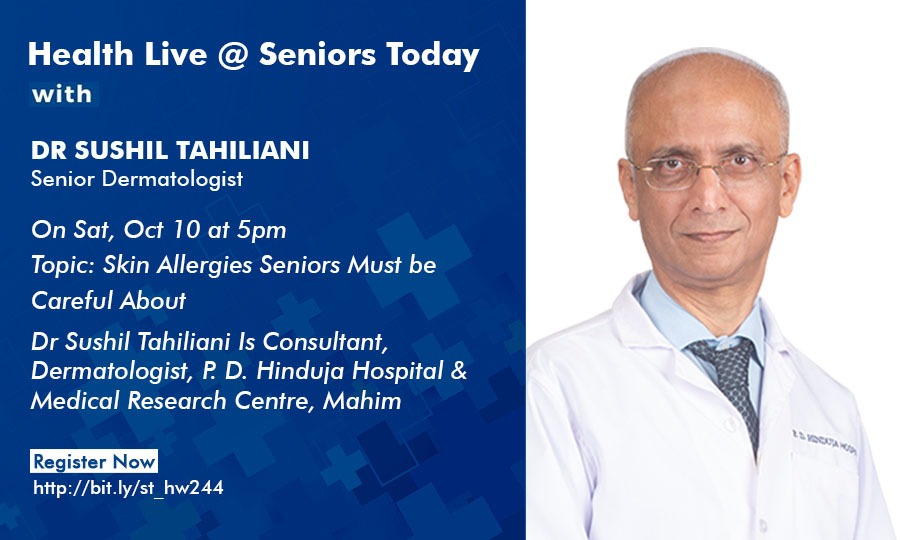
On 10 October, 2026, Seniors Today hosted their weekly Health Live Webinar with Dr Sushil Tahiliani who spoke on and answered questions about Skin Allergies Seniors Must be Careful About.
About Dr Sushil Tahiliani
Dr Sushil Tahiliani is a Consultant Dermatologist at P. D. Hinduja Hospital and Medical Research Centre, Mahim. He completed his MBBS, MD Dermatology from G S Medical College and K E M Hospital, Mumbai. He has over 37 years of experience. He has extensive experience in clinical dermatology, lasers and aesthetic procedures with more than a decade of experience in lasers and aesthetic treatments. He is a fellow of the American Academy of Dermatology and the European Academy of Dermatology. He has served as a reviewer for the Indian Journal of Dermatology. He is a regular faculty member at dermatology and dermato-surgical conferences and workshops. He has contributed chapters to textbooks published by ASACSI and various associations, as well as in the book of Diseases of the Nails. His areas of special interest include clinical dermatology, lasers, aesthetic procedures and nail diseases.
You can watch the full interactive broadcast on the Seniors Today YouTube Channel Skin Allergies Seniors Must be Careful About to listen to the extensive clinical insights shared by the doctors during this session.
- All our organs age, but the one which is shown to the world is our skin.
- Skin undergoes lots of changes as one ages. Some of these changes are:
- Thinning of skin
- Reduced collagen resulting in wrinkling
- Narrow barrier function- making the skin prone to more conditions and diseases
- Allergy is restricted to having an itchy rash that affects the skin due to involvement of the immune system of the body.
- An allergy is when the immune system is reacting to a particular substance.
- The allergen can be something you eat/ inhale/ come in contact with/ something than may have stung or bit you/ medication
- This allergy can manifest on a small part of the skin, or the entire skin. Occasionally, along with involvement of the skin there can also be involvement of the eyes, genitals and even the internal organs.
- The degree of allergy can vary from mild to very severe and even life threatening.
- Skin allergy can vary from very trivial to very annoying issues such as itching over a small area of skin. It can also change colour of the underlying skin which may be visible to the world. And it can also be potentially life threatening.
- Allergens are not always items that we consume or eat. They can also be substances that you may inhale or due to a medication you are consuming.
- Certain items that we come in contact with can also cause allergy such as imitation jewellery, wrist watch strap. This is called contact dermatitis. In this case the allergic reaction occurs on the part of the skin which is in direct contact with item externally.
- Contact dermatitis can also occur due to contact with pollens, fragrances, sunlight- resulting in itching and rash over sun exposed areas.
- Allergy can appear as:
- Localised itchy rash
- Extensive itchy rash
- Swellings on different parts of skin
- Extensive rash with burning sensation
- Rash with blisters
- Skin can become denuded
- Redness in eyes
- Sores in the mouth and/ or genitals
- Eczema can occur due to contact with a certain substance resulting in activation of the immune system, resulting in a reaction. This can cause a red, itchy rash. If you do not identify the allergen, the skin can become thick, cracked and fissured.
- Example: use of strong soaps and detergents- these can result in stripping of the oils of the skin and loss of water and hydration resulting in cracking and fissuring of the skin.
- Thus, you should avoid regular use of harsh soaps. Use gentle soaps instead and after washing your hands, you should apply some moisturiser to repair the dryness and retain the moisture inside.
- Allergy can also present as:
- Hives
- Can be closer to skin, it can also invade deeper tissues of the skin resulting in swelling and occasional distortion of the shape of the area around.
- It is urticaria with angioedema
- Drug induced reaction- fix eruption
- Toxic epidermal necrosis: where more than 33% of the skin peels like in the case of burns and comes off. These patients require admission in the ICU, management like a case of burns along with supportive treatment while you identify the causative agent and remove it. It has a high mortality rate.
- Allergies are more common in the senior age group because:
- Weakened barrier resulting in easier access of allergens to skin and allergic reaction
- Due to consumption of multiple medications
- Empty nest syndrome- for people staying alone, they tend to ignore their symptoms when they just begin and wait longer to have it treated, resulting in progression of the disease
- Home remedies
- Slower metabolism and reduced function of the organs
- Lower immunity
- Allergy tests:
- Allergy tests have their limitations and the tests that help include- patch testing to rule out external causes of eczematous lesions.
- For food allergens, you can test via intradermal or prick testing or even a blood test called RAST- these are all expensive methods
- Do not ask the laboratory to do a lab test for all the 100 things they might have the test for. They might give you a positive report for 20 odd things and you will end up trying to figure out what to use and what to stop.
- These tests have a high false positive rate.
- If you suspect allergy to a certain substance, you should test for only that substance. If positive, avoid the substance and your rash should hopefully settle down.
- Not all itchy rash on the body is an allergic phenomenon.
- Not all allergies are due to food items. Rash can occur due to a plethora of substance as have been described above.
- Ageing gracefully means being flexible and open to change and loving yourself.