






The best workouts for a sharper mind after 60
We tend to think of exercise as something we do for our heart, waistline, muscles and bones.
But there is another organ quietly benefiting every time we get up and move: our brain.
Walking to the market, practising Tai Chi, lifting a pair of light weights, doing yoga, dancing to an old favourite or simply standing on one leg while holding onto a chair may seem like very different activities. Yet they all send messages to the brain.
Movement demands attention. It requires coordination, balance, timing, spatial awareness and motor planning. Exercise also supports cardiovascular health, and what is good for the blood vessels is generally good for the brain.
The evidence has become compelling enough that physical activity is now considered an important part of maintaining brain health as we age. The World Health Organization recommends that adults aged 65 and above aim for 150–300 minutes of moderate-intensity aerobic activity a week, together with muscle-strengthening activities at least twice a week. Older adults should also incorporate activities that emphasise balance and functional strength.
And there is encouraging news for those who think they have started too late:
You don’t have to become an athlete to give your brain a workout.
You simply have to move—and keep moving.
- Walking: the simplest brain workout
If we had to choose one exercise that is accessible to the greatest number of seniors, walking would be hard to beat.
Walking gets the heart pumping, increases circulation and engages multiple systems simultaneously. It also offers something a treadmill or stationary bicycle cannot always provide: a constantly changing environment.
When you walk outdoors, your brain has to process uneven surfaces, people, vehicles, trees, steps, sounds and changing directions.
That is exercise for the body—and information processing for the brain.
How much should you walk?
A useful goal is to work towards 30 minutes of moderate-paced walking on most days, eventually reaching around 150 minutes per week.
But don’t let that number discourage you.
If you currently walk for 10 minutes, start with 10. You can divide your walking into shorter sessions during the day and gradually increase the duration.
A moderate pace generally means you are breathing faster but can still hold a conversation.
Try “interval walking”
Once comfortable, introduce small changes in pace:
2 minutes comfortable → 1 minute brisk → 2 minutes comfortable → 1 minute brisk.
Repeat several times.
You don’t need to race. The purpose is simply to ask your cardiovascular and nervous systems to adapt to changing demands.
And occasionally change your route
Your familiar morning walk becomes a little more cognitively stimulating when you take a different safe route.
New surroundings mean new visual information, new decisions and new orientation challenges.
- Tai Chi: meditation in motion
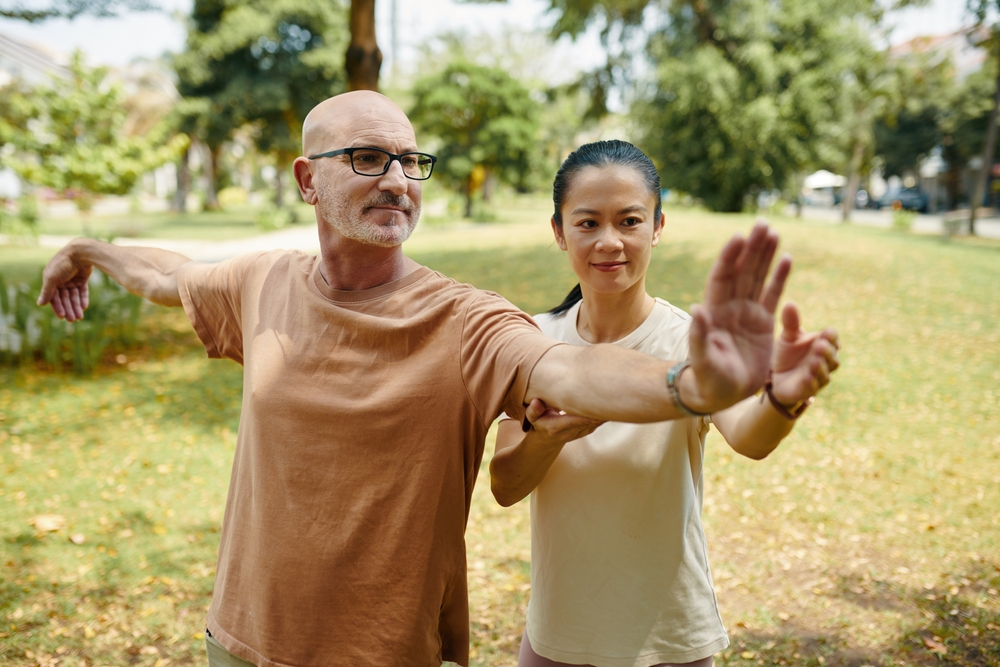
Tai Chi deserves a special place in a brain-health programme for older adults.
Its slow, controlled movements combine balance, coordination, breathing, concentration and body awareness.
You are not simply moving an arm or leg. You are remembering a sequence, controlling your weight shift, maintaining posture and paying attention to where your body is in space.
That makes Tai Chi particularly interesting for ageing brains.
Recent NIH-supported research has also found encouraging results from a form of Tai Chi enhanced with cognitive challenges in older adults with mild cognitive impairment, although this is an evolving area of research rather than a guarantee against cognitive decline.
Try it
Start with a beginner class taught by a qualified instructor.
Even 20–30 minutes, two or three times a week, can become a wonderful addition to your movement routine.
- Yoga: breathe, balance and pay attention
Yoga is sometimes dismissed as simply stretching.
It is much more than that.
Yoga asks us to coordinate movement with breathing while maintaining awareness of posture and body position.
For older adults, gentle yoga can help develop:
- flexibility
- balance
- body awareness
- strength
- breathing control
- relaxation
- concentration
And there is an important brain-health connection here.
Stress, poor sleep, inactivity and cardiometabolic health all intersect with cognitive health. Regular physical activity can support mental wellbeing as well as physical health.
Choose senior-friendly or therapeutic yoga when necessary. Chairs, walls, blocks and straps aren’t signs that you’re “doing less yoga”.
They are tools that allow you to practise safely.
- Pilates: teach your brain to control your body
Pilates is another excellent option for seniors because it focuses on controlled movement rather than speed.
It can strengthen the core, improve posture and encourage better control of the muscles supporting the spine, hips and pelvis.
But there is another benefit: Pilates requires concentration.
You have to think about alignment, breathing and movement simultaneously.
That combination of attention + movement + coordination makes it a useful component of a brain-friendly exercise programme.
Chair Pilates and modified Pilates can be excellent starting points for older adults who are not comfortable getting down onto the floor.
- Strength training: your brain needs your muscles
This may be one of the most important messages for older adults.
Strength training is not just about building muscles.
Ageing naturally brings a loss of muscle mass and strength. Maintaining strength helps us remain independent: getting out of a chair, climbing stairs, carrying shopping, opening jars and preventing falls all depend on it.
And strength training belongs in a brain-health programme because physical activity supports multiple systems involved in healthy ageing.
The WHO recommends muscle-strengthening activity involving the major muscle groups on at least two days a week.
You don’t need a sophisticated gym.
Start with exercises such as:
- Sit-to-stand from a sturdy chair
- Wall push-ups
- Calf raises while holding a chair
- Resistance-band exercises
- Light dumbbells or water bottles
- Supported step-ups
The principle is simple:
Challenge the muscles without compromising safety.
As strength improves, resistance can gradually increase.
- Dance: exercise disguised as pleasure
If walking is the simplest brain workout, dancing may be the most joyful.
Dance requires the brain to process:
rhythm + memory + movement + balance + sequencing + coordination.
You may have to remember the next step, change direction, match the music and coordinate your arms and legs—all while enjoying yourself.
And dancing can add something exercise machines cannot easily provide: social connection.
Try ballroom, Bollywood, Garba, folk dance, line dancing—or simply put on music at home and move.
You don’t have to perform.
You just have to participate.
- Balance exercises: train your brain’s navigation system
Balance isn’t purely a muscle function.
Your brain receives information from your eyes, inner ear, muscles and joints and constantly integrates these signals to help you remain upright.
That is why balance deserves regular practice.
Try:
- Standing with feet close together while holding a stable surface
- Heel-to-toe walking near a wall
- Weight shifting from one foot to the other
- Controlled sit-to-stand
- Gentle side steps
- Supported single-leg standing
Never practise challenging balance exercises near a staircase or without something sturdy to hold.
For older adults with poor mobility, WHO specifically recommends balance-focused physical activity on three or more days a week to help prevent falls.
- Give your brain a coordination workout
One of the most interesting ways to make ordinary movement more cognitively demanding is to add coordination.
For example:
March and touch
March slowly while touching the opposite knee with the opposite hand.
Balloon or soft-ball toss
Toss a soft ball from one hand to the other.
Movement sequences
Try:
Right arm up → left arm up → both arms down → march twice.
Then repeat the sequence.
These activities aren’t magic “neuro exercises”. Their value lies in requiring you to pay attention while moving.
And that is precisely the point.
- Try “dual-task” walking
Here is another fascinating challenge for the brain.
Instead of simply walking, occasionally combine walking with a safe mental task.
For example, while walking in a secure environment:
- Count backwards from 50
- Name fruits alphabetically
- Recite the months backwards
- Name cities beginning with successive letters
- Walk while carrying on a conversation
But there is an important safety rule:
Do not do this in traffic, on uneven ground or anywhere you need your full attention for safety.
If your balance is poor, practise the mental and physical tasks separately first.
The objective isn’t to make walking difficult.
It is to encourage the brain to manage movement and thinking together.
- Don’t underestimate ordinary movement
We sometimes imagine that exercise only counts if we are wearing trainers and following an instructor.
It doesn’t.
Physical activity includes walking for transport, climbing stairs, gardening, household tasks, dancing, recreational activities and other movement throughout the day. WHO specifically recognises these forms of everyday movement as physical activity.
So:
Walk to the neighbourhood shop.
Take the stairs when appropriate.
Garden.
Water the plants.
Stand up during television breaks.
Walk around while talking on the telephone.
Carry your own light shopping.
Get out of the chair regularly.
Your brain doesn’t care whether the movement came from a gym or your garden.
How much exercise does your brain need?
For adults aged 65 and above, the broad WHO target is:
150–300 minutes
of moderate aerobic activity each week
PLUS
Strength training
at least 2 days a week
PLUS
Balance and functional movement
particularly for those with reduced mobility, with WHO recommending this on 3 or more days a week.
But don’t look at these numbers as a pass-or-fail examination.
If you are currently inactive, start small.
Five or ten minutes of movement is better than remaining seated.
Build gradually—duration first, then intensity.
WHO specifically advises inactive people to begin with small amounts and progressively increase duration, frequency and intensity.
Your 7-Day Brain Fitness Plan
You don’t need to do everything every day.
The secret is variety.
| Day | Brain-friendly movement |
| Monday | 30-minute brisk walk + 10 minutes balance |
| Tuesday | 25–30 minutes strength training |
| Wednesday | 20–30 minutes Tai Chi + gentle stretching |
| Thursday | 30-minute walk with 4–5 short brisk intervals |
| Friday | 30 minutes yoga or Pilates |
| Saturday | 30 minutes dancing + a social activity |
| Sunday | Gentle walk + mobility exercises |
And every day:
Get up regularly. Break up long periods of sitting. Move whenever you can.
The real secret: make your brain work while your body moves
Perhaps the most useful way to think about exercise after 60 is this:
Ask:
“What can I do that makes my body and brain work together?”
Walk somewhere new.
Change your walking pace.
Learn a Tai Chi sequence.
Follow a dance routine.
Practise a new yoga movement.
Lift weights with good form.
Try a new Pilates exercise.
Work on balance.
Learn a new movement pattern.
Because the brain loves novelty, challenge and repetition.
And perhaps this is why movement can be such a powerful antidote to the increasingly sedentary lives many of us lead as we grow older.
Let’s give this some thought…
We often spend a great deal of time worrying about keeping our memory sharp.
We do puzzles.
We play Sudoku.
We read.
We learn languages.
All of these can be wonderful.
But perhaps we should add another instruction to our brain-health checklist:
Move.
Because the brain is not separate from the body.
Every step, every change of direction, every carefully controlled movement and every new physical skill is an opportunity for the brain to communicate with the body—and for the body to send information back.
The best brain workout may not always look like a brain workout at all.
It may simply look like an older person walking, dancing, stretching, lifting, balancing, learning and enjoying the extraordinary privilege of still being able to move.
This article is for general health and wellness information and is not medical advice. If you have a heart or lung condition, significant arthritis, osteoporosis, neurological problems, balance difficulties, recent surgery or another medical condition, speak with your doctor or physiotherapist about the safest form and intensity of exercise for you. Stop exercising and seek appropriate medical attention if you develop concerning symptoms such as chest pain, severe breathlessness, fainting or sudden neurological symptoms.