






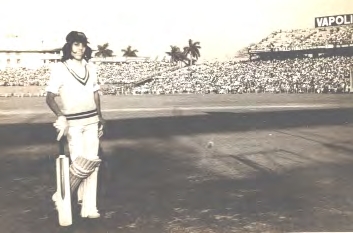
Ayaz Memon writes on Diana Edulji, whose fierce competitiveness, mentorship, reformist zeal and unyielding voice shaped women’s cricket
A few weeks back I was asked to moderate the release function of a book on women’s cricket in India. Titled – “Her Story Her Glory” the book, written by young author, Aditya Bhushan, traces the fascinating journey of the women’s game in the country from its origins, somewhere in the 1880s. Yes, that’s how long Indian women have been involved in the `gentleman’s game’!.
In the early years women would be part of mixed gender teams. These weremore social events than any significant competitive contests among women.Even so, such was the conservative social milieu then that women who playd cricket – or indeed participated in any sport – were the butt of jokes if not looked down upon.
From that flaky, insecure, stuttering start to the seminal ODI World Cup triumph by Harmanpreet Kaur’s team in late 2025
a century and a half later and last week beating home side England in the first-ever Test at Lord’s, women’s cricket in India has
traversed a long way.
Indeed, in the past decade, Indian women’s cricket has surged upwards by leaps and bounds. And in all formats. Australia remains a powerhouse, but not the only one. India stands alongside, and this rivalry is now the most intense and compelling – much as it is in men’s cricket. Much as it has in the men’s section, India’s become the epicentre of women’s cricket.
It’s not been smooth all smooth sailing, rather a had a bumpy roller-coaster ride, with umpteen ups and downs, on several occasions even reaching a dead-end before fortunately being salvaged in the nick of time. There were times when the impoverished women’s cricket association would be compelled to cancel matches because of lack of finance; a potential sponsor pulling out at the last minute, or facilities not being available was not uncommon. Such was the paucity of money that players would travel long distances to various venues in third class, often seated near stinking toilets.
Women’s cricket started taking a dramatic upward trajectory from 2006-7 when it came under the aegis of the BCCI. A decade later, India reached the final of the 2017 ODI World Cup, only to lose to England in the final.
The agony of that defeat was sublimated to some extent that India had beaten super power Australia in the semi-final. Three years later, India reached the final of the T20 World Cup, only to lose to Australia in front of a record 90,000 crowd at the venerated MCG. Now, women’s cricket has its own version of the IPL (called Women’s Premier League), Several Indian women cricketers play T20 Leagues (like Big Bash) and most importantly, India men and women cricketers receive equal pay, facilities and amenities.
I’ve given this extensive preamble to give a perspective to the growth of women’s cricket in India. Now, to move on to a couple of players who were at the fountainhead of this extraordinary rise.
The chief guest for the book release that evening was Diana Edulji. Getting her to do the honours was most apt. Diana is not just the epitome of cricketing excellence, but an iconic figure in the annals of the sport. In the Indian context, she stands on a pedestal perhaps on which – so far –perhaps only her contemporary Shanta Rangaswamy would find space.
In a way, Diana and Shanta are like another remarkable pair, Sunil Gavaskar and Kapil Dev, who dominated Indian men’s cricket in the from the late 1970s through the late 1980s.
The comparison is not in terms of individual skillsets or statistical records but in the influence they had on their respective teams, Indian cricket in their gender category, and in a socio-cultural dimension , on Indian life itself.
Like Gavaskar and Kapil, Diana and Shanta were the best players of their generation in their own area of specialisation and became mighty inspirations for subsequent generations of Indian cricketers.
Gavaskar is widely regarded as the Bhishma Pitamah of Indian batting. Starting with 774 runs in his debut series, he went on to break almost every batting record prevailing then.
His technical certitude and relentless run-getting saw him set up a monumental legacy. In the years since Gavaskar’s retirement, the baton of batting virtuosity has passed on to the likes of Dilip Vengsarkar, Sachin Tendulkar, Rohit Sharma and lately Shubman Gill, to name a few.
Kapil Dev sparked off a pace bowling revolution in India. Before him there was only Mohamed Nissar and Amar Singh who showed skill and pace worthy of the mention, but all too briefly. Spin was India’s main bowling weapon till Kapil arrived on the scene and fired the imagination of the nation with his record breaking feats, as world-class bowler and all-rounder.
Srinath, Venkatesh Prasad, Zaheer Khan, Ashish Nehra were among those who came in his wake. Over the next 15-20 years, Kapil’s lineage gathered such momentum that India today has more than a dozen fast bowlers, headlined by the outstanding Jasprit Bumrah, to pick from.
Gavaskar ended his Test career as the highest run-getter and century-scorer in the history of the game. By the time he hung his boots, Kapil had the highest number of Test wickets to his credit.
The statistical accomplishments of Diana and Shanta, as mentioned earlier, are modest in comparison, but the impact they had on women’s cricket and their influence in shaping the future of this genre bears parallel to Gavaskar and Kapil.
Both made their debut in the first ever Test played by the Indian women’s team, in 1976. Shanta, older of the two by a couple of years, only played 16 Tests between 1976 and 1991 and captained in 12 of these. She led the women’s team to its maiden Test victory and was also the country’s first centurion.
Diana, a left-arm spinner, handy lower order batter and excellent fielder, played 20 Tests between 1976 and 1993. She too captained the Indian team, in Tests and ODIs with success.
The success of Diana and Shanta made them the poster girls of women’s cricket in India. One creative writer, allying admiration with hyperbole, called them `Founding Mothers’.
Considering how women’s cricket in India has evolved, this definition of the duo is not shallow euphemism. The generations that succeeded Shanta and Diana have taken women’s cricket ahead and upwards by leaps and bounds.
From them and their contemporaries Shubhangi Kulkarni, Fouzia Khaleeli and others, spawned the likes of Sandhya Agarwal, Meetu David, and from them Anjum Chopra in whose wake came the likes of Mithali Raj, Jhulan Goswami etc, leading into the current lot of Harmanpreet Kaur, Smriti Mandhana, Jemimah Rodrigues, Shefali Verma, Yastika Bhatia, Deepti Sharma, Richa Ghosh and a host of others who helped win the ODI World Cup last year and this year notched up another milestone by beating England in a Test at Lord’s!.
These stars and their fantastic achievements all trace back to the impact and legacy of Diana and Shanta.
My introduction to them was early. Women’s cricket was among my beats when I was cutting my teeth as a sports writer in 1979. Shanta then was captain of India and already a towering figure. But I got to know Diana better as we were both from Mumbai (Shanta was from Madras), and met frequently on the local and domestic cricket circuit.
What marked her as distinct was not just her passion for cricket, but her candour (never shying from calling a spade a spade, which has remained intact over several decades , her ability to size up complex situations and address them with astuteness and courage, be patient, perseverant and never—say-die.
Brought up in Badhwar Park, the colony for officers who worked in the Railways as did her father, Diana’s `tom-boyish’ interest in sports saw her dabble in many disciplines in her early teens. Once she chose cricket as her calling, the commitment was for life.
What impressed me was her pursuit of excellence. She was always the first at nets and last to leave; tireless and always working out ways to improve.
To improve her skills, she often bowled at the Indian men’s team’s nets when they were in Mumbai for an assignment. Not all male cricketers were amiable; some were outrightly skeptical or scornful. Some were accommodating and helpful. Sunil Gavaskar, Diana says, was among these. From him, she imbibed important lessons about not just left-arm spin bowling, but big match temperament.
Seeking the help of male cricketers to improve her game wasn’t restricted to Indian players. Diana recalled approaching West Indies captain Clive Lloyd to bowl to him in the nets before the inaugural Test at the Wankhede stadium in 1974. Initially, Lloyd was perplexed and reluctant. More out of concern for Diana as he didn’t want her to be demoralised. But she cajoled him to agree, bowled a longish spell at him in the nets, and though clouted several times by the powerful left-hander, says it made her a better bowler for it.
Diana’s desire to keep enhancing her skills impressed the late Bishan Bedi, former India captain and also a left-arm spinner, enormously. Bedi once told me that Diana was as good as any spinner in the country.
Once her playing days were over, Diana didn’t lose connection with the sport, becoming a selector (as did Shanta), a talent scout and for many youngsters a mentor or benefactor who helped shape their future.
Current India captain Harmanpreet Kaur was one of the beneficiaries. Working with Northern Railway where she wasn’t making much headway, Diana, who was with the Railways in Mumbai, got Harmanpreet to Mumbai to help her grow in the sport.
The Railway bureaucracy wouldn’t allow the transfer, so Diana used her speed dial contact with Sachin Tendulkar requesting a letter of recommendation from him to the Railway authorities. Even that was initially rejected, which made Diana do a shindig, asking the authorities that if the recommendation “of the God Of Cricket’ and a Bharat Ratna to boot wasn’t good enough, what would be?
Sensing the recalcitrance of the authorities melting, Diana recalls, she did not settle for only Harmanpreet getting a job but also got 4-5 more from other sports disciplines to get jobs with the Railways on a sports quota.
Always looking for a new challenge to remain connected with cricket, Diana agreed immediately when invited to be part of the Supreme Court nominated Committee Of Advisors in 2017 along with former CAG head Vinod Rai, eminent banker Vikram Limaye and social scientist and eminent historian Ramchandra Guha to steer the BCCI’s passage through a particularly turbulent phase. Limaye and Guha quit the COA prematurely for different reasons, but Edulji stuck to the task fastidiously, even taking up cudgels against a senior functionary of the BCCI on account of `Me Too’ allegations.
‘’Both, as a woman and someone in a position of authority in the BCCI, I found the situation unacceptable,’’ says Diana. After her stint ended with the COA in 2019, Diana immersed herself in media-related work in cricket. In 2024, she was inducted into the ICC Hall Of Fame along with Meetu David. (Anjum Chopra became the third Indian woman cricketer to receive this honour in July 2026).
This year, Diana turned 70. She continues to move lightly on her feet, her lust for life keeping her ready for the next challenge that may come up. “The biggest lesson I’ve learnt from sport’’ she says philosophically, is to ‘’expect the unexpected. Like cricket, life is full of glorious uncertainties. To play this game well, you have to live not in the past or future, but in the present. That is the only thing you have!’’