






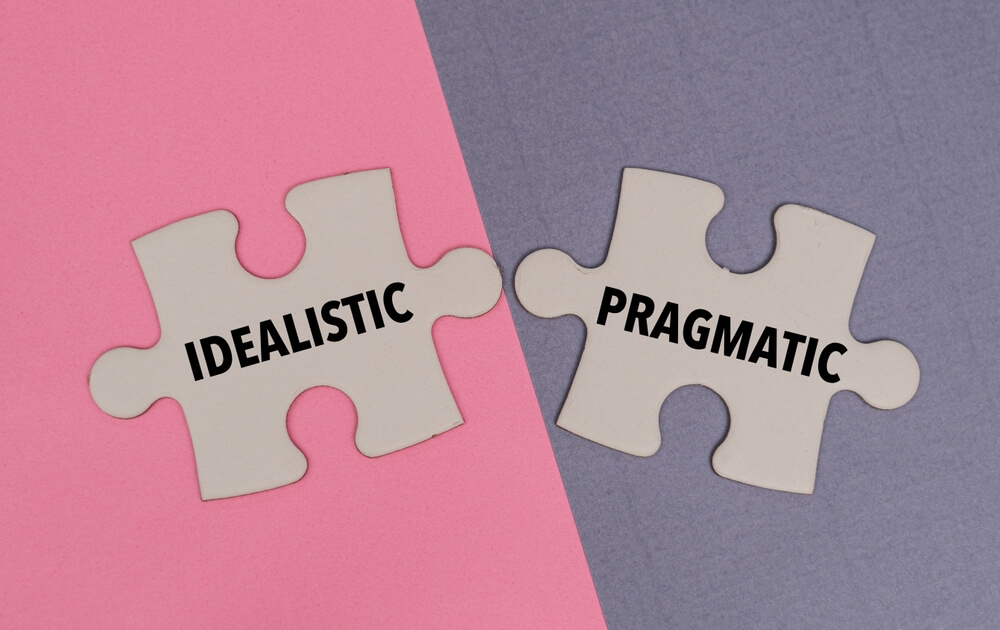
In both personal life and professional settings, we often approach challenges and decisions in markedly different ways. Some of us are guided by unwavering values and a vision of how things should be—these are the idealists. Others of us, are more grounded in practicality, navigating situations based on what works—these are the pragmatists.
Understanding where you fall on this spectrum not only sheds light on your personality and thinking style, but also helps improve communication, decision-making, and relationships. So, are you an idealist, a pragmatist, or perhaps a blend of both?
What Is an Idealist?
An idealist is someone who prioritises principles, values, and long-term visions. They tend to see the world in terms of what is morally right, fair, or aspirational. Idealists are often driven by a desire to improve the world and may focus on the bigger picture rather than the practical steps required to get there.
Traits of an idealist may include:
- A strong sense of ethics and justice
- Passion for causes or ideals
- Tendency to dream big and think conceptually
- Frustration with compromise or ‘grey areas’
- Preference for doing what’s “right” over what’s expedient
Idealists are often the visionaries, reformers, or creatives who challenge the status quo and push for meaningful change.
What Is a Pragmatist?
A pragmatist, by contrast, is focused on results, practicality, and what is achievable in the real world. They are problem-solvers who assess situations based on facts, context, and available resources, often choosing the path of least resistance or maximum efficiency.
Traits of a pragmatist may include:
- Emphasis on realistic goals and feasible solutions
- Willingness to compromise or adapt
- Preference for action over abstract thinking
- Focus on short- to medium-term outcomes
- Comfort with ambiguity and trade-offs
Pragmatists are typically the strategists, organisers, or implementers who get things done—even if it means letting go of ideal outcomes.
Which One Are You?
Here are a few questions to consider:
- When faced with a tough decision, do you stick to your values no matter the consequences (idealist), or do you weigh the pros and cons to find a workable solution (pragmatist)?
- Do you often feel frustrated when reality doesn’t live up to how things should be (idealist), or do you focus on navigating things as they are (pragmatist)?
- When working with others, are you more concerned with shared ideals (idealist), or with shared goals and progress (pragmatist)?
Most people aren’t entirely one or the other. Many of us exhibit both tendencies, depending on the situation. For example, you might be idealistic about your personal values, yet highly pragmatic when managing a business or dealing with everyday problems.
The Strengths—and Limits—of Each
Neither mind-set is inherently better than the other. In fact, both perspectives offer unique strengths:
- Idealists inspire, innovate, and lead change. However, they may struggle with compromise or feel disheartened by practical limitations.
- Pragmatists are adaptive, efficient, and solution-oriented. Yet they may be seen as lacking vision or compromising too easily.
The key lies in balance. Idealism without pragmatism can become unrealistic. Pragmatism without idealism can become aimless. The most effective individuals—and teams—know when to dream boldly and when to act wisely.
So, are you an idealist or a pragmatist? Or perhaps a thoughtful combination of both?
Recognising your natural tendencies can help you make more intentional choices, relate more effectively to others, and strike a healthy balance between your values and the realities of the world. Whether you lead with vision or with strategy, both mind-sets have a vital role to play in personal growth and collective progress.