







If Lata was the voice of India’s soul, Asha became the voice of its spirit, writes Dr Ramachandran Srinivasan
During the golden era of Indian cinema—spanning the high-fidelity ’60s to the synth-heavy Disco ’80s—the airwaves were tuned to a singular, unwavering pitch of “purity” conducted by Lata Mangeshkar. To find her own rhythm, her younger sister Asha Bhosle had to compose a career from the syncopated beats and sharp notes that others deemed too discordant or “too bold.” Asha didn’t just perform; she rearranged the entire score of her life, turning every controversial refrain into a foundational chord for an empire that eventually achieved a harmonic resonance rivalling that of her elder sibling.
The most defining controversy of Asha’s life — and the one that birthed her career — began not in a recording studio, but in an act of domestic defiance. In 1949, at just 16, Asha cut the umbilical cord and walked out of the Mangeshkar household to tie the nuptial cord with Ganpatrao Bhosle, a man twice her age and her sister Lata’s personal secretary. The family viewed this as a dual betrayal: a personal rebellion and a professional breach of trust. A cord that became a reason for discord.
The consequences were immediate and severe. Asha was effectively disowned and barred from the family home. She recounted the sheer struggle of those early days, stating that she left with virtually nothing.
“When I left home, I had no money, no support, and two small children to feed. I had to take whatever work came my way, even if it was just one line in a chorus,” Asha once shared.
This departure was a total snap of the Mangeshkar strings, leaving Asha without a safety net or a harmonic home. Even as Lata was being conducted as the successor to the greats, Asha was a homeless teenager seeking a new key at every studio door. She was often seen carrying her infant son, Hemant, to recording sessions, leaning on studio peons to hold the tempo of her personal life while she stepped into the recording booth. Because she had struck a dissonant chord with the premier musical family, many composers feared that giving her a solo would detune their relationship with Lata.
However, this isolation became her inner resonance. By leaving the home where “refined” music was the only metronome, she became available to the gritty, experimental arrangements of films that fell outside the A-Grade spotlight. This estrangement forced Asha into a difficult professional register. For decades, industry overtones suggested a deep-seated jealousy fuelled by Lata’s melodic dominance. While Lata held the centre stage for the “heroine” leitmotifs, Asha was relegated to the low-register growls of vamps, the staccato energy of cabaret dancers, and the complex minor keys of the antagonists.
“I thought to myself, if I continue to sing in a similar voice to didi, then I will never get work as long as she is in the business,” Asha later recalled.
This forced her to innovate. She mastered Westernised modulations and rhythmic breathing techniques that Lata refused to touch. However, the tension remained palpable. Composer O.P. Nayyar once claimed Asha suffered from a “Lata phobia,” noting that he had to work exceptionally hard to help her find an individualistic style distinct from her sister.
Yet the two sisters sang around 80 songs together. And yes, both of them sang for over 80 years as well.
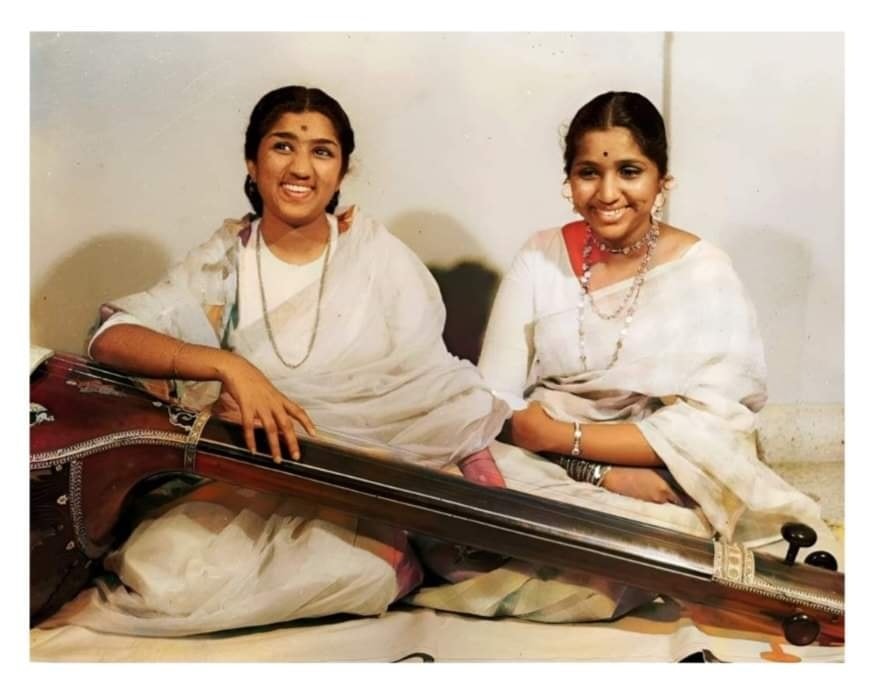
Tales of two gifted sisters.
But then, the intensity of this sibling friction became so deeply etched in the Indian psyche that it eventually inspired a cinematic post-mortem. In 1998, filmmaker Sai Paranjpye released Saaz, a film widely believed to be based on the lives of Lata and Asha. Though Paranjpye maintained it was a work of fiction, the parallels were impossible to ignore: two sisters, both gifted singers, navigating a world of professional jealousy, different musical temperaments, and the shadow of one looming over the other. Also Sai Paranjpye, the parallels to the sisters’ lives—such as two singing siblings, a younger sister struggling to find her identity, and even specific details like wearing long plaits—led to widespread public and media comparison
The film added a layer of cultural legitimacy to the rumours of their “cold war.” By portraying the younger sister’s struggle to find an identity in a monopolised industry, Saaz effectively turned the private whispers of the recording studios into a public narrative. While the Mangeshkar sisters remained largely tight-lipped about the film akin to the Kuch na kaho… Kuch bhi na kaho track, its existence served as a testament to how deeply their rivalry had shaped the folklore of Bollywood. Asha Bhosle once replied that commenting on the film would be a, “Waste of time!” and even referred to the Burman song from Amar Prem – Kuch toh log kahenge!
Usually, an enemy of my sister is also my enemy. But as Lata Mangeshkar’s song from her film Aakhir Kyon in 1985 – Dushman Na Kare Dost Ne Wo Kaam Kiya Hai – Asha chose to work with her sister’s ‘enemies’ which included composers and singers.
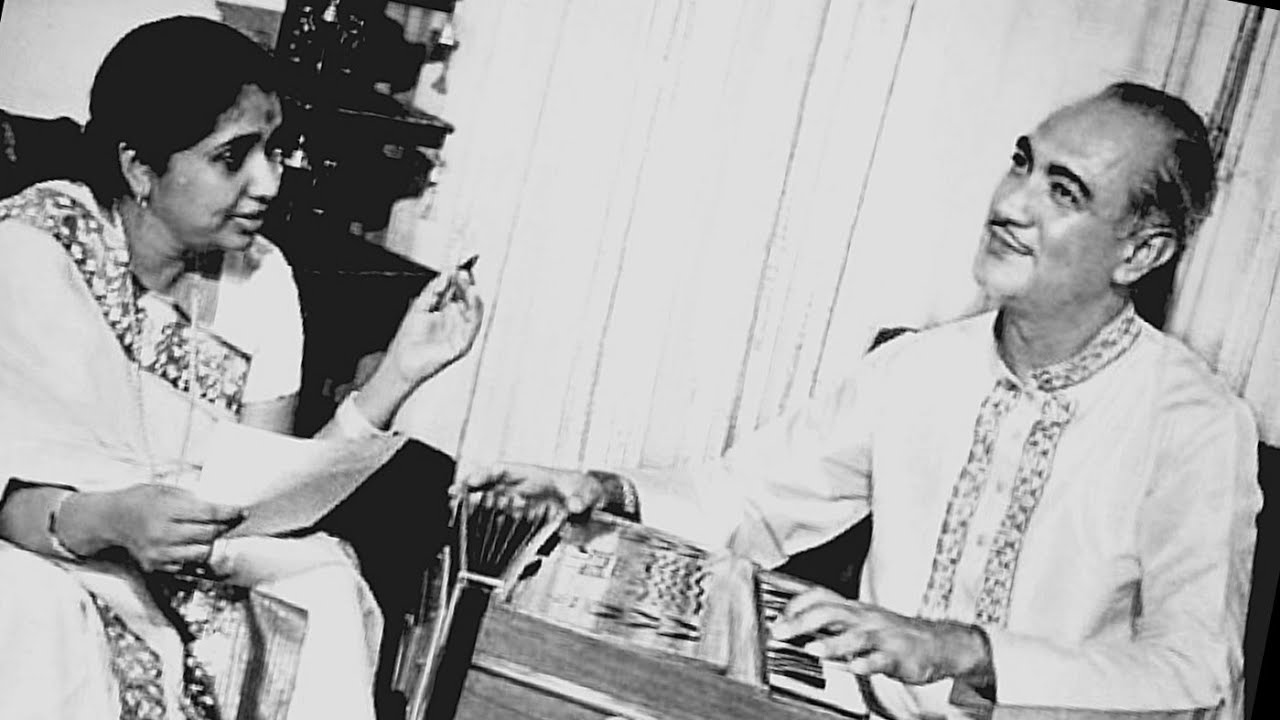
With O P Nayyar, who helped evolve her identity
Yes. Asha’s rise was powered by composers who had their own scores to settle with the elder Mangeshkar. These “camps” became the fault lines of Bollywood. The most famous was her 20-year collaboration with O P Nayyar, who famously never recorded a single song with Lata. Nayyar made Asha his muse, and their rumoured relationship and eventual bitter fallout in the 1970s caused a significant industry stir.
Similarly, when S D Burman had a five-year “cold war” with Lata in the late 1950s, he turned to Asha. She used this period to prove she could sing the “refined” and “soulful” songs usually reserved for Lata (most notably in Chalti Ka Naam Gaadi – 1958). By siding with composers who were “blacklisted” by her sister, Asha was often accused of fanning the flames to secure her own position.
The professional relationship between Lata Mangeshkar and composer Jaidev was famously strained in the late 1950s following a misunderstanding involving S D Burman. Lata accused Jaidev, then Burman’s assistant, of miscommunicating a message that escalated a tiff between the two legends—a charge Jaidev consistently denied. This rift ensued in a years-long boycott, which only ended when Dev Anand intervened during the production of Hum Dono (1961). His mediation successfully brought Lata back to Jaidev’s recording room, resulting in the timeless spiritual classic Prabhu Tero Naam and marking a formal reconciliation between the two artists.
During the years of Lata’s absence, Jaidev turned his creative focus to Asha Bhosle, playing a pivotal role in carving her distinct musical identity. By giving her classically inclined masterpieces like Abhi Na Jao Chhor Kar, he helped her step out from her sister’s shadow, though this shift gave rise to media rumours that Jaidev was intentionally challenging Lata’s industry “monopoly.” Despite this turbulent history, the tension eventually gave way to mutual respect. In a fitting final tribute shortly before he died in 1987, Jaidev was honoured with the Lata Mangeshkar Award, signifying a full-circle peace and the ultimate validation of his contribution to Indian cinema.
In the 1960s, a massive ego battle broke out between Lata Mangeshkar and Mohammed Rafi over singer royalties. Lata demanded that singers receive a share of record sales; Rafi believed that once a singer was paid their fee, they had no further claim.

When Lata refused to sing with Rafi for several years, Asha made the controversial choice to continue recording duets with him. To many in Lata’s circle, this was a betrayal that weakened the elder sister’s bargaining power. For Asha, it was survival. By remaining available when Lata was not, she became the indispensable choice for producers tired of the royalty drama.
Asha’s willingness to push boundaries often put her at odds with conservative government standards. Two of her most iconic hits were nearly silenced, including Dum Maro Dum from Hare Rama Hare Krishna. Despite the film’s anti-drug message, the song was accused of glamourising the drug culture. It was banned by All India Radio (AIR) and edited out by Doordarshan. Fans tuned into Radio Ceylon to hear it, keeping it at the top of the charts for months. And yes there was Piya Tu Ab To Aaja as well when lyricist Majrooh Sultanpuri was so embarrassed by the “bold” nature of the song that he reportedly told Asha, “Beti, maine ganda gana likha hai” (“Daughter, I have written a dirty song”).
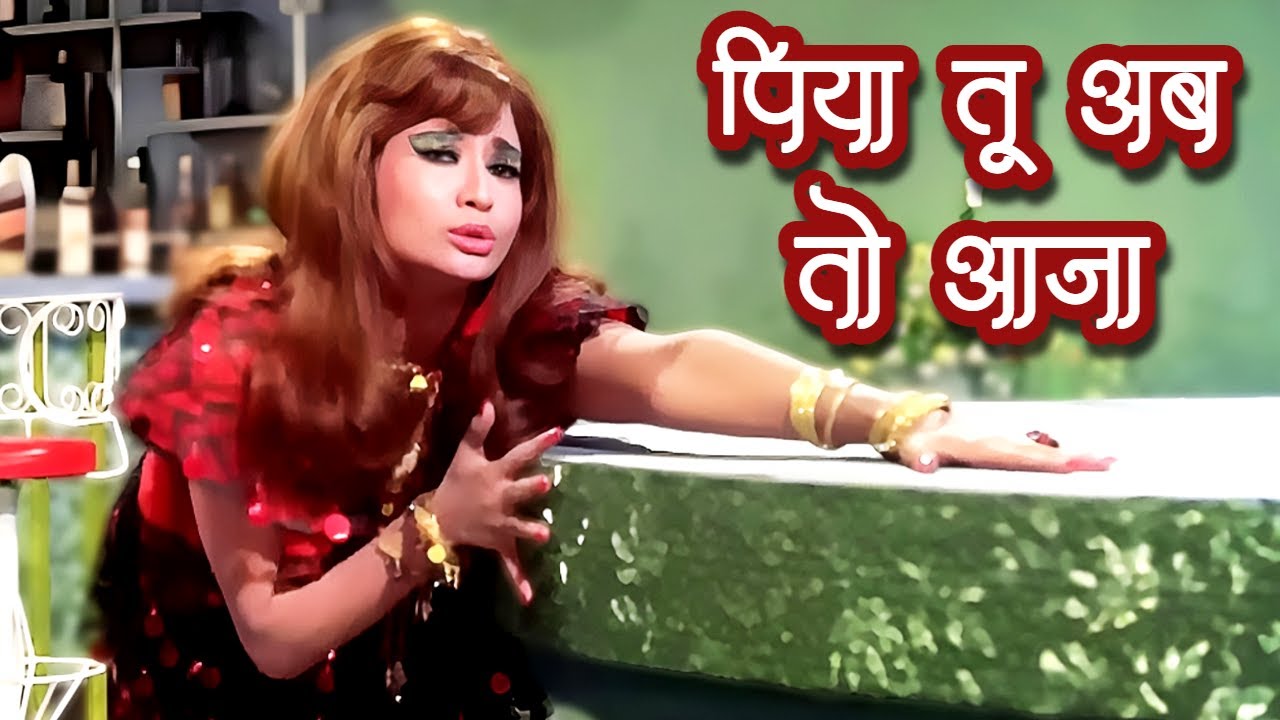
Only a “rebel” spirit like Asha could pull off this song
Asha later revealed she once confronted R D Burman (Pancham) about why she was repeatedly offered only provocative numbers. Pancham’s answer was simple: Asha was the only one with the technical range and the “rebel” spirit to pull them off.
Asha’s fiery personality wasn’t limited to the recording booth. In 2006, she publicly lashed out at Himesh Reshammiya after he suggested R D Burman sang through his nose. An incensed Asha reportedly stated that anyone making such claims “should be slapped,” leading to a swift public apology from Reshammiya.
Her later years brought legal battles, including a 2012 bungalow dispute with actress Sadhana over a garden area. More painfully, she was embroiled in a legal spat with her daughter-in-law, Sajida, following the death of her son Hemant in 2015. Sajida accused Asha of threatening her—allegations Asha handled with a characteristic silence until the matter was resolved privately.
Asha Bhosle’s career is a testament to her endurance. She didn’t just find a career; she found a voice that was more versatile, more daring, and ultimately more modern than the one she was originally meant to follow. By embracing the “bold,” the “banned,” and the “blacklisted,” she turned being the “second choice” into a global brand.
As she often told young aspirants in reality shows: “Accept change, whether or not you like it.” It is a philosophy that turned a family rift into a revolution, and a “dirty song” into the heartbeat of a nation. Asha Bhosle didn’t just survive the controversies; she used them to ensure that while Lata was the voice of India’s soul, Asha became the voice of its spirit.