






A world that produces food, yet struggles to nourish everyone
Food is a biological necessity, an economic resource, a cultural foundation, and a fundamental component of human dignity. Yet, in a world equipped with advanced agricultural machinery, satellite-based crop monitoring, genetic technologies, artificial intelligence, and sophisticated food supply chains, hunger and malnutrition remain persistent global challenges.
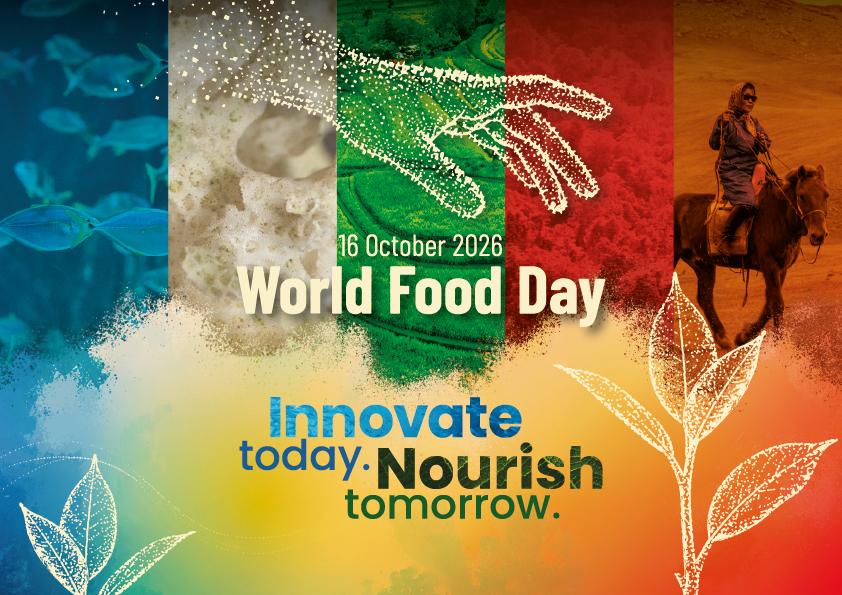
World Food Day, observed annually on 16 October, commemorates the founding of the Food and Agriculture Organization of the United Nations (FAO) in 1945. The theme for 2026, “Innovate today. Nourish tomorrow,” calls attention to the role of innovation, scientific knowledge, and inclusive approaches in building food systems that nourish people while protecting the planet.
The central question is no longer simply whether the world can produce enough food. It is whether nutritious food can be produced sustainably, distributed equitably, afforded by all, and made resilient to environmental and economic shocks.
- The global food crisis: More than a problem of production
The FAO and its partner agencies reported in The State of Food Security and Nutrition in the World 2025 that progress towards ending hunger and malnutrition remains insufficient. Food price inflation, conflict, economic instability, and climate-related disruptions continue to undermine access to adequate diets, particularly among low-income populations.
The underlying problem has several interconnected dimensions.
First, food availability does not guarantee food security. Food may be present in markets and warehouses, yet remain inaccessible to households that lack sufficient income. A family can obtain enough calories while being unable to afford adequate quantities of vegetables, fruit, pulses, dairy products, eggs, fish, and other nutrient-rich foods.
Second, the cost of a healthy diet matters as much as the supply of staple foods. Rising transport costs, energy prices, fertiliser costs, market disruptions, and climate-related crop losses can increase the retail prices of essential foods. The resulting dietary compromises may increase the risk of micronutrient deficiencies, poor child development, and diet-related chronic diseases.
Third, food insecurity and malnutrition coexist with food waste and overconsumption. Losses during harvesting, storage, transportation, processing, and retail reduce the amount of food reaching consumers. At the same time, excessive consumption of energy-dense, nutrient-poor foods contributes to obesity and metabolic disease in many populations. This coexistence demonstrates that food security is also a problem of access, nutrition, infrastructure, and dietary quality.
- Climate change, soil degradation and water scarcity
Food production depends on stable ecological foundations: fertile soil, adequate water, healthy pollinators, functional ecosystems, and predictable growing conditions. These foundations are under increasing pressure.
Rising temperatures, irregular rainfall, prolonged droughts, floods, heatwaves, and changing pest and disease patterns can reduce crop yields and destabilise agricultural livelihoods. Heat stress can impair reproductive development in crops, while high temperatures and water shortages can reduce livestock productivity. Warmer waters and ocean acidification also threaten some aquatic ecosystems and fisheries.
The FAO’s State of the World’s Land and Water Resources for Food and Agriculture 2025 highlights the scale of the challenge: agriculture accounts for more than 70% of global freshwater withdrawals, while over 60% of human-induced land degradation occurs on agricultural lands.
Soil degradation is particularly serious because soil is not merely a physical support for plants. It is a living system that stores carbon, cycles nutrients, regulates water movement, and supports diverse microorganisms. Erosion, salinisation, compaction, nutrient depletion, and the loss of soil organic matter can gradually weaken the productive capacity of farmland.
Scientific solutions must therefore extend beyond increasing crop yields. Conservation agriculture, crop diversification, efficient irrigation, integrated nutrient management, agroforestry, climate-resilient varieties, and restoration of degraded land can help maintain productivity while protecting natural resources.
However, these approaches require locally appropriate research, affordable technologies, effective extension services, and financial support for farmers during the transition.
- The global nutrition paradox
Modern food systems face a dual burden: undernutrition and micronutrient deficiencies persist alongside overweight, obesity, diabetes, and cardiovascular disease.
A diet may provide sufficient energy without supplying adequate protein quality, iron, zinc, iodine, vitamin A, vitamin B12, or other essential nutrients. Children, pregnant women, older adults, and economically disadvantaged groups may be especially vulnerable to deficiencies.
This is why food security must be assessed through more than grain production or calorie availability. Dietary diversity, food safety, nutritional quality, affordability, and access to clean drinking water and sanitation are equally important.
The scientific response involves strengthening nutrition-sensitive agriculture, improving access to diverse foods, supporting breastfeeding and appropriate complementary feeding, fortifying selected foods where justified, and reducing the excessive consumption of foods high in salt, free sugars, and unhealthy fats.
Food systems should be judged not only by the quantity of food they deliver, but also by their contribution to human health throughout the life course.
- India’s food security challenge: Progress alongside persistent vulnerabilities
India has made major advances in agricultural production, food distribution, dairy development, fisheries, and public food assistance. These achievements have helped strengthen national food availability and provide essential support to millions of households.
Nevertheless, national food production figures do not fully describe the nutritional and ecological realities faced by every community.
Agriculture under environmental pressure
Indian agriculture is highly diverse, ranging from irrigated cereal systems to rainfed farming, horticulture, livestock production, and fisheries. Yet many farming communities face increasingly difficult decisions concerning water use, input costs, weather uncertainty, soil health, and market access.
Overdependence on a limited number of crops in some regions can contribute to groundwater depletion, nutrient imbalances, declining soil quality, and reduced agricultural diversity. In other areas, inadequate irrigation, fragmented landholdings, limited storage facilities, and poor access to affordable credit constrain productivity.
Climate change compounds these difficulties. Heatwaves, intense rainfall, droughts, floods, and changing pest pressures can threaten crops and farm incomes. Small and marginal farmers may have limited financial reserves to absorb repeated losses.
India therefore needs a transition from a narrow focus on maximum output towards resource-efficient, climate-resilient, and nutritionally diverse agriculture.
Hunger, hidden hunger and dietary quality
India’s food security challenge also involves the relationship between food access and nutritional outcomes. Undernutrition, anaemia, low dietary diversity, and deficiencies of essential micronutrients remain important public health concerns, particularly among vulnerable women and children.
At the same time, urbanisation, changing lifestyles, and increased consumption of highly processed foods have contributed to a growing burden of overweight and non-communicable diseases.
The solution cannot be reduced to producing more rice and wheat alone. Pulses, millets, fruits, vegetables, dairy products, eggs, fish, and other locally appropriate nutrient-rich foods should form part of accessible, affordable diets.
Public food distribution, school meals, maternal and child nutrition programmes, food fortification where appropriate, and community-level nutrition education can help bridge the gap between food availability and nutritional well-being.
From farm productivity to food-system sustainability
India’s farmers operate within a system shaped by weather, soil, water, input prices, procurement arrangements, processing capacity, storage infrastructure, and consumer demand. Interventions that improve one part of this system may fail if other constraints are ignored.
For example, increasing the yield of a water-intensive crop may not be sustainable in a severely water-stressed region. Similarly, encouraging farmers to grow perishable vegetables without reliable cold chains and markets can expose them to substantial post-harvest losses.
A science-based strategy must therefore integrate agricultural research, hydrology, soil science, ecology, nutrition, economics, food technology, and public policy.
- Innovation: What can science realistically deliver?
The 2026 World Food Day theme is an opportunity to distinguish useful innovation from technology adopted merely because it is new.
Precision agriculture uses soil testing, sensors, satellite imagery, weather information, and data-driven recommendations to guide irrigation, fertiliser application, and crop management. When appropriately implemented, these approaches can reduce waste and improve the efficiency of farm inputs.
Climate-resilient crops can help farmers manage heat, drought, flooding, salinity, and emerging pests. Breeding programmes, biotechnology where appropriate, and conservation of crop genetic diversity can contribute to more stable production.
Regenerative and conservation-oriented practices aim to maintain soil cover, improve organic matter, diversify cropping systems, and reduce erosion. Their benefits depend on soil type, climate, crop selection, and local management; no single farming method is universally optimal.
Better storage and food processing can reduce losses and improve the availability of seasonal produce. Solar-powered cold storage, improved grain storage, local processing facilities, and efficient transport can be particularly valuable when designed around the needs of small producers.
Digital advisory services and artificial intelligence can support weather forecasting, pest surveillance, supply-chain coordination, and market information. However, their benefits depend on reliable data, digital access, affordability, and the ability of farmers to understand and act on the recommendations.
Finally, innovation must include social and institutional measures. Scientific advances cannot solve food insecurity if nutritious food remains unaffordable, women lack access to productive resources, or small farmers cannot reach viable markets.
- Food loss, food waste and the responsibility of consumers
Food that is produced but lost before reaching consumers represents wasted land, water, energy, labour, and other inputs. Inadequate drying, poor storage, insufficient refrigeration, transport delays, and weak market infrastructure can all contribute to losses.
Food waste at retail, institutional, and household levels presents a related challenge. Better forecasting, improved inventory management, appropriate packaging, clearer date labelling, meal planning, food donation systems, and safe redistribution can help prevent avoidable waste.
Composting and other biological recovery methods can return nutrients to the soil when prevention and redistribution are not feasible. However, preventing edible food from being lost or discarded should generally take priority over treating it as waste.
Responsibility is shared across the food chain: farmers, processors, distributors, retailers, institutions, policymakers, and consumers all have roles to play.
Conclusion: Nourishment must become the measure of progress
World Food Day 2026 invites us to rethink the relationship between scientific progress and human well-being. The future of food cannot depend exclusively on higher yields, new machinery, or increased production. It must also depend on healthy soils, responsible water management, climate resilience, fair livelihoods, nutritious diets, safe food, and equitable access.
For India, the task is to build on its agricultural achievements while addressing regional resource constraints, nutritional deficiencies, food affordability, post-harvest losses, and the vulnerability of smallholder farmers.
The most meaningful innovation is not necessarily the most technologically complex. It is the innovation that solves a real problem, works under local conditions, remains affordable, and delivers measurable benefits to people and ecosystems.
On this World Food Day, the goal should be clear: not merely to produce more food, but to nourish more people, more equitably and more sustainably.
Short note: Modern Aquaculture — A New Frontier in Food and Nutrition Security
Modern aquaculture—the controlled or managed farming of fish, crustaceans, molluscs, and aquatic plants—is increasingly important to the future of global food systems. It can supplement capture fisheries, provide high-quality protein and essential micronutrients, generate rural employment, and diversify food production beyond conventional agriculture.
India has considerable potential to expand scientifically managed freshwater, brackish-water, and marine aquaculture. According to the Government of India’s fisheries sector update published in January 2026, national fish production reached approximately 19.78 million tonnes in 2024–25, reflecting substantial growth over the preceding decade.
Press Information Bureau
+1
Key technologies and their scientific value
- Recirculating Aquaculture Systems (RAS): Water is filtered, treated, and reused, enabling production in relatively small spaces. These systems can reduce water demand but require reliable energy, technical expertise, and careful management of water quality.
- Biofloc technology: Beneficial microbial communities convert certain waste nutrients into microbial biomass, which can support nutrient recycling and, under suitable conditions, supplement fish or shrimp nutrition.
- Integrated aquaculture: Combining fish farming with agriculture, horticulture, or livestock systems can improve resource utilisation when nutrient flows and biosecurity are properly managed.
- Precision aquaculture: Sensors, automated feeding, dissolved-oxygen monitoring, and digital analytics can help farmers detect stress early, improve feed efficiency, and reduce avoidable mortality.
- Improved breeding and aquatic animal health: Selective breeding, quality-controlled seed, disease surveillance, and responsible health management can improve productivity and reduce production risks.
The sustainability conditions
Modern aquaculture is not automatically environmentally sustainable. Poorly managed farms may cause nutrient pollution, disease transmission, antimicrobial resistance, habitat loss, or excessive dependence on feed ingredients sourced from wild fisheries. High-density systems may also experience rapid losses if aeration, water quality, or power supplies fail.
Sustainable expansion therefore requires appropriate site selection, efficient feed formulation, responsible stocking densities, water-quality management, disease prevention, traceability, and protection of mangroves and other sensitive ecosystems. These principles align with the FAO’s Guidelines for Sustainable Aquaculture.
The way forward: Modern aquaculture should be viewed not simply as a means of increasing fish production, but as a science-driven approach to improving nutrition, supporting livelihoods, and diversifying climate-resilient food systems. Its success should be measured by nutritional benefits, environmental performance, economic viability, and equitable access to aquatic foods—not production volume alone.
Selected scientific references for the article
- FAO. World Food Day 2026: Innovate today. Nourish tomorrow.
- FAO, IFAD, UNICEF, WFP and WHO. The State of Food Security and Nutrition in the World 2025 .
- FAO. The State of the World’s Land and Water Resources for Food and Agriculture 2025 .
- UNEP. Promoting a Sustainable Agriculture and Food Sector: India (2024) .
- FAO. The State of World Fisheries and Aquaculture 2024: Blue Transformation in Action .
- Department of Fisheries, Government of India. Annual Report 2024–25