






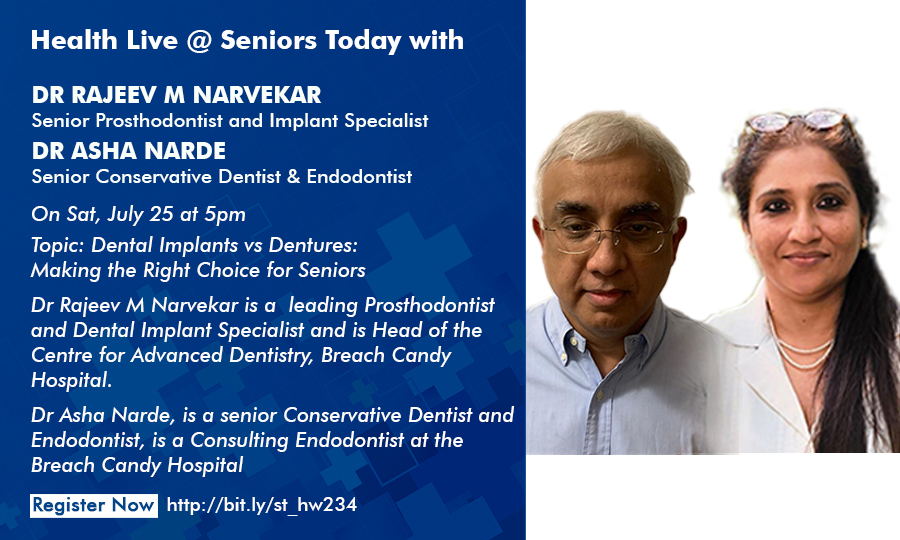
Mouth-Body Connection: Top Dental Experts Highlight Crucial Link Between Chewing Power and Cognitive Health in Seniors
In an era where increasing longevity is spotlighting geriatric health, leading clinical experts have issued a vital reminder to the ageing population: maintaining oral health is not merely a matter of aesthetics or localized comfort, but a fundamental pillar of systemic wellness and cognitive preservation.
Speaking at the weekly Seniors Today Health Live webinar hosted by Editor Pradyuman Maheshwari on 25 July 2026, two of the city’s foremost dental specialists dismantled long-standing misconceptions surrounding tooth loss, dentures, and modern dental implants.
The panel featured Dr Rajeev M Narvekar, Head of The Dental Clinic at Breach Candy Hospital and a US-trained Prosthodontist specialising in maxillofacial reconstruction, alongside Dr Asha Narde, a veteran Conservative Dentist, Endodontist, and Honorary Joint Secretary of the Association of Geriatric Dentistry. Drawing from over two decades of clinical collaboration at Breach Candy Hospital, the duo presented a comprehensive case for why senior citizens must aggressively protect their “chewing power”.
You can watch the full interactive broadcast on the Seniors Today Dental Health Live Discussion to listen to the extensive clinical insights shared by the doctors during this session.
The Domino Effect of Mid-Life Tooth Loss
A common pitfall among ageing adults is ignoring the loss of a single back tooth, assuming the remaining teeth can bear the load. Dr Narde strongly cautioned against this complacency, outlining a silent cascade of oral destruction.
“The minute a tooth is lost in the mouth, a significant loss of function occurs, which patients often do not realize initially,” Dr Narde explained. “There is immediate movement of the adjacent teeth, and the opposing teeth tend to drift downward into the empty space. This creates structural imbalances, opens up unnatural gaps, and leads to severe food lodgement, which rapidly accelerates cavities in the remaining healthy teeth.”
Beyond localized shifting, the specialists emphasized the systemic fallout of a compromised dentition. Without an adequate set of functional teeth, seniors are forced to alter their diet, often abandoning fibrous, nutrient-dense foods like raw vegetables, salads, and complex proteins in favour of soft, processed carbohydrates. This dietary regression directly undermines the medical management of chronic conditions such as diabetes, hypertension, and cardiovascular issues.
Chewing to Combat Cognitive Decline
Perhaps the most striking revelation of the session was the direct physiological correlation between mastication (chewing) and neurological health. Dr Narde highlighted scientifically proven links demonstrating that the physical mechanics of chewing act as a natural circulatory pump for the brain.
“The very act of chewing pushes blood supply directly to the brain, which actively stimulates and preserves neural pathways,” Dr Narde stated. “Consequently, a distinct lack of teeth and diminished chewing capacity has been established as a contributing risk factor for cognitive decline and accelerated dementia in the elderly.”
Furthermore, chronic oral inflammation, such as advanced gum disease, maintains a high bacterial load in the mouth. These oral pathogens can travel via the bloodstream to affect heart tissues, elevate the risk of pneumonia in patients with existing bronchial vulnerabilities, and cause blood glucose fluctuations in diabetic individuals.
Implants vs Dentures: Changing Paradigms
Addressing the core theme of the webinar, Dr Narvekar charted the evolution of tooth replacement. While conventional removable dentures were the baseline treatment up until the early 1990s, dental implants have fundamentally transformed geriatric dentistry by offering a highly predictable, fixed alternative.
“Implants initially began as a solution specifically for the lower jaw, where bone resorption frequently causes conventional dentures to slip and cause immense discomfort,” Dr Narvekar noted. “As the science proved highly predictable, the treatment shifted successfully to the softer bone of the upper jaw, and eventually to single-tooth replacements.”
Dental Evolution Timeline: Tooth Replacement Paradigms
| Pre-1990s | Early 1990s | Modern Era (2026) |
| Removable dentures were the standard baseline for replacing missing teeth. | Fixed dental implants began to emerge as a more stable alternative to removable dentures. | Precision 3D digital planning and guided implant surgery enable highly accurate, customised implant placement. |
| Dentures could contribute to localised bone loss over time due to pressure on the underlying tissues and jawbone. | Early implant treatment focused largely on the lower jaw, primarily to improve denture stability and restore chewing function. | Advanced implant systems offer predictable, long-term outcomes, with reported global failure rates generally in the low single digits (approximately 3–4%), depending on patient and treatment factors. |
For senior citizens worried about the longevity or safety of the procedure, Dr Narvekar provided reassuring metrics. When executed accurately by a trained specialist and backed by disciplined patient home care, modern implants carry a lifetime success profile, with global failure rates dropping between 3% and 4%.
Furthermore, advanced diagnostics like Cone Beam CT (CBCT) scans allow surgeons to map the precise three-dimensional quality of the bone and locate vital anatomical structures, such as nerves and sinuses, prior to surgery. Dr Narvekar demystified the surgical experience by noting that while a complex tooth extraction can take roughly 15 minutes, the actual modern placement of an implant takes a specialist a mere two to three minutes. He also clarified that minor anatomical angulation variations (up to 30 degrees) are entirely common and seamlessly corrected using engineered structural abutments, ensuring the visible crown remains parallel.
Crucial Medical Protocols for Elderly Patients
Given that many senior citizens manage concurrent medical issues, the specialists laid out rigid safety parameters for surgical interventions:
- The Osteoporosis Risk (Prolia/Denosumab): A critical segment of the discussion focused on patients undergoing advanced treatment for osteoporosis. Monoclonal antibodies like Prolia (administered every 6 months) carry a rare but severe risk of inducing osteonecrosis of the jaw if invasive bone surgeries are mis-timed. Dr Narde issued an urgent directive: “Ideally, any patient scheduled for osteoporosis therapy should obtain a full dental clearance before starting their first dose.” For patients already on the drug, surgeries must be strictly timed during a “drug window”—typically 3 months after the last injection, allowing at least 4 weeks of complete post-operative healing before the next scheduled dose.
- Cardiovascular Management and Blood Thinners: Seniors taking anticoagulant therapies do not need to avoid implants, but their schedules require precise coordination. The standard surgical protocol mandates pausing blood thinners for 4 days before the procedure, strictly subject to a written clearance from the patient’s supervising cardiologist. For high-risk patients who absolutely cannot break their anti-platelet therapy, surgeries can still proceed inside controlled environments utilizing specialized localized haemostatic management.
- The Case for Hospital Sedation: While single implants are easily managed in a standard clinic, Dr Narvekar recommended that extensive full-mouth reconstructions or procedures for patients with significant cardiovascular co-morbidities be conducted in a hospital setting. Performing these under mild sedation allows a dedicated medical anaesthetist to continuously monitor vitals, managing the physiological stress and adrenaline levels associated with localized anaesthetics.
Preventative Paradigms for Advanced Age
The webinar concluded with an appeal for proactive, rather than reactive, dental care. While a biannual checkup (every 6 months) remains the standard recommendation for healthy adults, the doctors advocated for a tighter timeline for specific high-risk seniors.
Patients suffering from age-induced dry mouth (xerostomia)—often caused by polypharmacy or systematic changes—face a drastically high risk of rapid cavity development because they lack the natural cleansing properties of saliva. For these individuals, alongside those managing burning mouth syndrome or severe diabetes, a dental review is strongly advised every 2 to 3 months. Even completely painless, broken teeth or old roots should be evaluated radiographically to ensure they are not quietly harbouring asymptomatic chronic abscesses that could compromise systemic health.