






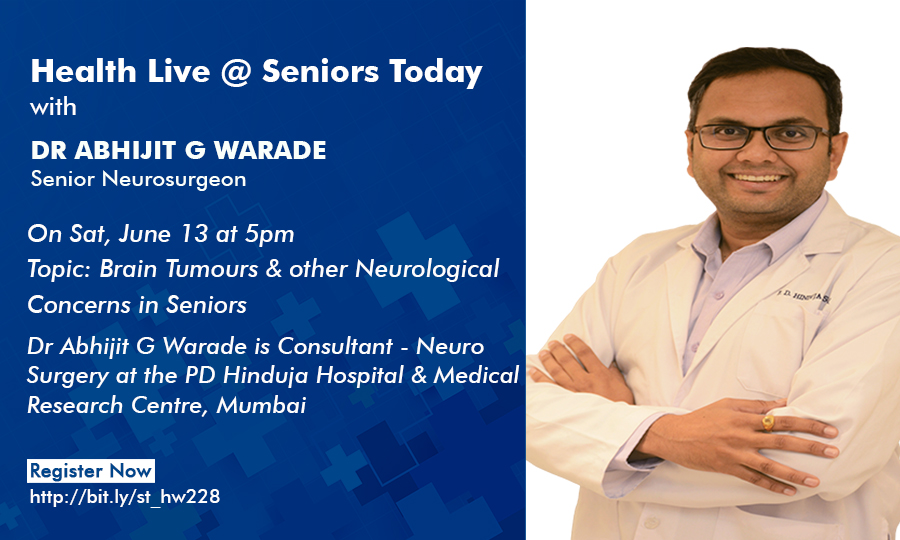
On 13th June 2026, Seniors Today hosted their Weekly Health Live session with Dr Abhijit G Warade, who spoke on and answered questions about Brain Tumours and other Neurological Concerns in Seniors.
Dr Abhijit Warade is a Senior Neurosurgery Consultant at the PD Hinduja Hospital, Mahim and Khar. He has over 20 years of experience in the field of neurosciences and neurosurgery. He has been with the Hinduja hospital for 18 years and before that he was in MIOT Hospital, Chennai. He has also had experience in Spain and Canada. He has authored over 50 international and national publications including journal articles and book chapters. He has delivered numerous podium presentations and served as a sessions chair at fairly coveted national and international conferences.
Awareness has increased amongst the population and the practicing physicians resulting in early diagnosis and timely treatment in the field of neurosciences.
Imaging is more readily available and is being incorporated well into the practice helping us physicians reach a definitive diagnosis sooner.
Early diagnosis helps in prompt treatment and better prognosis.
Glioblastoma multiforme
Glioblastoma multiforme is a type of high grade tumour most commonly seen in the elderly.
Its presentation can start from the third decade of life.
It is a very aggressive tumour with a male predominance.
There are no known risk factors for the disease, i.e. it can happen to anyone and everyone.
The patients can present with
– Sudden onset headache
- Rapid Progression
- Vomiting: usually in the morning
- Weakness in one side of the body: Depending on the size and part of brain affected
- Speech can get affected
- Memory changes
The symptoms also depend on the size of the brain, the affected part and the size of the tumour.
MRI is an investigation of choice.
The only definitive management is surgery followed by post surgery radio and chemotherapy.
Despite these measures the prognosis is not very good.
Primary CNS lymphoma
These comprise a total of 4% of all primary brain tumours.
These are usually seen in the elderly, immunocompetent and in immunocompromised patients – patients on chemotherapy, long standing diseases.
Their presentation is very similar to that of Glioblastoma Multiforme.
MRI is the investigation of choice.
These patients may be started on corticosteroids. This helps in shrinking the size of the tumour.
To confirm the diagnosis a tissue biopsy/ excision needs to be done after stopping steroids. Once the histopathological examination confirms the diagnosis of CNS lymphoma the next line of treatment has started which includes chemotherapy, occasional radiotherapy.
Meningioma
Meningiomas are very slowly growing tumours. They can take anywhere between 4-10 years and often have a late presentation.
There are 3 grades of memingiomas.
Grade 1 meningiomas are most common.
Grade 3 meningioma is the least common but extremely aggressive.
Common presentations are:-
- Headache
- Female predominance
These tumours also have predisposing risk factors which include
- Prior chemotherapy
- Radiation Therapy
- NFT mutations
Meningiomas do not arise from inside the brain. They arise from the arachnoid cells which push the brain parenchyma. It arises from the dura and pushes the brain inside.
Since these are slow growing tumours the management includes regular follow-up every six monthly. In case of increase in size surgical intervention is done.
Pituitary Adenoma
These are tumours which arise from the pituitary gland. These can be functioning or non functioning tumours.
A functioning tumour actively secretes hormones.
Non functioning tumours only cause changes because of size and pressure.
These are two slow growing tumours. Non functioning pituitary adenomas are seen more commonly in the elderly patients.
These tumours have an equal sex distribution.
Presentation may include:-
- Visual disturbances
- Headache
- Hypopituitarism results in deficiency of hormones such as thyroid hormone, corticosteroids
- Fatigue
- Weight gain
Pituitary apoplexy – When the size of the tumour grows big enough such that the blood supply to the tumour is cut off resulting in an infarct of the tumour. Because of this the patients can present with acute and sudden onset headache, unconsciousness, vision loss. It is an emergency and such patients require emergent surgical management.
Vestibular Schwannoma – The presenting complaint includes sudden hearing loss, muffled sounds. It is often ignored in the elderly. These patients will have unilateral sensory neural hearing loss, tinnitus, vertigo, imbalance.
Brain metastasis- Any tumour/ cancer in the body can metastasise and enter the brain, most common being lung metastasis resulting in mets in the brain. In case of a solitary lesion of an operable size, surgery is the best option.