






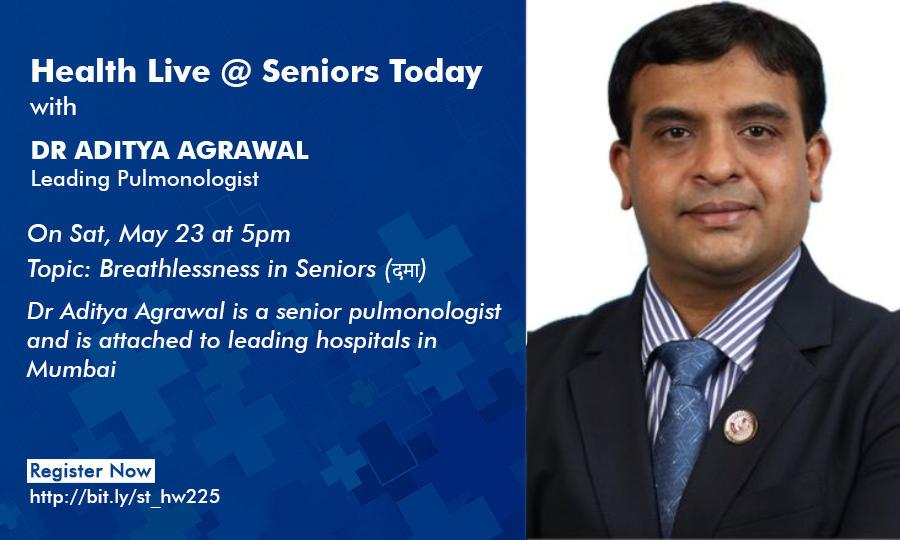
On 23 May, 2026, Seniors Today hosted their Weekly Health Live Webinar with a leading Pulmonologist, Dr Aditya Agrawal who spoke on and answered questions about Breathlessness in Seniors.
Dr Aditya Agrawal is a leading Consultant Pulmonologist attached to several large hospitals in Mumbai. He is extensively trained in respiratory diseases both in India and the US. His special interests are in difficult-to-treat cough, asthma, bronchitis and lung fibrosis, and runs a specialised clinic for patients with chronic cough. He is a dedicated researcher and a peer influencer in the management of respiratory diseases.
Very often, when patients come to the clinic with advanced lung disease, the patient thinks that the onset of the disease is sudden. What the patient does not understand is that they were breathless for a very long time but were not able to understand the manifestation of breathlessness or were not able verbalise the concern. Most patients believe that it is part of the normal process of ageing.
Breathlessness is a warning sign.
Ageing can slow us down a little, but it should not make you breathless on walking, talking, while dressing, walking from room to room, lying on a bed.
Very often, patients with breathlessness adapt rather than reporting their symptoms. Due to this the diagnosis gets delayed and independence shrinks quietly.
Self restriction is most often the first sign of breathlessness.
Air hunger- need for sitting in open air/ under a fan gives the patient a slight relief in his breathlessness.
Breathlessness is called dyspnoea in medical terminology.
It is a symptom and not a disease. It is how a disease presents to you or a doctor.
Just like pain, breathlessness is the body’s alarm signalling something is wrong in the body.
Never treat breathlessness without knowing the cause.
There is no single, correct way to describe breathlessness/ air hunger.
Especially in patients over the age of 60, persistent breathlessness deserves proper evaluation.
Breathlessness is a feeling of discomfort while breathing. Breathing is an effortless task, however when someone is breathless, they make an extra physical effort to breathe and when it becomes uncomfortable, it’s called breathlessness.
The lungs are like elastic balloons and the chest wall ie the ribs, they open up with each breath and shut when you exhale.
When you age, the elasticity of the lungs reduces, the chest wall does not open and close as much. This in addition to other conditions such as a bent spine, obesity- it becomes even worse.
In obese patients, the abdominal fat pushes the diaphragm upwards, not allowing the diaphragm to move down or the lungs to expand with each breath.
With ageing the exercise capacity starts reducing gradually. The heart rate reserve is lower than that of a younger person. And this patient may not be able to tolerate high altitude.
If your body temperature rises by 1°F, your breathing increases by a ratio of 4 and your heart rate increases by a factor of 10.
When you get older, your heart rate does not increase that much and neither does your breathing. This is what makes you uncomfortable and breathless.
As you age:
- Your breathing may slow down
- You may need more pacing on stairs
- You may not be able to walk as fast you could earlier
- High altitudes may result in laborious breathing
Breathlessness is not normal if you get breathless during:
- Walking from your bedroom to your kitchen
- Talking to someone
- Sitting down
- Any breathlessness that wakes you up from sleep
- Gasping
- Lips turning blue
- Swelling on your ankle
- Chest pain
Asthma is so commonly misinterpreted as breathlessness.
Breathlessness in itself is a feeling of difficulty in breathing. You may find your chest to be very tight or you may feel like you have been having unsatisfactory breathing.
Breathlessness is felt in the chest, throat and sometimes in the airways. The patient may say that he/she “cannot get enough air”.
Breathlessness can occur at rest, at night and it can happen with little activity also.
Breathlessness and physical exhaustion are often misinterpreted to be the same. Breathlessness is not fully relieved on rest, however, physical exertion improves with rest, food and sleep.
Breathlessness is often associated with wheezing/ cough/ chest tightness/ swelling in the feet/ palpitations. However physical exhaustion is associated with yawning/ sore muscles and sleepiness.
Breathlessness may actually reflect a serious heart or lung condition that often requires proper medical attention. Physical exhaustion is often not emergent and its persistence requires seeking medical attention.
Normal: A normal person can do some amount of strenuous exercise without feeling breathless.
Grade 1 breathlessness: Breathlessness on climbing a few stair/ uphill climb/ running on flat ground
Grade 2 breathlessness: Breathlessness on walking slower than peers/ stopping after 100m
Grade 3 breathlessness: Stopping after every few minutes of walking on a flat ground
Grade 4 breathlessness: Individual is too breathless to leave home/ breathlessness during activities of daily living, example: bathing, getting dressed. These patients should seek immediate medical help.
Patients who are breathless have been experiencing breathlessness for a very long time and have been avoiding activities that they were otherwise indulging in, such as going to a park/ gym/ temple.
These patient’s pace becomes slower and slower.
These patients adapt themselves to complete adaption atrophy where their movement is restricted to being in the bed/ chair and they only go to the bathroom to do essential chores.
Most common causes of breathlessness in elderly:
- Asthma
- COPD
These patients may also complain of wheezing, cough with a whistling note
- Heart failure, other problems of the heart- these patients may complain of breathlessness on lying down flat, swelling in feet, ghabrahat
- Sleep apnoea
- Iron deficiency anemia
- Obesity
- Interstitial lung disease/ fibrosis- these patients may complain of dry cough, progressive exertional breathlessness
- Sleep disorder breathing
- Anxiety related disorders
Indicators of progressive pulmonary fibrosis:
- Persistent dry cough
- Exertion on walking
- Progressively worsening breathlessness
- Reduced oxygen after physical activity
Danger signs with breathlessness:
- chest pain
- Fainting/ dizziness
- Palpitations/ ghabrahat
- Breathlessness on walking/ talking or even on rest
- New swelling in ankles
- Blue lips/ fingers
- Very low oxygen reading in the pulse oximeter
- Waking up gasping of bed
- Inability to lie flat on bed
- Sudden, severe breathlessness within hours to days
If you see any of the above signs, you should seek immediate medical attention
The doctor will take your history, followed by your blood investigations such as CBC, chest x ray, ECG, pulmonary function test, spirometer, 2 D ECHO, 6 min walk test
After a clinical diagnosis is made, the doctor may do some advance testing to back up his initial clinical diagnosis where he may order a CT scan of the chest, sleep study, diffusion testing ( for patients with fibrosis), cardiopulmonary test.