


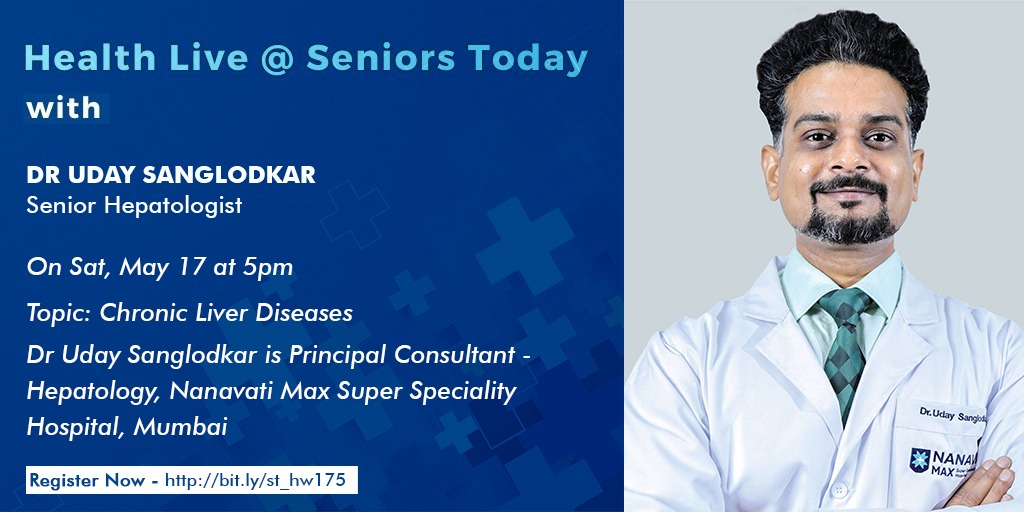
On 18 May 2025, Senior Today hosted their weekly Health Live Webinar with Dr Uday Sanglodkar who spoke on and answered questions about chronic liver diseases.
Dr Uday Sanglodkar is the Principal Consultant Hepatology at the Nanavati Max Institute of Liver, Intestine and Pancreas Sciences, Mumbai. Before this he was a Senior Consultant Hepatology and Clinical Lead of the Liver Intensive Care Unit at the Global Hospital, Mumbai. He was Registrar at Medical Gastrology, Glen Eagles Hospital, Chennai. He has done his MBBS at Amravati Medical College and his DNB in Medicine from BARC, Mumbai and super specialisation in Medical Gastroenterology from the Glen Eagles Hospital, Chennai. He has won a fair number of awards. He is a member of some of the key associations in the medical fraternity. His special interests are in chronic liver diseases, pre and post liver transplant, management of acute liver failure and acute on chronic liver failure and management of hepatobiliary malignancies.
The liver is the 2nd largest organ in the body and it performs over 500 functions in a day, which include:
- Storage of protein
- Metabolism of proteins, carbohydrates, lipids
- Maintains the viscosity of the blood
- Secretion of bile juices
- All food items, including medicines go through the liver
The liver is a precious organ, if there is even the slightest problem in the liver, the functioning of other organs also starts to get affected.
Fatty liver is nothing but accumulation/ deposition of fat in a normal, healthy in colour which is usually greyish- pinkish in colour becomes dark yellow.
This is seen in 30% of the normal population.
People who consume alcohol on the regular, their liver enzymes and function tests go back to normal as soon as they stop consuming alcohol.
However, those who do not drink, or have never consumed alcohol directly present at the age of 65- 70 years. This is also because such patients tend to not have themselves scanned for fatty liver.
The natural course of fatty liver is such that if a patient goes undiagnosed, the patient directly lands up in a stage of cirrhosis which is an irreversible stage.
Cirrhosis happens after 5-10 years of persistent fatty liver, if not intervened correctly and timely.
No alcoholic steatosis (NASH) is more common. This if continued for a long duration causes hardening of the liver, called fibrosis.
The next stage is cirrhosis.
Out of 100 patients, 15 may develop cirrhosis over a time of 10- 15 years.
Cirrhosis is not a reversible or treatable stage. This is the end stage liver disease. Which means that the best precaution is prevention.
The following individuals should have themselves tested for fatty liver:
- Patients with diabetes
- Patients with hypertension
- Patients with dyslipidemia
- Patients with thyroid disorders
- Obese individuals with a BMI over 30 kg/m2 and waist circumference more than 90 cm for men and more than 80 cm for women
- Strong family history of liver cirrhosis/ hepatocellular carcinoma
Tests for fatty liver include:
- Complete blood count
- Liver function test
- Renal function test
- Blood sugar levels, HbA1c
- Lipid profile
- Thyroid function test
- Ultrasonography- however it is not a good investigation to detect fibrosis
- Fibroscan
- MR Elastography
Fatty liver is also an indirect indicator of otters issues that might be prevailing in your other systems. Which is why you should also screen your heart, kidneys, eyes and bones.
There are no symptoms of fatty liver. It is usually an incidental finding.
You only develop symptoms when you develop liver cirrhosis, which are:
- Ascites, which is accumulation of fluid in the abdomen/ peritoneum
- Bleeding
- Hampered blood supply to the liver
- Oesophageal varices- life- threatening complication
- Encephalopathy
- Significant weight loss
Cirrhosis is also called Chronic Liver Disease.
There is no treatment for liver cirrhosis. Whatever treatment is given to the patient is given to prevent the complications associated with the disease.
The permanent solution is a liver transplant.