






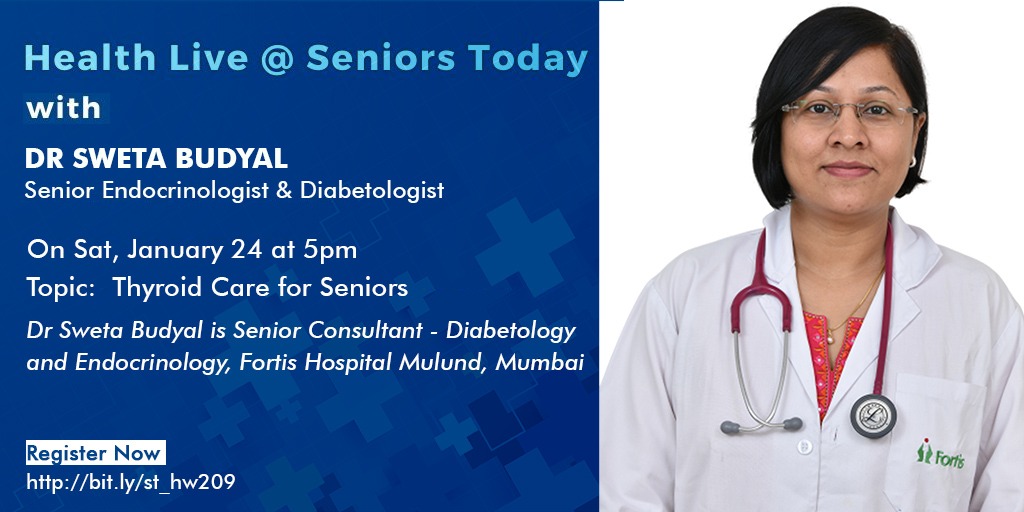
On 24 Jan, 2026, Seniors Today hosted their weekly Health Live Webinar with a Senior Endocrinologist & Diabetologist Dr Sweta Budyal who spoke on and answered questions on Thyroid Care for Seniors. This week’s session was conducted as part of the Thyroid Awareness Month which is observed in January 2026.
Dr Budyal is a Consultant Endocrinologist and Diabetologist based in Mumbai, with over 12 years of clinical experience in managing complex hormonal and metabolic disorders. She completed her MBBS from Lokmanya Tilak Municipal Medical College, Sion, Mumbai, in 2006, followed by a DM in Endocrinology from King Edward Memorial Hospital and Seth Gordhandas Sunderdas Medical College in 2013. She further pursued a Fellowship in Bariatric Medicine from the University of Ottawa, Canada, in 2016. Dr Budyal’s clinical expertise spans a wide range of endocrine conditions, including pituitary disorders, osteoporosis, PCOD/PCOS, parathyroid diseases, adrenal disorders, and diabetes management. With a strong focus on evidence-based and patient-centric care, she is known for delivering comprehensive treatment plans tailored to individual patient needs.
In the present time and day, thyroid function tests have become a part of our routine evaluation and check ups. Oftentimes, we do come across a deranged/ abnormal report which causes a great deal of anxiety. So it’s always better to know what the thyroid gland is, what are its functions?
A thyroid gland is a small, butterfly shaped gland- the size of our thumb.
It’s located at the base of our neck in the front.
The gland produces hormones which are- Tri-iodothyronine (T3) and Thyroxine (T4). Like all other endocrine glands in the body, the hormones are poured directly into the blood stream, from where they reach all the organs and parts and cells of our body.
Every cell, organ in our body requires the thyroid hormone for proper functioning of the body.
The thyroid gland is under the control of the pituitary gland, like all other endocrine glands. The pituitary gland is located at the base of our brain and is called the “master endocrine gland”. It controls the TSH and also how much thyroid hormones should be produced under different conditions- normal circumstances, physically/ mentally/ emotionally distressing situations.
5-10% of the general population may have thyroid disorders. They are common but they can all be early detected and adequately treated. Some patients may require more advanced testing in the form of ultrasonography of the thyroid gland.
These hormones bind with two specific receptors anywhere and everywhere in our body. The primary function is to:
- Regulate the metabolism- carbohydrate- protein, fat metabolism
- Regulate our body weight
- Amount of fat storage
- They also regulate the way our bones function. They have a role to play in calcium metabolism
- In women, thyroid hormones play a very important role in reproductive health. Thyroid hormones are required for normal fertility, pregnancy, etc.
- Thyroid is also required for the normal functioning of the heart, brain.
When thyroid hormone is created in abnormal quantities due to any reason patients present with a different variety of symptoms.
Thyroid disorders are broadly classified into 2 categories:
- Related to functioning of the gland
- Related to the structure of the gland
Disorders which are related to the production of the hormones are called:
- Hypothyroidism: under functioning thyroid gland.
- It’s more commonly seen in women.
- Patients can present with a variety of specific and non-specific symptoms. The primary symptoms of hypothyroidism are:
- Unexplained weight gain
- Hairloss
- Irregular periods
- Fertility issues
- Cold intolerance
- Brittle nails
- They can also cause changes to our blood sugar levels
- When the degree of hypothyroidism is very severe, they can also impact the functioning of our heart, kidneys, liver etc.. This can cause the patient to have a deranged lipid profile, low heart rates, heart blocks, depression, anxiety, low mood. There can also be fluid accumulation in the body, resulting in oedema
- If the hypothyroidism is very severe and untreated, in case of a severely stressful situation such as a surgery the patient can slip into something called the “myxoedema coma”, which can be life threatening.
- Any form/ severity of hypothyroidism is amenable to treatment. The tablet available is Tab. Thyroxine, it is the T4 hormone in the form of a pill.
- The treatment is long term.
- If we regularly monitor the TSH in a patient with hypothyroidism/ under active thyroid gland and keep it within the normal limits admissible for the age of the patient, the medication has zero side effects. It has to however be taken for a long term.
- When a lady is pregnant, the requirement of the hormone increases because the thyroid hormone is transferred across the placenta to the baby. During pregnancy, the requirement of the thyroid hormone is high because the baby does not produce thyroid hormone in appropriate amounts for his own body for the first 5 months. If the mother is not treated well, it can impact the foetal and neonatal outcome- increased risk of miscarriages, the baby may also lose out on IQ points.
- If you are planning for a pregnancy, and have hypothyroidism, it is important that your TSH levels are below 2.5 before you start planning and there have to be regular follow ups and monitoring during the pregnancy.
- An under active thyroid gland in most cases is caused due to auto immune disorders such as Hashimoto’s thyroiditis- your own immune system keeps reacting against the thyroid gland and the thyroid gland shrinks, undergoes fibrosis and scarring.
- Other causes include:
- Iodine deficiency
- In children, it can be congenital- all babies should be evaluated/ screened on day 3 of life. Congenital hypothyroidism is the most common cause for preventable mental retardation. The thyroid hormone is extremely important for the normal development of the child, especially in the first 3 years.
2. Hyperthyroidism: hyper active thyroid gland. The symptoms are exactly the opposite. Patients with hyperthyroidism present with more dramatic signs and symptoms like:
- Palpitations
- Excessive sweating
- Dramatic weight loss
- Anxiety, panic attacks
- Heat intolerance
- Irregular periods
- Osteoporosis
- Hair loss
- When the severity is high, much like hypothyroidism, it can affect various organs
- The most dreaded complication is a thyroid storm
- Hyperthyroidism is also treatable. Hyperthyroidism in most patients is treated with antithyroid medications. Depending on the root cause of hyperthyroidism, the duration of the treatment differs.
- Causes for hyperthyroidism:
- Grave’s disease: autoimmune disorder wherein the immune system attacks the thyroid gland and makes it hyperactive, more vascular resulting in production of way more hormones than what the body requires. It typically requires treatment with anti thyroid medicines for a few years
- Multi nodular goitre
- Single nodular goitre: a single nodule which is over functioning
- The duration and type of treatment is dependent on the cause for hyperthyroidism and can be completely treated in some cases either with radioactive iodine treatment or surgery.
Disorders which are related to the structure of the thyroid gland are:
- Thyroid nodules: as we age, we are prone to developing thyroid nodules which are actually tumours/ bumps in our thyroid gland and majority of the times, these are benign ie non cancerous. Any person who has thyroid nodules requires a systematic work up to see the nature of the nodules. They may require a procedure called FNAC which is a fine needle biopsy or a radio- nucleotide scan. Based on the results of the investigations, it is decided if the further course of treatment will be in crude surveillance or surgery.
- Thyroid cancers: most of the patients detected with thyroid cancer early can be cured and the prognosis is very good. However they require rigorous monitoring and may require radioactive iodine treatment.
The thyroid disorders though common are early detectable and efficiently treatable disorders.