







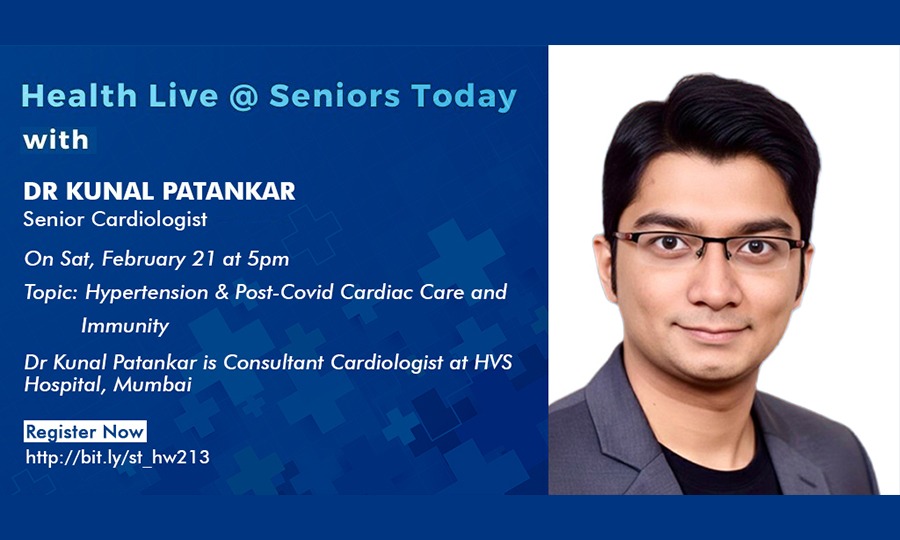
Seniors Today hosted their weekly Health Live Webinar with a Consultant Cardiologist, Dr Kunal Patankar who spoke on and answered questions about Hypertension and Post COVID Cardiac Care and Immunity.
About Dr Kunal Patankar
Dr Kunal Patankar is an Interventional Cardiologist in Mumbai, known for combining clinical excellence with patient centred care. He is trained at the Grant Medical College, Sir JJ group of hospitals, NKP Salve Institute of Medical Sciences, Nagpur and PD Hinduja Hospital and medical research Centre in Mumbai. His training has equipped him with handling a variety of complex cardiovascular conditions using contemporary medical techniques. Apart from his medical knowledge, he also stands out for his ability to simplify complex heart health concepts to patients and families. He is a consultant and interventional cardiologist in the dept of cardiology at the HVS Symbiosis Super Speciality Hospital in Mumbai, which is now a chain of hospitals.
- You might be young at heart, but the body does age and so does the mechanism of the heart to pump the blood, too.
- Our blood vessels are elastic in nature when you are young. They have the property of elasticity that helps them expand and and recoil as per the blood pressure of your body.
- As we grow old, a process called athero- arteriosclerosis. Atherosclerosis is the deposition of lipids/ cholesterol inside your blood vessels- this can cause blockages. Stiffening of the elasticity of your blood vessels is called arteriosclerosis.
- In arteriosclerosis, your flexible blood vessels/ pipes start becoming stiff. Whenever there are fluctuations in your blood pressure, your blood vessels will lose their ability to adapt. Hence, eventually leading to increased risk of hypertension.
- Hypertension is inevitable fir mist, as they age. But at the same time treating it aggressively by a cardiologist becomes a point of concern- since a sudden and/ or significant drop in your blood pressure can also cause a dreadful complication in the elderly- a fall.
- A fall in elderly is the most common accident and can lead to fractures, injuries, etc.
- The LSAI Study (Longitudinal Study of Ageing in India) has found that more than 40% of the people above the of 65 fall into the pre hypertensive group. 22 % in stage 1 hypertension and approximately 10% in Stage 2. A deduction can be made from the study that approximately more than 50% of the people are hypertensive but are not being treated, or if being treated, are not getting adequate treatment for the same.
- As you age, because of the process of arteriosclerosis and atherosclerosis, the vessels become stiff. If your blood pressure is not controlled, it puts an indirect pressure on the heart, causing it to work harder to pump the same blood, taking more effort 24 x 7.
- It can also cause end organ damage. This can result in a stroke, kidney disease, etc.
- This is how, slowly yet steadily the cost of uncontrolled pressure can be very high in the long run.
- Sometimes, even microvascular strokes in the brain can cause dementia. Or even a major stroke resulting in paralysis.
- If you are hypertensive, you have to monitor your kidneys, brain, eyes and heart.
– Heart: 2D ECHO should be done, either annually or once in 2 years
– Kidneys: Serum creatinine and USG for KUB
– Eyes: look out for any diminished vision, retinopathies
- Ageing does not equal disease. If you start ageing with disease, it reduces the compliance and also reduces your (patient’s) motivation.
- We also need to reduce our dependence on symptoms. In Indian society, we do not screen for diseases, we wait for the symptoms to appear. No symptoms does not always mean being safe. A screening test is done essentially to catch a problem, before they start causing damage that is irreversible.
- Medication for chronic illnesses such as hypertension, diabetes, hypothyroidism, dyslipidemia should not be treated as a “course medication”. If after taking any of these medications, you get a good control, please do not discontinue taking those medications. Good control with medication means that the medicines are working along with your definite lifestyle modifications. But they do not give you the freedom to stop your medication at will, without any consultation.
- Isolated sodium restriction is not the only dietary modification that you need to make. There are many other food items in your kitchen that need to be restricted as well, such as papad, pickles, and processed food items.
- Sodium directly absorbs excessive water from the kidneys, eventually leading to a high blood pressure inside your body.
- This does not mean that you have bland food. However, you need to avoid table salt, avoid adding extra salt to your food, and avoid preserved food items.
- The DASH Diet (Dietary Approaches to Stop Hypertension) tells you that if you decrease your sodium intake and at the other end, increase your potassium (potassium rich foods- kiwi, banana, etc.), calcium and magnesium intake.
- Potassium helps remove sodium from the body and at the same time helps relax your blood vessels causing them to relax and bring down your blood pressure.
- You can take 2 gms of sodium in a day. In a hypertensive patient, it is 1.5 gms.
- In measurable terms, 1 teaspoon of salt is enough for your daily intake.
- A balanced diet is advised, with 30% carbohydrates, 30% protein, 30% fats and 10% fibre- is a good diet for everyone to follow. Moderation is key.
- In ayurveda, when you take a herb in the form of a medication, you are consuming the chemical form of the active ingredient.
- In allopathy, that same active is used or is mimicked for making allopathic medications. You cannot use both allopathy and ayurveda together. This is dangerous.
- For example, ashwagandha which is the most commonly used ayurvedic drug. It is a well known stress modulator, neuroprotector, that enhances response. There is an enzyme in the liver known as the P450 which helps modulate the allopathy medicines you might take. If you are on ashwagandha and also taking any blood thinners (warfarin)/ cardiac medicines, the ashwagandha modulation speeds up the enzyme resulting in the dose of warfarin being sub therapeutic. In case of Digoxin, it can slow down the absorption and clearing of the drug resulting in digoxin toxicity.