






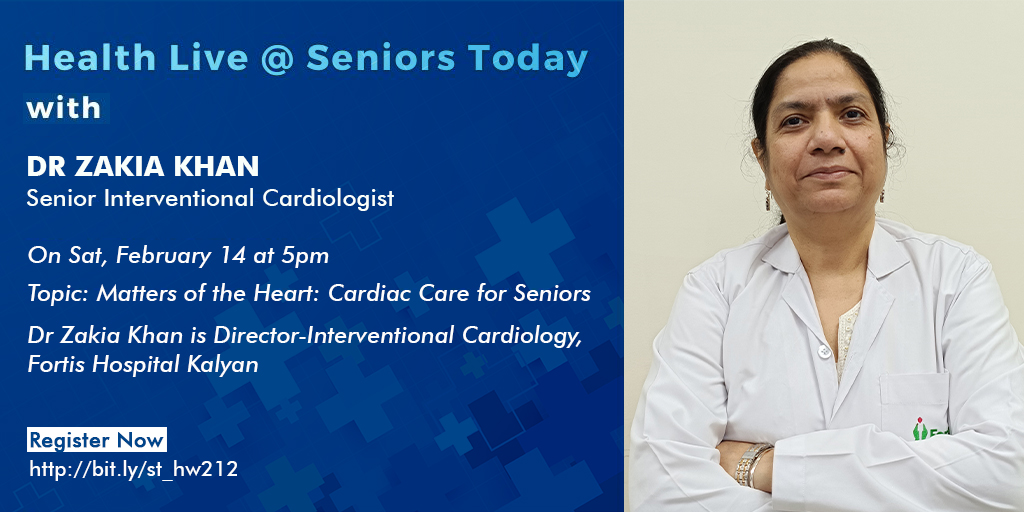
On 14 Feb, 2026, Seniors Today hosted their weekly Health Live Webinar with Dr Zakia Khan, Director- Interventional Cardiology, who spoke on and answered questions about Matters of Heart: Cardiac Care for Seniors.
Dr Zakia Khan is a senior interventional cardiologist. She is one of the first woman interventional cardiologists in Maharashtra and Mumbai region. She is currently the head of Cardiology Department and Cath Lab at Fortis Hospital in Kalyan. The centre is the first in the region to offer angioplasty in acute heart attack and cardiogenic shock patients. It also offers comprehensive treatments like pacemaker insertions. She has been educated at the Grant Medical College, Mumbai. She was awarded “the legend of cardiology” by the Economic Times in 2022. Her areas of expertise include clinical, non-invasive and invasive cardiology procedures with an encompassing experience of more than 30 years. She has treated a large number of acute myocardial infarction cases and cardiac emergencies.
In India we are now seeing that the number of patients with heart diseases are increasing by leaps and bounds. The number of heart patients has doubled in the last 10 years.
Not just that, our patients are also getting a decade younger i.e. a heart disease which may present itself in a western ethnicity individual at the age of 60 or 70 years of age, is presenting in Indians 10 years earlier.
One of the important causes for this is that diabetes is a risk factor for cardiac disease and India is sadly the Diabetes capital of the world.
The number of people with heart disease are increasing because the number of diabetics are increasing.
Our lifestyle is changing drastically. We are becoming more sedentary in our lifestyle than active. We have started consuming larger quantities of fast foods as compared to before. This is resulting in a high number of youngsters developing cardiac disease.
Heart is the central organ that pumps blood to all the other organs and supplies blood to the entire body, including the heart itself.
Coronary arteries are small arteries that supply blood to the heart. Heart attack is the disease pertaining to these vessels.
Atherosclerosis is the process of fat deposition in their vessels. This fat deposition starts occurring in the vessel wall and increases with time. A time comes when the artery becomes entirely occluded, thereby cutting the entire blood supply.
When this happens, the darkening area is the area with restricted blood supply ie the area of impending heart attack. The area supplied by the occluded artery gets damaged. Permanent damage sets in within 6 hours. If not death at the earliest, in an emergency then you are dealing with a damaged heart forever.
The procedure done is called primary angioplasty. The cardiologist goes into the artery, opens it with a balloon and puts a mesh like structure called the stent- this prevents recoil of the artery and reestablishes the flow.
According to international guidelines, it should be done within 90 minutes following a heart attack so that you save the heart.
In heart disease and especially in heart attacks, it’s said that “time is muscle”, which means, the more time you waste, more the muscle gets damaged and more the muscle damaged means that the pumping power of the heart gets poor which is a poor long term outcome for the patient.
Everything is done quickly and simultaneously as a team approach.
Bypass surgery is done when you have multiple blocks. Surgeons bypass the blocks to perform the angioplasty.
The risk of cardiac diseases is higher in the younger population in our country.
With the life expectancy increasing, we not only see the you get population but also the elderly population that comes with a heart attack.
Most of the patient have the following symptoms before they have a heart attack:
- Chest pain on exertion
- Breathing difficulties
- Unusual difficulty in breathing on otherwise routine activities
- Sudden fainting
- First time presentation of a heart attack can even be sudden death
Risk factors for heart disease:
- Diabetes
- High/ uncontrolled blood pressure
- High cholesterol
- Tobacco consumption in any form
- Obesity
- Physical inactivity
- Stress
- Premature coronary heart disease in the family
- Advancing age
- Male > females
The majority of heart disease patients are treated with drugs called “statins” to reduce the cholesterol levels in a heart patient.
Your heart health lies in your gums. If you have chronically inflamed gums, they are a marker of heart disease. This is because the enzymes released by the bacteria in the gums can travel to the heart and damage a vessel wall.
Tobacco in any form is bad. It causes lipid abnormalities, increases the risk of clotting, and increases the blood pressure.
Passive smoking is just as harmful and should be prevented.
Diabetes has to be well controlled because uncontrolled blood sugar levels increase the risk of blockage, increases the blood pressure and affects all target organs of the body- heart, brain, eyes.