






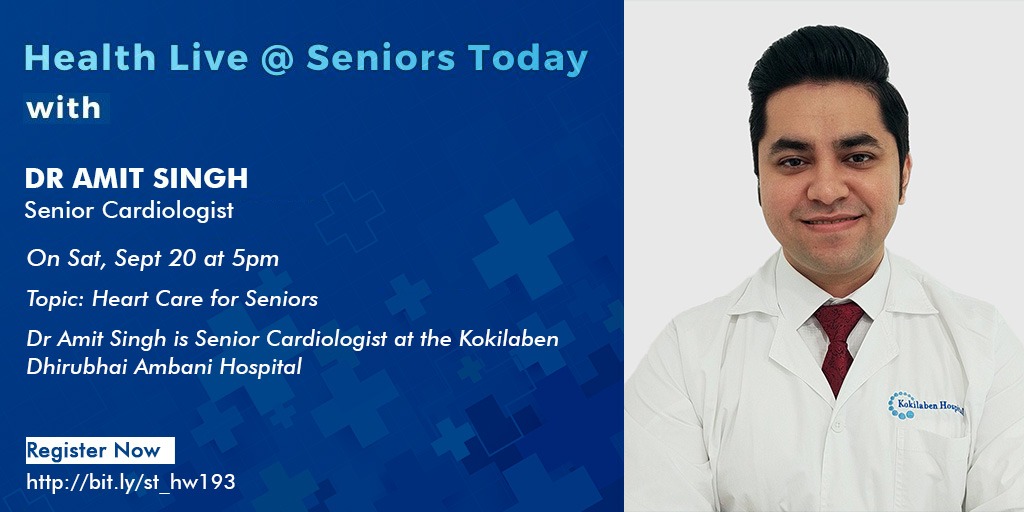
On 20 September, 2025, Seniors Today hosted their weekly Health Live Webinar with a Senior Interventional Cardiologist, Dr Amit Singh who spoke on and answered questions about Heart Care for Seniors on the occasion of World Heart Day which is observed on 29 September.
Dr Amit Singh is Senior Interventional Cardiologist and Heart failure specialist at the Kokilaben Dhirubhai Ambani Hospital. He is at the forefront of cardiac healthcare in the Mumbai metropolitan region. He’s trained at St. GS Medical College at KEM Hospital. His expertise is in interventional cardiology and management of heart failure patients.
Prevention is better than cure. Fitness will help you in the long run.
Being healthy is not just merely the absence of a disease. A healthy individual is one who is physically, mentally, emotionally and socially healthy as well.
The holy 4 to keep your heart healthy:
- Nutrition
- Physical activity
- Staying away from bad addiction such as smoking
- Avoid drinking
Even after making the necessary lifestyle and behavioural modifications, we can only reduce the risk of developing a heart disease but never reduce it to an absolute zero. This is because there are some risk factors which are non modifiable and cannot be changed. These non modifiable risk factors include:
- Age
- Gender
- Ethnicity: South East Asian population has the highest risk of developing a heart disease in the entire world
- Genetic make up
- Hereditary
But we can take care of a few things to lower our risk of developing a heart disease. These include:
- Maintaining your cholesterol levels
- Maintaining your blood pressure
- Maintaining your ideal body weight
- Eating a healthy and nutritious diet
- Stay away from addictions such as tobacco, alcohol
- Stay physically active
You should undergo an annual health checkup and know your- cholesterol and triglyceride levels, your baseline blood pressure, your blood sugar levels, your Body Mass Index (BMI),
- You would exercise for a minimum 30 minutes a day for at least 5 days a week. This means you should do at least 150 minutes of moderate intensity exercises for at least 5 days in a week.
- Moderate intensity exercises include brisk walking.
Heart healthy habits include:
- Nutritious, healthy diet
- Physical activity and maintaining your ideal body weight
- Avoiding addictions such as with tobacco, alcohol
- Sleep
If you quit smoking, you not only reduce the risk of heart disease but also the risks of developing various types of cancers such as lung cancer, oral cancer and other diseases such as emphysema and bronchitis.
If you plan on quitting smoking, you can do so in the following ways:
- Keep yourself busy
- Stay motivated
- Family and friends support
- Join de-addiction groups
- Take help from medical professionals in the way of nicotine patches, anti- craving medications
- Your diet needs to be tailor-made for your body’s nutritional requirements. Make small sustainable changes in your diet so you can maintain a healthy and nutritious diet.
- A healthy diet includes a colourful plate and the portion of each colour should be nearly the same. This only goes down to mean that you require equal amounts of carbohydrates, fats, and proteins in your daily diet.
- Your plate should include a healthy amount of fruits, vegetables, protein, and grains.
- Switch from full fat milk to toned milk.
- An Indian consumes three times more than the daily required salt intake i.e. 9 gm per day as compared to other countries where their daily consumption of salt/ sodium is between 2.5 to 3 g.
- Stop adding salt additionally on your tables
- Switch from regular salt to low sodium salt
- Just a simple substitutions make a big difference in your diet and make it a nutritious and balanced one
- Children should not be given pink salt or rock salt since it lacks iodine and can result in iodine deficiency in children. The white salt which is available in the market in India is fortified with iodine. Rock salt has the same amount of sodium as a regular salt.
- If you are hypertensive pink salt and rock salt are not an option for you you need to replace your salt with low sodium salt
- You need to stay away from simple carbohydrates such as sugar, fruit juices, etc. since it causes a sudden spike in the insulin levels. You should take complex carbohydrates. Sugar-free substitutes are safe for consumption.
- Add whole grains such as millets, wheat in your diet.
- Non-polished rice should be preferred over polished rice since it contains more fibre content.
- For protein, you need to have eggs. If you follow a vegetarian diet you can substitute it with soya bean, paneer.
- Consumption of any oil in excess is bad and consumption of all oils in moderation is advised.
- If you’re taking a regular balance date, you do not need omega-3 supplements.