







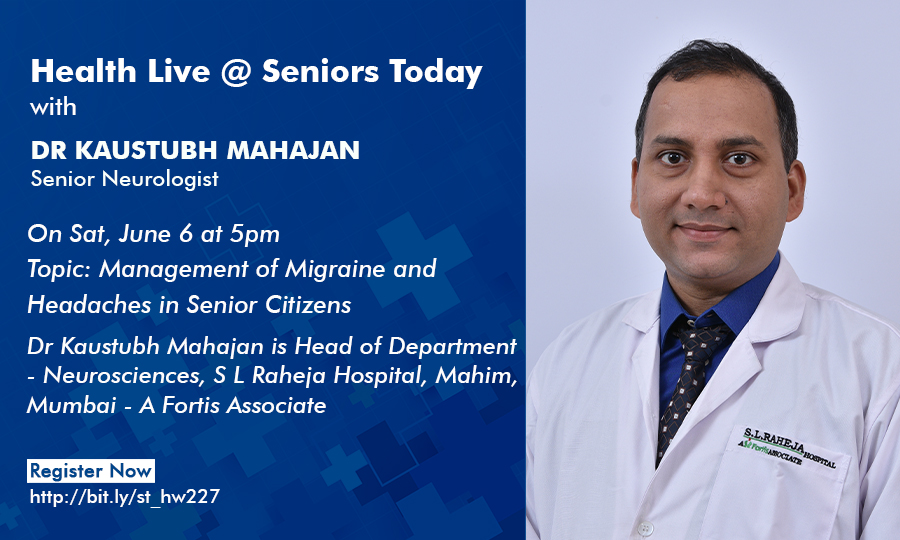
On 06 Jun, 2026, Seniors Today hosted their weekly Health Live Webinar with Dr Kaustabh Mahajan a Senior Neurologist who spoke on and answered questions about the Management of Migraine and headaches in Senior Citizens.
Dr Kaustab Mahajan is a well known Neurologist with experience of nearly 2 decades in the field. He is the Head of Department of Neuro Sciences at the SL Raheja (?), Hospital, Maheem, which is a Fortis Group of Hospitals Associate.
He completed his MBBS and post graduation from St. GS Medical College, which is attached to the KEM Hospital, Parel, Mumbai. He also then did his DM in Neurology subsequently. He is also a member of the prestigious American Academy of Neurology, IMA, MCI and the Neurological Society of India. He specialises in headache, stroke care, movement disorders and epilepsy.
Migraine is more common in the younger age groups, and as you grow old the frequency of migraines decreases.
Other/ secondary causes of headaches are more common in the senior age groups.
Headache management over the age of 60 is important. It also helps us differentiate between benign and malignant headaches and how to deal with them.
Primary headache is any headache where there is no obvious cause which is structural or organic such as- tumor, bleeding, clots.
In primary headaches we expect the MRI, CT scan and other imaging modalities to be normal.
Secondary headaches are secondary to any other cause such as a stroke, tumor, bleeding site.
Any headache over 50 years of age which has presented itself for the first time, even if it is mild in intensity, is considered a red flag and requires further investigation.
These headaches can most likely be secondary.
Headaches are common at any age, but new onset headaches over the age of 50 requires further evaluation.
As the age increases, the chances of secondary headaches increases.
These headaches can be vision and even life threatening.
Early diagnosis of secondary headaches helps save lives.
Secondary headaches can be very catastrophic and cannot be labeled as migraines and ignored.
The red flags in a headache:
Any new onset headache over the age of 50
Recurrent headaches with increasing frequency
Change in headache pattern
Waking up from headache
If the patient has had such headaches in the past and also has triggers such as:
Lack of sleep
Lack of food/
Lack of caffeinated food items causing headaches
Any other trigger
If any of the above are present, it is very likely that the headache is migraine headache.
Migraine can never start at the age of 60. It has a younger age onset and continues into adulthood/ senior age group.
Migraine is a trigger based headache.
Causes of Primary/ benign headaches:
Migraine: most common cause
Tension headache
Cluster headaches
Causes for Secondary Headaches:
Stroke: especially if it is hemorrhagic, the pain will be sudden and progressively worsening
Tumor: depends on the site of the tumor, whether it is increasing rapidly, presence of any hemorrhage inside tumor
Giant cell arthritis
Meningitis: severe brain infection, this also be associated with high grade fever. If left untreated the patient may become drowsy and confused.
Intracranial hemorrhage
High blood pressure: the first thing that can be done if you have a head ache, is check your blood pressure and if the blood pressure is very high, then bringing the BP down makes sense and will also help in relieving the headache
If your blood pressure is high and you have headache with focal neurological deficit, like slurring of speech, unsteady gait, etc. this is a very important red flag where an impending bleed in the brain has to be ruled out by imaging after consulting a neurologist.
Classic migraine features:
Unilateral headaches
Pulsating type
Moderate to severe in intensity
Associated with nausea, vomiting
Signs of hypersensitivity- photophobia and phonophobia ie when a person is going through a migraine attack, very commonly these individuals also become severely sensitive to bright light and loud sound. This can also be to strong smells, movement, etc.
Aura may occur before headache
Aura may also occur without headache, this is called acephalgic headache.
A headache should be cause for concern if:
Systemic symptoms: headache associated with symptoms of fever, weight loss, HIV, etc. Pre-existing chronic condition PS such as SLE, rheumatoid arthritis.
Neurological deficit: any slurred speech, visual blurring, weakness in any limb / side
Sudden onset. Described as “worst headache of life”
Old age
Pattern change of headache
The most commonly seen headache in the elderly, after 50 years of age is due to Giant Cell Arthritis also known as Temporal Arthritis. It can commonly be confused for a migraine headache.
This headache is also one sided
A common feature that helps us differentiate between Temporal Arthritis and Migraine is presence of visual blurring/ disturbance on the side of the inflamed artery, this type of headache also increases with chewing/ jaw movement- this is due to jaw claudication.
This headache requires immediate treatment with steroids. They respond very well to treatment.
If left untrOn 06 Jun, 2026, Seniors Today hosted their weekly Health Live Webinar with Dr Kaustab Mahajan a Senior Neurologist who spoke on and answered questions about the Management of Migraine and headaches in Senior Citizens.
Dr Kaustab Mahajan is a well known Neurologist with experience of nearly 2 decades in the field. He is the Head of Department of Neuro Sciences at the SL Raheja (?), Hospital, Maheem, which is a Fortis Group of Hospitals Associate.
He completed his MBBS and post graduation from St. GS Medical College, which is attached to the KEM Hospital, Parel, Mumbai. He also then did his DM in Neurology subsequently. He is also a member of the prestigious American Academy of Neurology, IMA, MCI and the Neurological Society of India. He specialises in headache, stroke care, movement disorders and epilepsy.
Migraine is more common in the younger age groups, and as you grow old the frequency of migraines decreases.
Other/ secondary causes of headaches are more common in the senior age groups.
Headache management over the age of 60 is important. It also helps us differentiate between benign and malignant headaches and how to deal with them.
Primary headache is any headache where there is no obvious cause which is structural or organic such as- tumor, bleeding, clots.
In primary headaches we expect the MRI, CT scan and other imaging modalities to be normal.
Secondary headaches are secondary to any other cause such as a stroke, tumor, bleeding site.
Any headache over 50 years of age which has presented itself for the first time, even if it is mild in intensity, is considered a red flag and requires further investigation.
These headaches can most likely be secondary.
Headaches are common at any age, but new onset headaches over the age of 50 requires further evaluation.
As the age increases, the chances of secondary headaches increases.
These headaches can be vision and even life threatening.
Early diagnosis of secondary headaches helps save lives.
Secondary headaches can be very catastrophic and cannot be labeled as migraines and ignored.
The red flags in a headache:
Any new onset headache over the age of 50
Recurrent headaches with increasing frequency
Change in headache pattern
Waking up from headache
If the patient has had such headaches in the past and also has triggers such as:
Lack of sleep
Lack of food/
Lack of caffeinated food items causing headaches
Any other trigger
If any of the above are present, it is very likely that the headache is migraine headache.
Migraine can never start at the age of 60. It has a younger age onset and continues into adulthood/ senior age group.
Migraine is a trigger based headache.
Causes of Primary/ benign headaches:
Migraine: most common cause
Tension headache
Cluster headaches
Causes for Secondary Headaches:
Stroke: especially if it is hemorrhagic, the pain will be sudden and progressively worsening
Tumor: depends on the site of the tumor, whether it is increasing rapidly, presence of any hemorrhage inside tumor
Giant cell arthritis
Meningitis: severe brain infection, this also be associated with high grade fever. If left untreated the patient may become drowsy and confused.
Intracranial hemorrhage
High blood pressure: the first thing that can be done if you have a head ache, is check your blood pressure and if the blood pressure is very high, then bringing the BP down makes sense and will also help in relieving the headache
If your blood pressure is high and you have headache with focal neurological deficit, like slurring of speech, unsteady gait, etc. this is a very important red flag where an impending bleed in the brain has to be ruled out by imaging after consulting a neurologist.
Classic migraine features:
Unilateral headaches
Pulsating type
Moderate to severe in intensity
Associated with nausea, vomiting
Signs of hypersensitivity- photophobia and phonophobia ie when a person is going through a migraine attack, very commonly these individuals also become severely sensitive to bright light and loud sound. This can also be to strong smells, movement, etc.
Aura may occur before headache
Aura may also occur without headache, this is called acephalgic headache.
A headache should be cause for concern if:
Systemic symptoms: headache associated with symptoms of fever, weight loss, HIV, etc. Pre-existing chronic condition PS such as SLE, rheumatoid arthritis.
Neurological deficit: any slurred speech, visual blurring, weakness in any limb / side
Sudden onset. Described as “worst headache of life”
Old age
Pattern change of headache
The most commonly seen headache in the elderly, after 50 years of age is due to Giant Cell Arthritis also known as Temporal Arthritis. It can commonly be confused for a migraine headache.
This headache is also one sided
A common feature that helps us differentiate between Temporal Arthritis and Migraine is presence of visual blurring/ disturbance on the side of the inflamed artery, this type of headache also increases with chewing/ jaw movement- this is due to jaw claudication.
This headache requires immediate treatment with steroids. They respond very well to treatment.
If left untreated, it can be life threatening.
A patient with headache requires further investigation and imaging if:
New onset headache
Headache after age of 50
Neurological deficit
Systemic symptoms
Headache in an immunocompromised individual
eated, it can be life threatening.
A patient with headache requires further investigation and imaging if:
New onset headache
Headache after age of 50
Neurological deficit
Systemic symptoms
Headache in an immunocompromised individual