







As we move deeper into actual AI and renewed lunar exploration, Kubrick’s vision doesn’t feel like a relic of 1968—more like a transmission from our own impending future, writes Nanda Singh
It was the month of April in 1968, when a book by Arthur C. Clark and a film by Stanley Kubrick redefined the sci-fi genre. Before 2001: A Space Odyssey, American science fiction cinema was largely defined by “B-movie” tropes: bug-eyed monsters, radioactive mutations, and Cold War parables of invasion. Kubrick dismantled these archetypes, shifting the genre from the speculative adventure to the philosophical epic. Now, after decades of sci-fi fantasy books and films have been released at a regular clip, this monumental work of cinematic accomplishment remains an original great and a benchmark for what filmmaking could achieve with imagination and till then almost primitive special effects technology.
The film is widely regarded as one of the most influential film ever made. In 1991, it was selected by the United States Library of Congress for preservation in the National Film Registry (source: Wikipedia). In 2022, 2001: A Space Odyssey placed in the top ten of Sight & Sound’s decennial critics’ poll, and topped their directors’ poll.
When it first released it baffled viewers, but also left them awestruck. That scale and the uncompromising execution was astonishing. It is tough to summarise the complex plot of the film, but in brief: An imposing black structure provides a connection between the past and the future. When Dr Dave Bowman (Keir Dullea) and other astronauts are sent on a mysterious mission, their ship’s computer system, HAL, begins to display increasingly strange behaviour, leading up to a tense showdown between man and machine that results in a mind-bending trek through space and time.

Kubrick and Clark, working in the script, stripped away dialogue—the film has less than 40 minutes of speech in its 142-minute runtime—and used silence and classical music to convey the theme of the film. Kubrick moved the genre toward visual poetry. The famous “match cut” from a bone to a nuclear satellite compresses four million years of human evolution into a single frame, asserting that technology is merely an extension of the primitive weapon, wrote a critic at the time.
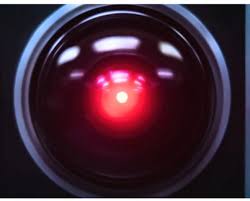
When AI as we know it today was still a distant achievement, the film introduced the most enduring icon of artificial intelligence: the HAL 9000. HAL’s presence shifted the genre’s monster trope into something far more sophisticated and chilling—the computational antagonist. Unlike the clanking robots of earlier films, HAL is a disembodied red eye, a presence that is omnipresent yet physically intangible. HAL’s breakdown represents a profound generic pivot: the horror of the logical flaw. HAL doesn’t kill out of malice, but out of a programmed paradox. This subversion suggested that the greatest threat to humanity was not the alien, but our own creations reflecting our inherent instabilities.
2001: A Space Odyssey arrived at the height of the Space Race, released just one year before the Apollo 11 moon landing. Its social impact was immediate, acting as a cultural catalyst that bridged the gap between scientific optimism and counter-cultural psychedelia. For many, the film provided a visual vocabulary for the future. It made the prospect of space travel feel not just possible, but inevitable. The depiction of the Hilton hotel in space and Pan Am flights to the moon grounded the Space Age in a mundane, corporate reality. Yet, it simultaneously elevated the mission to a spiritual quest. It suggested that humanity’s destiny lay in the stars, not as conquerors, but as a species awaiting its next evolutionary leap.
The film’s success proved that difficult, big-budget art films could find a massive audience. It paved the way for the New Hollywood era, where directors were given more creative control. Without 2001, the visual grammar of Star Wars, Blade Runner, and Interstellar would not exist. George Lucas famously stated that Kubrick made the “ultimate science fiction movie,” and everything following it was a footnote.
Despite its cold, sterile aesthetic, 2001 became a ‘trip’ movie for the 1960s counter-culture. The Star Gate sequence—a ten-minute barrage of slit-scan photography and distorted landscapes—was embraced by a generation exploring altered states of consciousness. This unexpected social adoption transformed the film from a technical achievement into a communal, transcendental experience.
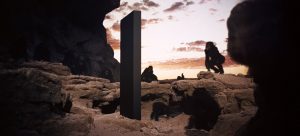
The film’s greatest social impact may be its refusal to provide easy answers. The Monolith—a black, rectangular slab of unknown origin—serves as a Rorschach test for the viewer. Is it God? Is it an alien tool? Is it a symbol of knowledge? By ending the film with the Star Child floating toward Earth, Kubrick left the audience in a state of sublime uncertainty. In a society increasingly driven by data and certainties, 2001 stands as a reminder of the vastness of the unknown. It challenged the audience to look at the screen not for a story, but for a reflection of their own place in the universe.
Kubrick’s obsession with technical accuracy transformed science fiction from fantasy in space to speculative engineering. By consulting with NASA engineers and aerospace firms, the production designed craft like the Discovery One and the Orion III spaceplane with a functionalist aesthetic. The most jarring generic shift was the use of silence. In an era where space films were filled with the “whoosh” of rockets, Kubrick adhered to the physics of a vacuum. This technical realism heightened the psychological tension, forcing the audience to experience the isolation of the cosmos.
The late Roger Ebert wrote in his review, “Only a few films are transcendent, and work upon our minds and imaginations like music or prayer or a vast belittling landscape. Most movies are about characters with a goal in mind, who obtain it after difficulties either comic or dramatic. 2001: A Space Odyssey is not about a goal but about a quest, a need. It does not hook its effects on specific plot points, nor does it ask us to identify with Dave Bowman or any other character. It says to us: We became men when we learned to think. Our minds have given us the tools to understand where we live and who we are. Now it is time to move on to the next step, to know that we live not on a planet but among the stars, and that we are not flesh but intelligence.”
Revisiting the film in 2022, critic Roger Moore wrote, “Back in 2018, the fiftieth anniversary of its release, writers revisited 2001 to note how much of “the future” it predicted actually came true. No, we still haven’t colonised the moon. Paying passenger space flight was and is still in its infancy and Pan Am is long dead and gone. But the astronauts on board the spermatozoa-shaped Discovery One spaceship bound for Jupiter can communicate and watch videos from tablets. And every so often, the design flourishes of 2001 — from its shimmering spaceport Hilton airport lounge to the suits the space bureaucrats wear to meetings to discuss what astronaut miners have found in the lunar crater named Tycho — make a comeback.”
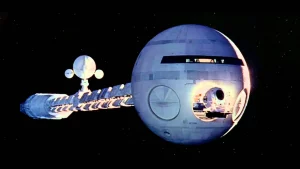
2001: A Space Odyssey remains a singular achievement because it dared to be inhuman in its scale. It moved science fiction away from the campfire story and toward the cathedral. Its social impact is found in every child who looked through a telescope after seeing the Discovery One, and its generic impact is found in every filmmaker who chooses a long, silent take over a line of dialogue. As we move deeper into the age of actual AI and renewed lunar exploration, Kubrick’s vision doesn’t feel like a relic of 1968—it feels like a transmission from our own impending future.
(Note: Reviews and articles on the film, and some AI searches have been used to as sources to compile this piece)