






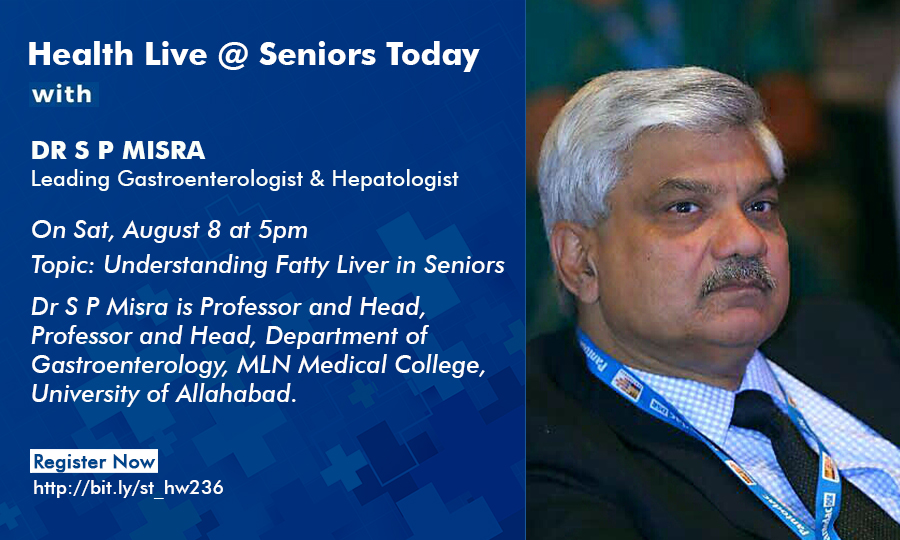
On Saturday, August 8, 2026, Seniors Today hosted an edition of its weekly Health Live webinar series titled “Understanding Fatty Liver in Seniors.” The session featured veteran gastroenterologist and hepatologist Dr SP Misra (MD, DM, FRCP, FICP, FACG, FNASc, FAMS), Professor & Head of the Department of Gastroenterology at MLN Medical College, University of Allahabad, and was moderated by Pradyuman Maheshwari, Editor of Seniors Today.
Understanding Fatty Liver: Causes & Mechanism
- Caloric Imbalance & Lifestyle: Dr Misra highlighted that easy availability of cheap, high-calorie foods combined with increasingly sedentary habits has made fatty liver a widespread issue, affecting roughly 40–50% of the population.
- Underlying Factors: Key contributors include obesity, type 2 diabetes, hypothyroidism, elevated cholesterol/triglycerides, and specific long-term medications (such as amiodarone, methotrexate, and certain painkillers).
- Cardiovascular Risks: Dr Misra emphasized that fatty liver is part of a broader metabolic syndrome. Most individuals with fatty liver face greater risks from cardiovascular complications (e.g., heart attacks) than from direct liver failure itself.
Diagnosis & Ultrasound Grading
Fatty liver is most commonly detected incidentally during routine ultrasounds or blood tests. On an ultrasound, fat accumulation causes the liver to appear brighter than adjacent tissues:
- Grade 1: Liver is brighter than normal, but intrahepatic blood vessels and the diaphragm remain clearly visible.
- Grade 2: Liver is brighter, intrahepatic vessels become obscured/less clear, but the diaphragm is still visible.
- Grade 3: Liver is significantly bright; both the intrahepatic vessels and the diaphragm are difficult to see or obscured.
You can watch the full interactive broadcast on the Seniors Today Understanding Fatty Liver Live Discussion to listen to the extensive clinical insights shared by the doctors during this session.
Management & Lifestyle Interventions
- First-Line Therapy: Lifestyle modification remains the primary and most effective treatment. A weight reduction of even 2–4% significantly lowers the risk of progression to fibrosis, cirrhosis, or hepatocellular carcinoma.
- Exercise Guidelines:
- A minimum of 135 minutes of walking per week (approx. 19 minutes/day) serves as an effective threshold.
- A balanced routine combining aerobic exercises (walking, running, swimming) daily with resistive exercises (weight training, squats) 3 days a week helps preserve muscle mass.
- Medications & Caveats: Newer weight-loss and metabolic medications (GLP-1 receptor agonists like semaglutide) should only be taken under strict medical supervision. Without proper resistive training, rapid pharmacological weight loss can lead to muscle wasting (sarcopenia).
Preventive Care & Vaccines
- Hepatitis Vaccination: Dr Misra strongly recommended that everyone—especially seniors and those diagnosed with fatty liver—get vaccinated against Hepatitis B (and consider vaccines for Hepatitis A and E), as superadded viral infections on an already compromised liver can trigger rapid decompensation.
- Booster Shots: For those vaccinated long ago, checking antibody levels (anti-HBs) or getting a booster shot is safe and advised.
Dietary & Lifestyle Advice (Q&A Highlights)
- Ghee & Non-Veg: Consuming 1–2 teaspoons of ghee daily is safe and can be beneficial. Non-vegetarian food isn’t inherently harmful if lean cuts are chosen over high-fat preparations.
- Black Coffee: Moderate black coffee consumption (up to 4–6 cups daily) has shown protective benefits for liver health.
- Sweets & Alcohol: High fructose intake (sweetened beverages, excessive desserts) and alcohol are major drivers of liver fat accumulation and should be strictly controlled.
- Sleep Hygiene: Getting 7–8 hours of quality, uninterrupted sleep in a completely dark room is critical for liver metabolism and melatonin production.
Life Philosophy: The “3 Ps”
In addition to medical guidance, Dr Misra shared his personal philosophy for healthy aging, advocating for the Three Ps:
- Passion: Engaging in creative pursuits (Dr Misra speaks 20 languages and writes lyrics daily).
- Pals: Maintaining strong social connections and friendships to reduce anxiety and stress.
- Pets: Caring for animals to foster emotional well-being (Dr Misra personally cares for 19 pets).