






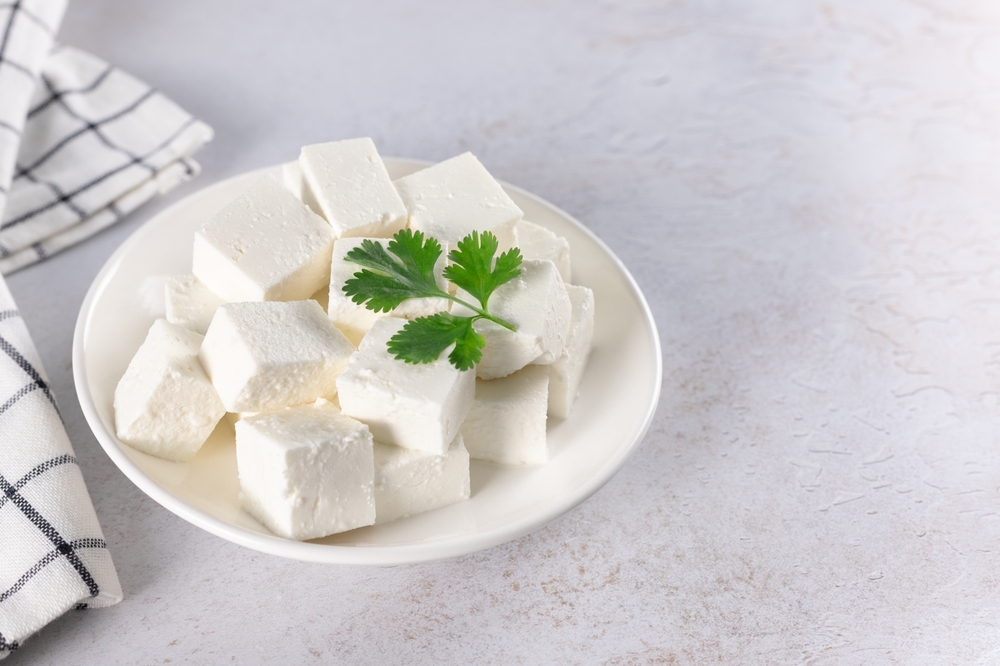
That familiar white block in your refrigerator may look like paneer, cook like paneer and even taste like paneer. But what is it actually made from?
Paneer has long been one of India’s favourite sources of protein. It appears in everything from matar paneer and palak paneer to grilled snacks, sandwiches and salads. For many people, particularly as they get older, it is an easy way to add protein to a meal.
But there is a growing distinction you should know about: dairy paneer and paneer analogue.
They may look remarkably similar, but they are not the same product.
And before you start worrying, there is an important clarification: an analogue is not necessarily “fake”, poisonous or illegal. A dairy analogue is a formulated food designed to resemble a conventional dairy product while replacing some or all milk constituents with ingredients that do not come from milk. FSSAI recognises dairy analogues as a distinct category and has provisions for their labelling.
The important question is therefore not simply, “Is this fake paneer?”
It is:
“Do I know what I am buying?”
First, what exactly is traditional paneer?
Traditional paneer is a relatively simple dairy food.
Milk is heated and then coagulated using an acidifying agent such as lemon juice, citric acid or another permitted acidulant. The milk proteins coagulate, separating the curds from the whey. The curds are collected, pressed and cooled to produce the firm, fresh cheese we know as paneer.
In other words, its basic identity comes from milk.
FSSAI’s food standards recognise paneer as a milk product and prescribe compositional requirements for it. The regulations also distinguish between regular paneer and categories such as low-fat and medium-fat paneer.
Traditional paneer therefore naturally contains milk proteins, milk fat and other milk-derived components.
So what is analogue paneer?
A dairy analogue is made to resemble a conventional dairy product but substitutes some or all of its milk constituents with ingredients that are not derived from milk.
FSSAI’s current explanatory material specifically lists paneer analogues among dairy analogues. Depending on the formulation, manufacturers may use combinations of vegetable oils or fats, milk solids, plant proteins, starches, stabilisers and emulsifiers, together with other permitted ingredients.
Why make it?
There are several reasons.
- Cost
Replacing some milk fat or milk protein with less expensive ingredients can reduce production costs.
- Functionality
Different fats, proteins and stabilisers can give the product particular properties — for example, firmness, slicing ability, cooking stability or a longer usable life.
- Consistency
Manufacturers can formulate a product to achieve a fairly consistent texture and performance from batch to batch.
- Dietary preferences
Dairy analogues can also be designed for particular dietary requirements, although a product containing milk constituents is not automatically suitable for someone with a milk allergy or for someone following a strictly vegan diet.
FSSAI itself identifies cost reduction, functional properties and demand for alternatives among the reasons dairy analogues are produced.
What’s actually inside an analogue?
This is where the label becomes your best friend.
A formulation might contain ingredients such as:
- vegetable oil or vegetable fat
- milk solids or skimmed milk powder
- plant proteins such as soy or pea protein
- starch or modified starch
- stabilisers
- emulsifiers
- permitted flavours or other functional ingredients
Not every analogue contains all of these.
And the presence of a long ingredient list does not, by itself, make a product unsafe.
The bigger issue is that these ingredients produce a food with a nutritional profile that can differ substantially from conventional paneer.
For example, replacing milk fat with vegetable fat changes the type and amount of fat present. Replacing some milk protein with plant protein changes the protein composition.
That matters if you are buying paneer specifically because you think you are getting the nutritional profile of a traditional milk-based food.
The most important clue is on the packet
You do not need to become a food scientist.
Turn the packet over.
Look first at the ingredient list.
Under Indian labelling rules, ingredients are generally listed in descending order by weight at the time of manufacture. So the first few ingredients tell you a great deal about what makes up the product.
If you are looking for conventional dairy paneer, you would expect milk to be central to the ingredient declaration.
If you see ingredients such as vegetable oil, vegetable fat, palm fat, plant protein, starch or modified starch playing a significant role, you are looking at a formulated product rather than straightforward traditional paneer.
There is another useful clue.
FSSAI’s provisions for dairy analogues require disclosure of non-milk constituents that replace milk constituents. Where milk fat or milk protein is partly replaced, the label is required to indicate the relevant non-milk constituent and its source; where a milk constituent is completely replaced, the regulations provide for a declaration such as “Contains no Milk Fat” or “Contains no Milk Protein”, as applicable.
So don’t rely on the picture on the front of the packet.
Read the back.
What about the word “paneer”?
This is where things become particularly important.
FSSAI has been paying increased attention to the labelling and presentation of dairy analogues because consumers should not be led to believe that a non-dairy or partly non-dairy analogue is an ordinary dairy product. Its 2025 consultation paper specifically discussed the need for clear differentiation between dairy products and dairy analogues.
So a product’s description, ingredient list and other declarations matter much more than whether it simply resembles paneer.
Can you identify analogue paneer at home?
Sometimes you can get clues.
But here is an important warning:
No home test can reliably prove that a piece of paneer is genuine dairy paneer.
There are many internet “tests” involving iodine, boiling, burning, rubbing or observing how paneer melts. These should not be treated as definitive authenticity tests.
For example, starch can sometimes be detected using an iodine test, but its presence alone does not tell you the entire composition or safety of a product. Conversely, the absence of starch does not prove that the product is traditional dairy paneer.
Likewise, cooking behaviour can provide clues, but it is not a laboratory test.
Look at the texture
Traditional paneer generally has a fresh, slightly crumbly yet cohesive texture.
An analogue may feel unusually uniform, rubbery, waxy or exceptionally smooth, depending on its formulation.
But remember: paneer texture also varies with the milk used, processing method, moisture level, pressing and storage.
Watch what happens in the pan
Paneer does not behave exactly like mozzarella or another melting cheese.
Traditional paneer generally retains its structure during ordinary cooking and can brown on the outside.
An analogue may behave differently because its fat, protein and starch system is different. It may brown, soften, become rubbery or retain its shape in ways that differ from dairy paneer.
But again, cooking behaviour is a clue, not proof.
Notice the taste
Traditional dairy paneer usually has a mild, fresh dairy flavour.
An analogue may have a noticeably different mouthfeel or flavour depending on the fats, proteins and flavouring used.
But taste is subjective — and a well-formulated analogue may be surprisingly convincing.
Is analogue paneer unhealthy?
Not necessarily.
This is an important distinction.
“Different” does not automatically mean “bad”.
A food can be perfectly legal and safe to eat while having a different nutritional profile from the food it resembles.
The question is whether its composition suits your dietary needs.
If you buy paneer because you want a convenient source of high-quality dairy protein, an analogue containing substantial amounts of vegetable fat and less milk protein may not provide the same nutritional package.
If you are watching your saturated fat intake, the type and amount of fat matter.
If you are trying to maintain muscle as you age, the amount and quality of protein matter.
And if you are trying to keep your overall diet minimally processed, you may simply prefer a product with a shorter and more recognisable ingredient list.
Why does this matter more as you get older?
Protein becomes increasingly important with ageing.
From around middle age onwards, maintaining muscle mass and strength becomes a greater nutritional priority. Resistance exercise combined with adequate protein helps support muscle maintenance.
Paneer can be useful because milk proteins provide essential amino acids, including leucine, which plays an important role in stimulating muscle protein synthesis.
But don’t make the mistake of thinking that all products sold as paneer have exactly the same nutritional value.
A dairy paneer and an analogue may contain comparable-looking amounts of protein on paper while differing in the source and quality of that protein, the amount of milk protein, the type of fat and the presence of other ingredients.
This is why the nutrition panel and ingredient list matter.
And paneer should not be your only protein source. Dal, beans, curd, yoghurt, eggs, fish, chicken, soy and other protein-rich foods can all contribute to a varied diet.
A five-second paneer label check
Before putting that packet into your shopping basket, take five seconds.
THE 5-SECOND PANEER CHECK
- Look at the name.
Is it clearly identified as paneer, or does it describe itself as an analogue or another formulated product? - Read the first few ingredients.
What comes first — milk or a combination of vegetable fats, starches and other ingredients? - Look for vegetable fat/oil.
Its presence is an important clue that the product is not simply traditional milk-based paneer. - Check the protein.
Look at the protein per 100 g rather than assuming every paneer provides the same amount. - Check the fat.
Look at total fat and, where declared, saturated fat.
Sixth — if you have another second: check the manufacturer’s details, date of manufacture and storage instructions.
What about loose paneer from a shop?
This is harder.
When you buy loose paneer from a local dairy, restaurant, sweet shop or caterer, you may not have access to a full ingredient list.
You can ask:
“Is this made entirely from milk?”
If you are buying in bulk or regularly from the same establishment, ask whether the product contains vegetable fat, plant protein or starch.
For prepared foods, the situation can be even less obvious. Paneer used in a restaurant dish may not be identical to the paneer you buy in a supermarket.
This is one reason sourcing matters.
Don’t confuse analogue with adulterated
There is a crucial difference between an intentionally formulated analogue that is properly labelled and a food that is adulterated or fraudulently misrepresented.
An analogue can be a legitimate food product.
The problem arises when a consumer believes they are buying conventional dairy paneer but is actually getting a substantially different product without clear information.
FSSAI’s current material specifically emphasises preventing misleading presentation of dairy analogues.
So the issue is not about creating panic around every packet of paneer.
It is about informed choice.
Do you stop eating paneer?
You don’t need to stop eating paneer.
Nor do you need to conduct kitchen experiments every time you buy it.
Instead, become a better label reader.
If you want traditional dairy paneer, look for a product whose identity and ingredients clearly indicate that it is milk-based. If you are perfectly comfortable with an analogue, that’s a different choice — just understand what it contains and how its nutritional profile compares with dairy paneer.
And remember:
White, square and familiar-looking does not tell you what a food is made of.
The ingredient list does.
Quick comparison
| Traditional dairy paneer | Paneer analogue | |
|---|---|---|
| Primary basis | Milk | May use milk plus non-milk ingredients |
| Milk protein | Central to the product | May be partly or wholly replaced |
| Milk fat | Naturally present unless a specific low-fat formulation | May be partly or wholly replaced by vegetable fat/oil |
| Starch | Not a defining ingredient | May be used for texture/function |
| Plant protein | Not a defining ingredient | May be used in some formulations |
| Texture | Firm, fresh, mildly crumbly | Can vary depending on formulation |
| Cooking behaviour | Characteristically holds its shape | May behave differently depending on formulation |
| Best way to identify | Ingredient and nutrition labels | Clear analogue declarations + ingredient list |
The simplest rule is this: don’t judge paneer by its appearance. Read the label.
This article is intended for general nutritional awareness and does not replace individual dietary advice, particularly if you have a milk allergy, kidney disease or another condition requiring specific protein or fat restrictions.