






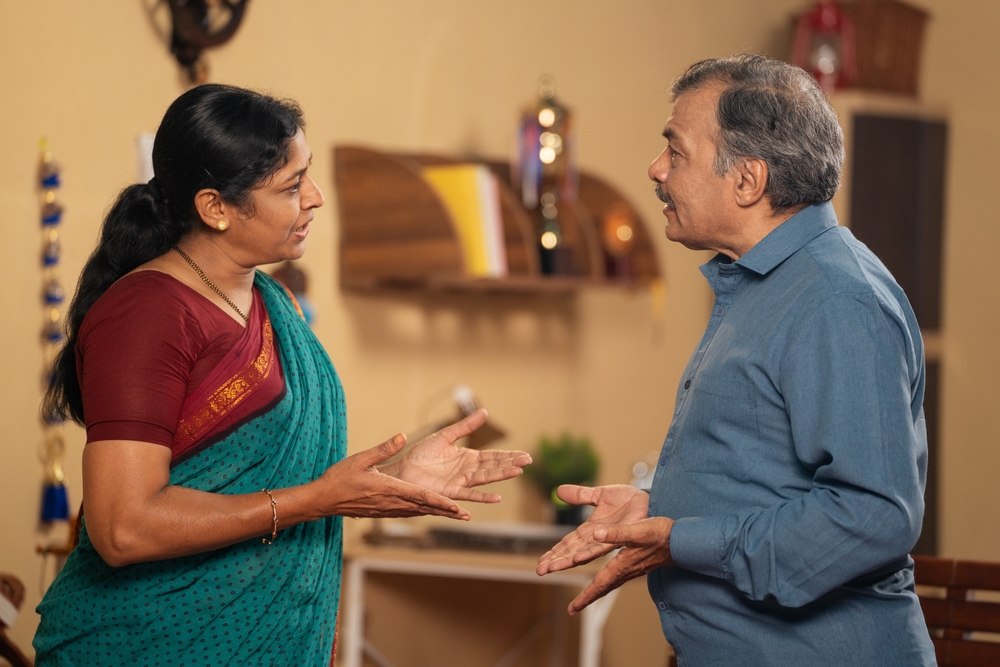
How to disagree without losing the people you love
There is a peculiar thing we are taught as we grow older: that peace is always preferable to conflict.
Keep quiet.
Don’t make a scene.
Let it go.
They are your children.
He is your husband.
She is your daughter-in-law.
What will people say?
At your age, why fight?
But perhaps we have misunderstood something important.
Not all fighting is destructive. And not all peace is peaceful.
Sometimes what looks like peace is simply one person swallowing their feelings while another gets their way. Sometimes silence is not acceptance but exhaustion. Sometimes “I don’t want to argue” really means “I don’t know how to have this conversation without hurting us both.”
Priya Parker, whose earlier book The Art of Gathering explored how we come together meaningfully, turns her attention to something we are usually much less comfortable discussing: conflict. In her forthcoming book The Art of Fighting, she challenges the idea that healthy relationships are those in which people rarely disagree. Her argument is more interesting: strong relationships need the capacity to fight well.
For those of us over 60, this is worth thinking about.
Because by this stage of life, you have probably accumulated a lifetime of things you care deeply about — and therefore a lifetime of things worth disagreeing about.
You have not suddenly become difficult
Perhaps your daughter thinks you are being stubborn about moving into a smaller home.
Perhaps your son thinks you should sell the old family house.
Perhaps your children want you to stop driving.
Perhaps you don’t agree with how they are raising your grandchildren.
Perhaps you have spent forty years in a marriage and have finally decided that certain things you tolerated at 35 are no longer acceptable at 70.
Perhaps a friend has changed, a sibling has disappointed you, or someone you have known for decades has become politically, socially or personally impossible for you to talk to.
And perhaps you have been told, directly or indirectly, that at your age you should simply “adjust”.
But ageing does not mean becoming voiceless.
You are allowed to disagree.
The question is how you disagree.
The difference between fighting and hurting
There is a world of difference between saying:
“I don’t agree with you.”
and:
“You have never cared about what I think.”
One challenges an idea. The other attacks a person.
A healthy disagreement stays as close as possible to the problem.
An unhealthy fight brings the entire history of the relationship into the room.
“You always…”
“You never…”
“After everything I have done for you…”
“Your father was exactly like this…”
“I knew your marriage would…”
“You were impossible even as a child…”
Once the conversation becomes a courtroom for every grievance accumulated over 30 years, nobody is really listening anymore.
You are no longer trying to solve something.
You are trying to win.
And winning an argument while damaging a relationship is often a very expensive victory.
Why seniors sometimes avoid conflict
There are good reasons older people may avoid difficult conversations.
You may have been raised in a generation where keeping family matters private was considered a virtue.
You may have learnt that elders should maintain dignity by remaining composed.
You may fear losing your children’s affection.
You may depend on family members practically or financially and worry that speaking honestly will have consequences.
You may simply be tired.
Or you may think:
“I have only so many years left. Why waste them arguing?”
But there is another way of looking at it.
Perhaps the question isn’t:
“Should I fight?”
Perhaps it is:
“Is this important enough to talk about?”
That is a much better question.
Choose your battles — but don’t abandon yourself
Growing older should bring perspective.
Not everything deserves a confrontation.
Someone’s irritating political opinion? Perhaps let it pass.
A neighbour’s insensitive remark? Perhaps it isn’t worth your blood pressure.
Your daughter forgetting to call one Sunday? Maybe don’t turn it into a referendum on her love.
But your son deciding that you are no longer capable of making decisions about your own money?
That may deserve a conversation.
A spouse repeatedly dismissing your wishes?
Worth discussing.
A sibling pressuring you about property?
Definitely worth discussing.
A friend continually making you feel small?
Perhaps the friendship needs attention.
The art is learning the difference between an irritation and an issue.
Before you fight, ask: What am I protecting?
This is one of the most useful questions we can ask ourselves.
Am I fighting because my pride has been hurt?
Because I want to be right?
Because I am frightened?
Because I want control?
Or because something genuinely important is at stake?
Perhaps you are arguing with your children about moving house.
Underneath the argument may not be the house at all.
You may be protecting your independence.
Your children may be protecting your safety.
Suddenly, the argument changes.
Instead of:
“You are trying to control me.”
and
“You are being irresponsible.”
the conversation can become:
“I need to feel that I still have a say in my own life.”
and:
“We need to know that you are safe.”
Now there is something to work with.
Don’t fight the person. Fight for the issue.
This is perhaps the most important distinction.
If your daughter says something you dislike, don’t make the disagreement about her character.
If your son disagrees with you, don’t interpret it automatically as disrespect.
If your spouse refuses something, don’t immediately reach for a catalogue of everything they have done wrong since 1987.
Stay with the issue.
“This is what I heard.”
“This is how it made me feel.”
“This is what I would like to change.”
“What do you think?”
That last sentence is surprisingly powerful.
Because a fight changes character when both people are allowed to speak.
And listen — really listen
We often think that fighting means talking forcefully.
Sometimes it means listening bravely.
You may hear something you don’t like.
Your daughter may tell you that your advice feels like criticism.
Your son may tell you that he feels guilty every time he visits because you complain about how little time he gives you.
Your spouse may tell you that they feel invisible.
Your friend may tell you that your jokes have become hurtful.
Your first instinct may be to defend yourself.
Try not to.
Take a breath.
You don’t have to agree with everything someone says in order to understand what they are saying.
Understanding is not surrender.
The senior advantage: you have lived long enough to know that people change
One of the gifts of age is perspective.
You have survived arguments before.
You have seen friendships end and begin again.
You have watched children become adults.
You have changed your own mind.
You have probably been wrong about something you once felt absolutely certain about.
This is valuable knowledge.
It means you can enter a disagreement without believing that every argument has to end with a winner.
Sometimes the outcome can simply be:
“We don’t agree, but I understand you better now.”
That is not failure.
That is maturity.
Beware of the silent fight
There is another kind of fighting that deserves attention — the fight that never happens.
You stop speaking.
You become polite.
You withdraw.
You stop asking.
You stop expecting.
You tell yourself you don’t care.
And gradually, the relationship becomes emotionally empty.
This can happen in marriages particularly.
Two people can live under the same roof for years while having stopped having any real conversations.
There is no shouting.
No dramatic confrontation.
No obvious crisis.
Just distance.
That isn’t necessarily peace.
Sometimes it is unresolved conflict that has gone quiet.
Parker has written about the danger of confusing the absence of visible conflict with the presence of healthy relationships. Her work argues that thriving groups and relationships need ways to face disagreement rather than simply suppress it.
Create rules for difficult conversations
When something matters deeply, don’t simply launch into it when you are angry.
Create a little structure.
Perhaps say:
“There is something important I want to discuss. Can we talk after dinner rather than doing this in the middle of an argument?”
Then agree on a few simple rules:
- No shouting.
- No insults.
- No bringing up unrelated old grievances.
- Each person gets uninterrupted time to speak.
- Either person can ask for a break.
- The purpose is understanding or finding a way forward — not winning.
These may sound obvious.
They are not.
When emotions are high, obvious things disappear.
Parker’s broader work emphasises the usefulness of intentional structures and temporary rules in making difficult conversations more productive.
Say what you need — not just what you don’t like
This is particularly important for seniors.
Instead of:
“You never visit me.”
Try:
“I would really like us to have dinner together once a month.”
Instead of:
“You treat me like a child.”
Try:
“I want you to give me your advice, but I want the final decision about my finances to remain mine.”
Instead of:
“Nobody listens to me anymore.”
Try:
“I would like to be included when decisions about my life are being made.”
A complaint tells somebody what is wrong.
A clear request tells them what they can do.
You are allowed to set boundaries
There is another misconception about ageing: that being gracious means accepting everything.
It doesn’t.
You can say:
“I won’t continue this conversation if you shout at me.”
“I am happy to discuss the property, but not if I am being pressured.”
“I love you, but I don’t agree with you.”
“I understand that you are worried about me. I still want to make this decision myself.”
These aren’t acts of aggression.
They are boundaries.
And boundaries can make relationships healthier precisely because they make expectations clearer.
Some fights are not meant to be won
This may be the hardest lesson.
There will be people with whom you cannot reach agreement.
A sibling may never see things your way.
Your adult child may make choices you profoundly dislike.
A spouse may have values that have diverged from yours.
A friend may no longer be someone with whom you can maintain a close relationship.
Not every conflict can be resolved.
Sometimes the healthiest conclusion is not reconciliation but clarity.
You may decide:
“We will remain family, but I will not discuss this subject with you.”
Or:
“I accept that we see politics differently.”
Or:
“I will maintain the friendship, but I need some distance.”
Or, sometimes:
“This relationship is no longer good for me.”
There is dignity in knowing when to continue the conversation — and when to stop.
The goal is not to become better at fighting
This is where the title can be misleading.
The Art of Fighting is not really about becoming more argumentative.
It is about becoming more intentional about conflict.
The question is not:
“How can I win?”
It is:
“What matters here?”
What am I protecting?
What am I afraid of?
What do I need?
What might the other person need?
What am I unwilling to accept?
And perhaps most importantly:
What do I want this relationship to look like after this conversation?
That final question can change everything.
Because if you know that you want your daughter in your life for the next twenty years, perhaps you will choose your words differently.
If you want your marriage to survive its next chapter, perhaps you will finally discuss the things you have avoided for decades.
If you want to remain independent, perhaps you will have the difficult financial conversation now rather than waiting for someone else to make decisions for you.
Fight for the relationship, not against the person
At this stage of life, we have something younger people don’t always possess:
We know that time is precious.
That should not make us afraid of difficult conversations.
It should make us better at them.
You don’t have to swallow your anger.
You don’t have to shout it either.
You can speak.
You can listen.
You can disagree.
You can draw a boundary.
You can change your mind.
You can apologise.
You can say, “I was wrong.”
You can say, “I don’t agree, but I love you.”
And you can walk away from a conversation before it becomes cruel.
Perhaps that is the real art of fighting.
Not learning how to defeat another person.
But learning how to tell the truth without destroying the connection.
Because sometimes the argument we have been avoiding is precisely the conversation a relationship needs.
And sometimes, the bravest words we can say are not:
“I win.”
but:
“Let’s talk about this properly.”
Let us always always keep in mind – As we grow older, perhaps the greatest art is not learning how to avoid conflict, but learning how to disagree without losing the love, dignity and connection that matter most.