







It does not happen too often that a mainstream film captures the zeitgeist of the times, as Deewar (1975) did in the Seventies. Mostly this social and political awareness is read in a film after its release. However, when the writers are the sharply observant Salim-Javed, and the director is Yash Chopra, it is possible to believe that the structure of the film and the development of the characters was well thought out.
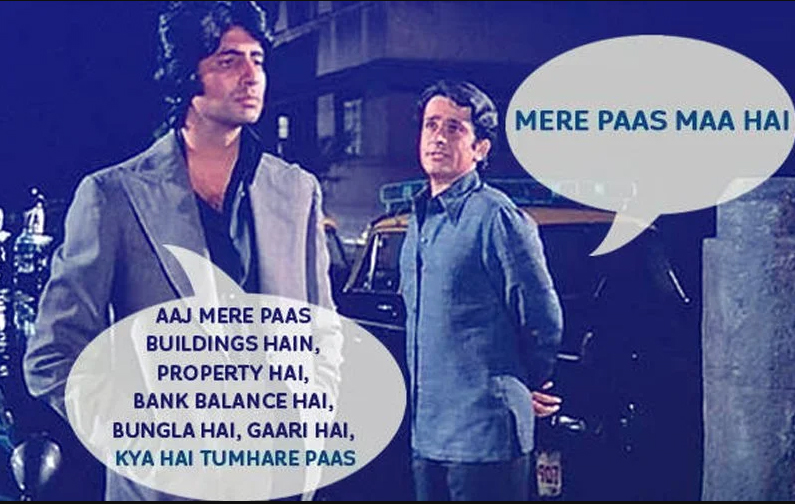
It is possible that today’s generation has not seen the film, but at least three of its lines have passed into everyday use – Mere Paas Ma Hai, Aaj Khush To Bahut Honge Tum and Main Aaj Bhi Phenke Hue Paise Nahin Uthata.
Deewar, starring Amitabh Bachchan, Shashi Kapoor, Parveen Babi, Nirupa Roy and Neetu Singh, captured India at the cusp of change. The decline of the trade union movement, rampant corruption, the rise of the criminal underworld and the gangster coming out of the darkness into the open plying his trade with defiance. Political unrest in the air, the dark clouds of the Emergency were hovering, the mood of the people had shifted from hopeful to cynical. It was time for the grey-shaded anti-hero to arrive, and who better to personify him than the intense Amitabh Bachchan. When the dock worker turned smuggler Vijay (Bachchan) taunts his police officer brother Ravi (Kapoor) that he has everything—bangla, gaadi, paisa, it is only the mandatory emotional content of the times that made Ravi retort Mere paas ma hai, and have the audience go gaga. Today, the mother has been almost wiped out of mainstream cinema.
The film opens with police inspector Ravi Verma (Shashi Kapoor) receiving an award for going beyond the call of duty in upholding the law. He thanks his mother, Sumitra Devi (Nirupa Roy), who is in the audience, with tearful eyes. He asks her to come up and receive the medal with him, because she is the power behind his achievement.
The film then goes into a flashback of Ravi’s childhood. Master Raju played the young Ravi, and Master Alankar his brother Vijay. The boys’ father, Anand Verma (Satyen Kappu) is a principled and respected trade union leader, who has been leading a strike of miners, demanding better conditions from the owner, Badri Prasad (Kamal Kapoor). The evil boss kidnaps Anand’s family and forces him to sign a contract against the interests of the striking labourers. When they hear of this treachery, the workers beat up Anand, leaving him for dead. Some of them catch hold of Vijay and tattoo his left arm with the words Mera baap chor hai. This humiliation leaves a deep scar on Vijay’s mind, and dictates the course of his doomed life.
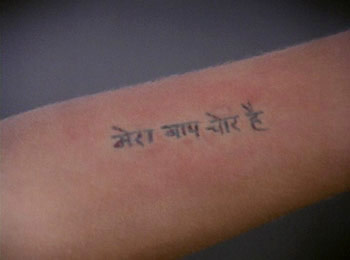
Sumitra brings Vijay and Ravi to Mumbai and does menial labour at a construction site to raise her sons. They grow up in poverty, and an angry Vijay even refuses to enter a temple, saying that he will chart his own destiny. Vijay starts out as a shoeshine boy and later works at the docks (that famous badge number 786 made its appearance here), sacrificing his own education to provide for his brother. Even as a child, he holds on to his self–respect; when a customer (who will later change his life) tosses a coin at him, he snarls that he is not a beggar, he does not pick up coins thrown on the street.
The unemployed Ravi, who is romancing Veera (Neetu Singh), the daughter of DCP Narang (Manmohan Krishna), is sent for police training, and becomes a cop.
Vijay refuses to pay the weekly hafta demanded by the henchmen of the shipyard boss Samant (Madan Puri) and beats them up. There is a fantastic (and much imitated) scene in which Vijay enters the warehouse where the goons are and locks the door. He then thrashes them and opens the door when they are all beaten, then staggers up to a tap and puts his head under it.
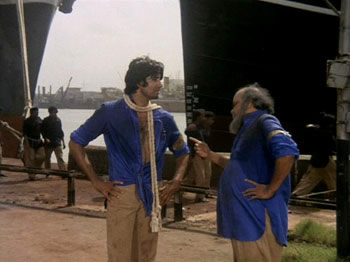
Vijay’s derringdo brings him the notice of Samant’s rival Daavar (Iftikhar), who hires Vijay to prevent Samant’s men from stealing his smuggled gold consignment. Vijay succeeds in the job, and is given a large sum of money (the Main Aaj Bhi Phenke Hue Paise Nahin Uthata line comes here) and moves his family to a luxurious mansion. It is this part of the plot that made viewers notice the inspiration from Haji Mastan’s life– the underworld don, who started his criminal career as a dock worker. Back then, gold smuggling was a big crime, which seems almost innocuous now that the underworld deals with drugs, weapons, humans and terrorism.
DCP Narang gives Ravi the task of nabbing the criminals and smugglers of Mumbai, that include his brother. Ravi is shocked that Vijay, the son of honest parents, has turned to crime. He confronts Vijay and orders him to surrender to the police. Vijay refuses, reminding his brother of all the suffering and injustice their family went through. Ravi decides to leave Vijay’s grand house and live in police quarters. Much to Vijay’s anguish, their mother decides to go with Ravi. The people who tormented us were nothing to us, she says as he pleads with her to stay, “but how could my own son write on my forehead that he is a thief. Vijay had purchased, at an inflated price, the building where his mother had worked as a labourer, he tears up the papers in a rage.
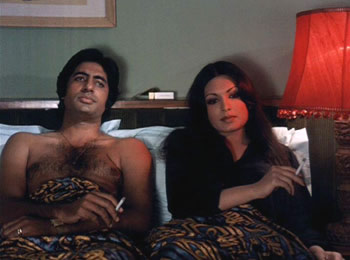
Ravi starts a sustained campaign to end crime and arrests many members of the gang. An increasingly alienated Vijay, gets into a relationship with Anita (Parveen Babi), a call girl he meets at a bar. Till then, movie heroines were supposed to be virtuous, and to have a scene of the protagonist in bed with a sex worker, did cause some mild shock. She understands him, and with her, he gets a few moments of peace in his otherwise precarious life.
When Vijay is unable to see his ailing mother in hospital, he goes to the temple for the first time, and has that “Aaj khush to bahut honge tum” confrontation with the deity.
The film did not shy away from melodrama when it was needed—the scene in which Anand’s corpse is found in a train—Ravi realises the unknown man was his father, he goes home and prevents his mother from applying red bindi on her forehead. Till she did not know his fate, she lived like a married woman even in his absence. The finality of his death and her widowhood shatters Sumitra, still, she turns away from Vijay as he reaches out to console her.
When Vijay learns from Anita that she is pregnant, he wants to marry her then surrender, so that nobody can tell his child that their father was a thief. He calls his mother to come and bless him in the temple. Before they can leave for the ceremony, Samant and his men kill Anita and in retaliation, Vijay slaughters the whole gang. He also writes his own death sentence, since there is no way back for him.
Ravi leaves home in pursuit, with his mother sending him off with the words: “May your hand not tremble while shooting.” In a way, she condemns Vijay to death. It is no spoiler that Ravi shoots Vijay, who reaches the temple somehow, and dies in his mother’s lap. In spite of his choosing crime and erecting a wall between himself and his family, Vijay turned out to be the sympathetic character in comparison to the inflexibly dutiful Ravi. The scene of his death was a lump-in-the-throat moment—a man, who never got an easy break in life, still protected and cared for his family and died heart-broken and alone. “I am tired,” he says as his life ebbs out, “I never slept a night after being separated from you. Now put me to sleep like you did when I was a boy.”
Bachchan worked on Sholay and Deewar at the same time, though Deewar was made faster and he played the strong, silent type in both. The spur-of-the-moment decision to knot Bachchan’s shirt, because the costume provided was ill-fitting, started a trend.
Rajesh Khanna was the first choice for Vijay, Navin Nischol for Ravi and Vyjayanthimala for the mother who was immortalised by Nirupa Roy. A mother who rejected her wayward son was very much like the classic Mother India. Nischol who wanted to play only lead parts refused a parallel role (he was the hero of Parwana in which Bachchan was the negative second lead), which Shashi Kapoor took up and resurrected his career, while Nischol’s went downhill.
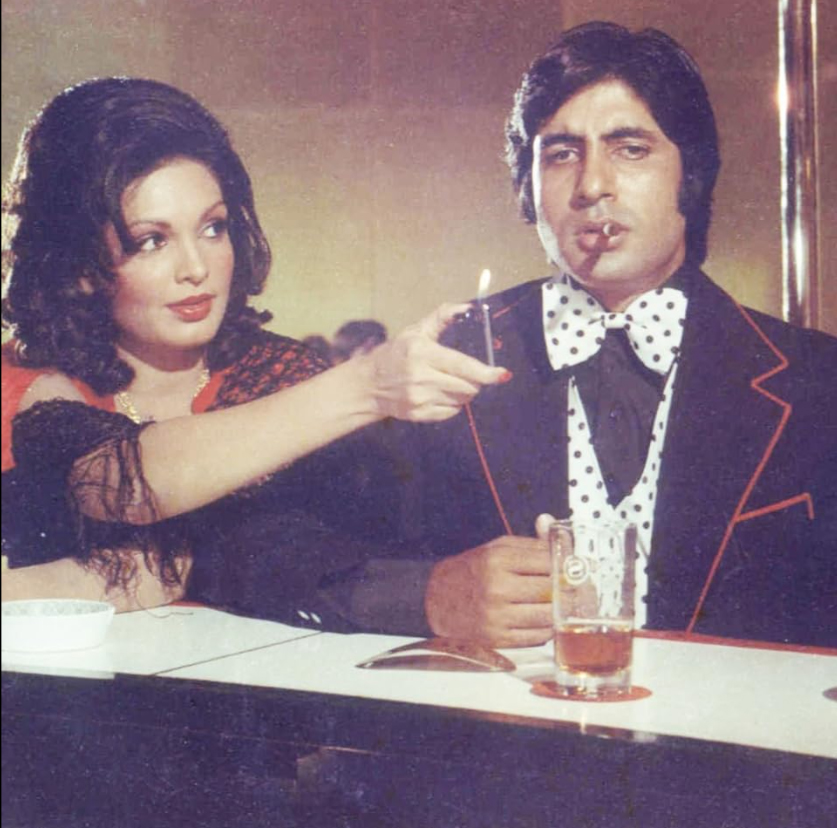
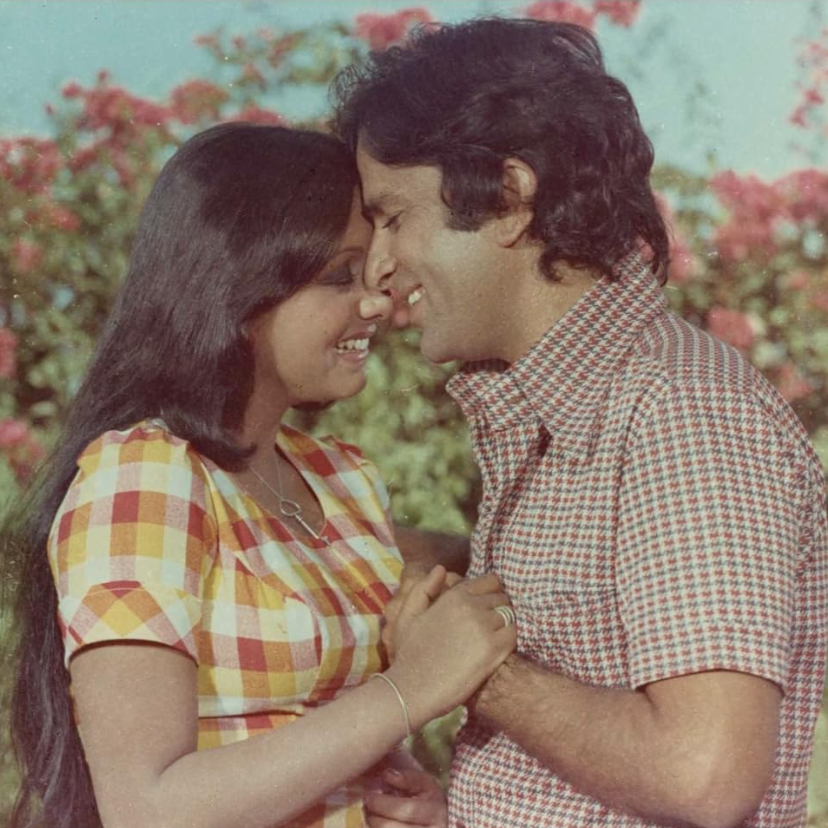
The film also had a bold female lead for the time, Parveen Babi, who smoked, drank and worked as a hooker, without explanation or apology; in contrast, Neetu Singh was the typical bubbly young woman opposite Shashi Kapoor, uncle of her to be husband Rishi Kapoor.
It did not escape notice that Deewar was an updated, urban version of Ganga Jumna—the dacoit replaced by a gangster, the dutiful cop brother remaining the same. In every age, good battles evil and always wins. A few years after Deewar, the certainty that good would always win, at least in the movies, was also shaken.