






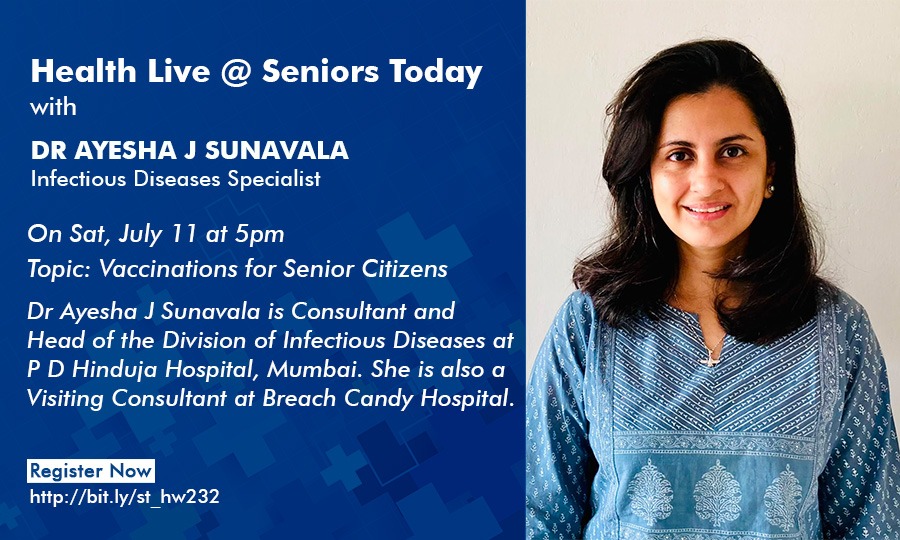
Seniors Today conducted its weekly health webinar on Vaccinations for Senior Citizens on Saturday, July 11 where leading infectious diseases specialist Dr Ayesha J Sunavala outlined the essential immunisations needed for older adults and addressed key considerations for their safety and administration.
Dr Sunavala serves as Consultant and Head of the Division of Infectious Diseases at P D Hinduja Hospital, Mumbai, and is a Visiting Consultant at Breach Candy Hospital. An accomplished clinician, academic, and teacher, she holds a Doctorate in Infectious Diseases from P D Hinduja Hospital and is actively involved in training the next generation of healthcare professionals. She has also contributed to medical literature as a co-author of the textbook Casebook of HIV Medicine.
Her outstanding contribution to infectious disease care has been widely recognised across the industry. She received the Women Achiever’s Award from the Government of Maharashtra for her exemplary service during the COVID-19 pandemic and was honoured with the Economic Times Award for Inspiring Infectious Diseases Specialist in 2022.
The core takeaways from her presentation and responses to audience questions are detailed below:
The Critical Vaccines for Seniors
Dr Sunavala emphasised three vaccinations that are most critical for older adults due to the exponential rise in mortality and long-term complications from these infections as the immune system ages:
- Influenza: Recommended annually. For individuals living in western or southern India, it is best taken pre-monsoon when the southern hemisphere vaccine becomes available. For north India, the northern hemisphere vaccine aligned with winter is more suitable.
- Pneumococcal Disease: Protects against severe community-acquired pneumonia caused by Streptococcus pneumoniae. The newest version requires just a single lifetime dose.
- Herpes Zoster (Shingles): Recommended for adults aged 50 and above. It is a two-dose lifetime vaccine with an efficacy rate of 80–90%, protecting against both shingles and post-herpetic neuralgia (severe nerve pain).
Key Insights from the Q&A Session
- Co-administration: All the common adult vaccines can be safely administered together on the same day or spaced out by days or weeks without safety concerns.
- Pre-vaccination Travel and Lifestyle: Individuals should avoid travelling or engaging in heavy weightlifting or gym workouts for 24–48 hours post-vaccination. Common side effects like arm soreness, fatigue, or mild fever last only a day or two and can be managed with paracetamol. There are no dietary restrictions, and mild social alcohol consumption does not interfere with the vaccines.
- Immunocompromised Individuals: While the vaccines are safe for those on steroids, chemotherapy, or treating autoimmune conditions like rheumatoid arthritis. However, it is highly recommended to get vaccinated at the time of diagnosis before starting immunosuppressive therapies, as the medications can reduce the vaccine’s overall efficacy.
- Storage and Administration Cautions: Dr Sunavala strongly advised against home administration. Vaccines must be administered in a clinic or hospital setting where patients can be monitored for 15–20 minutes for rare hypersensitivity reactions. Furthermore, clinical settings ensure correct cold-chain storage temperatures, which local chemists might fail to maintain during power cuts, causing the vaccine to lose potency.
- Vaccines Not for Chronic Conditions: Responding to audience queries, she clarified that vaccines only target infectious diseases, meaning there are no vaccinations to prevent or treat non-infectious conditions like arthritis, osteoporosis, joint pain, or skin dryness.
- Future and Overseas Vaccines: While a vaccine for recurrent Urinary Tract Infections (UTIs)—administered as a sublingual spray—is used in parts of Europe, the UK, and Singapore, it is not yet available in India. However, a dengue vaccine is expected to launch in India next year.