






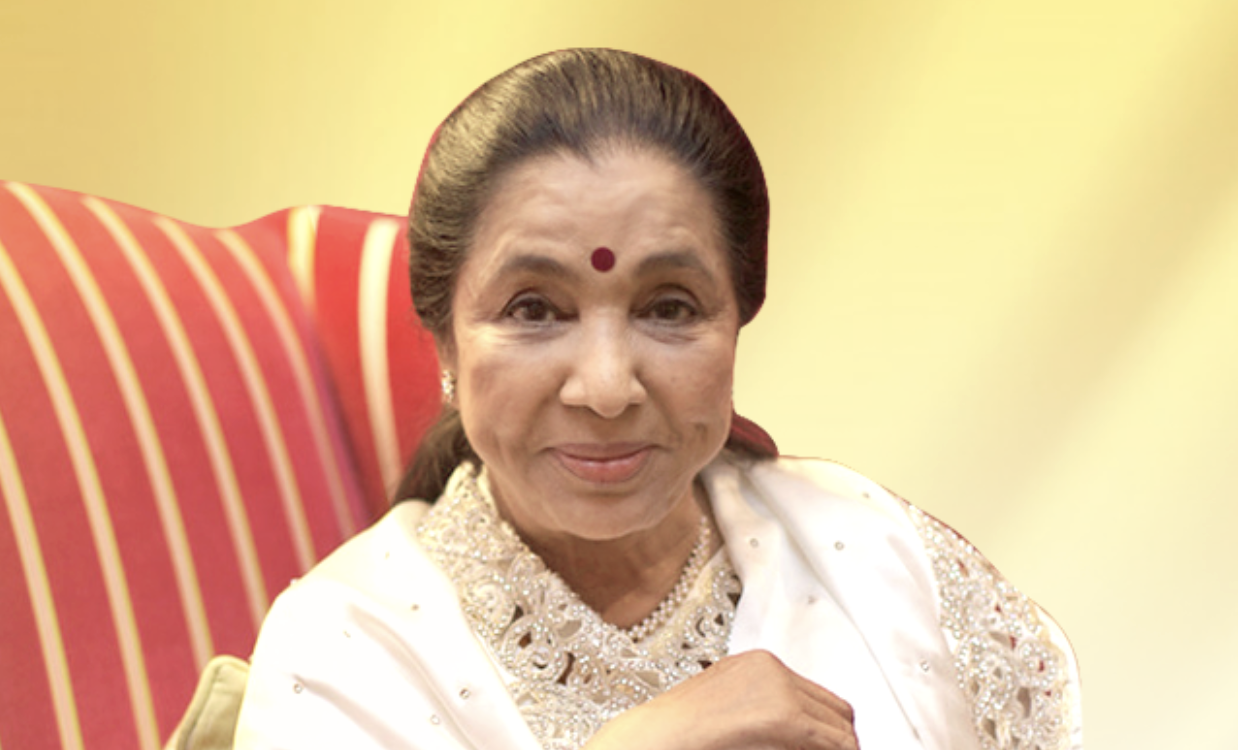
There was a time, not very long ago, when music in our homes did not arrive in playlists or algorithms. It came, instead, like a familiar guest, through the warm crackle of a radio, or the careful placing of a record. And among those voices that entered our living rooms unannounced, yet always welcome, was that of Asha Bhosle.
We often speak of her in the language of melody, and rightly so. But if one were to look at her life with a slightly different lens, one might discover something equally fascinating: the story of a woman who quietly, and repeatedly, reinvented herself long before the world learnt to call it “reinvention”.
In her early years, the world of Hindi film music was rather particular about what it considered the “ideal” female voice. It was meant to be pure, almost otherworldly—like a temple bell heard from afar. This was a space beautifully occupied by her elder sister, Lata Mangeshkar. For many, that might have seemed like a ceiling impossible to breach.
But Asha did not attempt to climb that same ladder. She chose, instead, to walk down a different path altogether.
She sang the songs others hesitated to touch—the playful ones, the mischievous ones, the ones that had a wink in their voice and a rhythm in their step. There was something delightfully human about her singing. It laughed, it teased, it flirted with the listener. And slowly, almost imperceptibly, she built a space that was entirely her own.
Then came the 1960s and 70s, a time when the world itself seemed to be changing its tune. Western influences began to drift into our cinema, bringing with them jazz, rock-and-roll, and a certain restless energy. Where some might have faltered, Asha seemed to come alive.
Her partnership with R D Burman was not just collaboration; it was chemistry. Together, they created songs that did not merely play—they pulsed. Think of “Piya Tu Ab To Aaja”, and you can almost hear the breath between the beats, the smile behind the sound. It was as if her voice had discovered new colours—and was unafraid to use all of them.
And just when the world had decided it knew her, that she was the voice of glamour, of cabaret, of the modern woman, she did something rather unexpected. She turned inward.
With Umrao Jaan, under the gentle guidance of Khayyam, her voice softened, deepened, and acquired a certain ache. The playfulness gave way to poetry. The rhythm slowed to a sigh. It was the same voice, and yet, it felt entirely new—as though she had opened a window into another part of her soul.
For those who had been listening closely, it was a quiet reminder: do not place her in a box, for she will not stay there.
Years later, when the world had changed once again—when cassettes replaced records, and then yielded to the invisible streams of the digital age—many of her contemporaries chose to step back, to let the next generation take centre stage.
Asha stepped forward.
Her work with A R Rahman in Rangeela was not the effort of someone trying to keep up. It was the ease of someone who had never really fallen behind. There was a freshness to her voice, an agelessness, as though time itself had decided to treat her kindly.
Beyond music, she extended herself into other spaces, most notably with her chain of restaurants, Asha’s. It felt, in a way, perfectly natural. For was she not always about warmth, flavour, and a certain generosity of spirit? The same qualities that made her singing so memorable seemed to find their way into everything she touched.
And now, when we look back at her journey, what stands out is not merely the longevity—though that, in itself, is remarkable—but the spirit with which she embraced change. She did not resist it. She did not fear it. She welcomed it, like an old friend arriving with a new story to tell.
In an age where we often speak of “branding” and “reinvention” in rather serious tones, her life offers a gentler lesson. That one can remain true to oneself, and yet be unafraid to change. That relevance is not something one chases, but something one earns—by staying curious, by staying alive to the moment.
Asha Bhosle did not merely sing songs. She lived them, reshaped them, and, in doing so, quietly reshaped us.
And somewhere, if one listens carefully enough, that voice still lingers—not just in our ears, but in our memories.
RIP, Asha Bhosle