






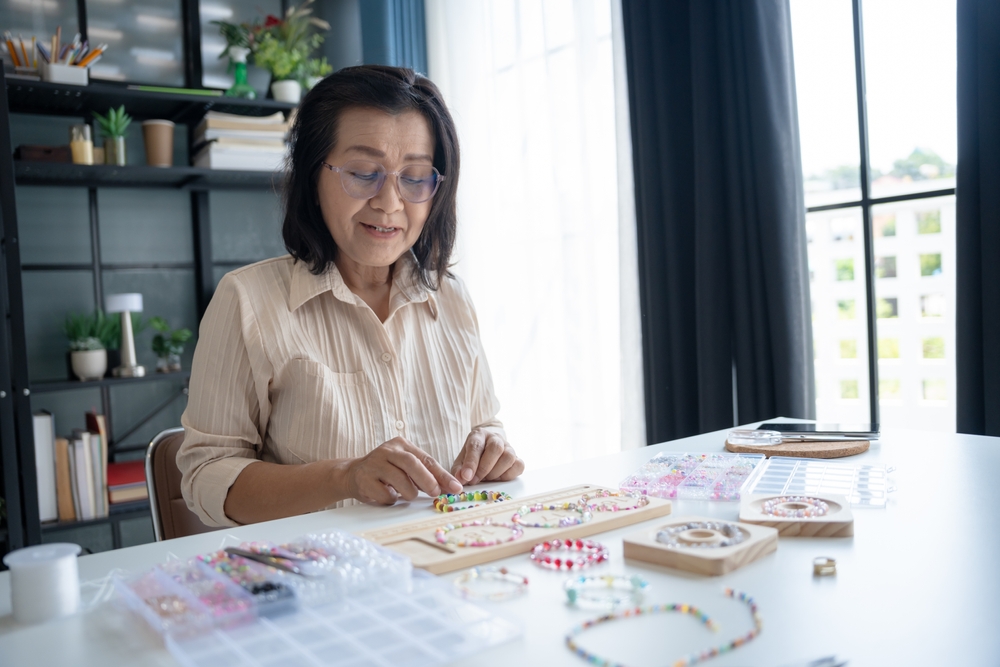
How an overlooked interest can grow into a passion after 60
There is a peculiar assumption about growing older: that by a certain age, you should already know what you like doing. You have had decades to discover your interests, after all. But what if some of your most rewarding hobbies are still waiting to be discovered?
Perhaps you have always enjoyed taking photographs but never thought of yourself as a photographer. Maybe you collect old recipes, repair broken objects, arrange flowers, sketch while talking on the telephone, or find yourself fascinated by maps, birds, buildings or family history. Perhaps you enjoy listening to other people’s stories more than telling your own.
These may seem like small habits. They may not even qualify, in your mind, as hobbies.
Yet they could be the beginnings of a passion.
The science of having something to look forward to
A hobby is more than a pleasant way to fill an afternoon. Research into ageing and wellbeing has repeatedly linked meaningful leisure activities with better quality of life, psychological wellbeing and social engagement. Activities that are mentally stimulating, creative or socially connected can help support cognitive health and emotional resilience.
The important word is meaningful.
You do not need to be extraordinarily talented. You need an activity that gives you a reason to become absorbed in something.
Psychologists sometimes describe this as flow—a state in which you become so engaged in an activity that you lose track of time. Flow is more likely when an activity is challenging enough to be interesting but not so difficult that it becomes frustrating.
This is one reason a hobby can become particularly valuable in later life. When professional responsibilities reduce, children become independent and routines change, you may suddenly have more unstructured time. A passion can give that time shape.
It can provide a small reason to get up in the morning and think, I want to do this today.
Start by looking at what you already do
The best new hobby may not be entirely new.
Look at the things you do almost unconsciously.
Do you save interesting newspaper cuttings? You may enjoy collage-making, scrapbooking or researching a subject.
Do you constantly photograph sunsets, trees or buildings on your phone? You may have an interest in mobile photography.
Do friends ask you to tell stories about your childhood? Perhaps you could explore memoir writing or oral history.
Do you enjoy rearranging furniture? You may have an instinct for interior styling.
Do you spend hours watching cooking videos but rarely cook? Try learning one regional cuisine at a time.
Do you love old songs? You might explore music history, playlist curation or collecting vinyl records.
Do you enjoy identifying plants on your walks? You could develop an interest in botany or nature journalling.
The clue is often hidden in the activities that make you curious rather than the ones you think you should be doing.
Underrated hobbies worth exploring
- Nature journalling
You do not need to be an artist to keep a nature journal. Observe a tree, bird, flower or changing sky and record what you see. Add a few words, a sketch or a photograph.
Over time, you may begin noticing seasonal patterns and local biodiversity that previously escaped your attention.
What starts as a notebook can become a lifelong study of the natural world.
- Learning the history of your neighbourhood
You may walk past the same buildings every day without knowing their stories.
Researching the history of your neighbourhood can turn an ordinary walk into an archaeological adventure. Old photographs, maps, newspapers and conversations with long-time residents can reveal how your surroundings have changed.
You might eventually create a digital archive, write articles or give informal heritage walks.
- Oral history
Every family contains stories that risk disappearing when one generation is gone.
Recording the memories of relatives, friends or members of your community can become a fascinating hobby. You can learn basic interviewing techniques, preserve photographs and organise recordings.
The result may become a family archive—or something much larger.
- Repair and restoration
In a world increasingly dominated by disposable products, repairing things can be surprisingly satisfying.
You might begin with an old clock, a piece of furniture, a radio or a treasured object. Learning how something works—and giving it another life—combines creativity with problem-solving.
It also has an environmental benefit: repairing and reusing products can help reduce waste and extend their useful life.
- Birdwatching
Birdwatching is one of the most accessible hobbies because it requires very little to begin. You can start with your own balcony, garden or neighbourhood.
As your curiosity grows, so can your knowledge. You may learn to identify species by their calls, understand migration patterns or join local birding groups.
A morning walk suddenly has a purpose.
- Handwriting and letter writing
The handwritten letter may be an underrated form of creativity.
You could write to an old friend, correspond with someone in another country or simply maintain a personal journal. You might even explore fountain pens, calligraphy or beautiful stationery.
The hobby is not merely writing. It is the art of slowing down.
- Learning to cook one cuisine deeply
Instead of trying hundreds of recipes, choose one culinary tradition and explore it properly.
Learn about its ingredients, history, techniques and regional variations. Try making one dish repeatedly until you understand it.
A casual interest in cooking can become culinary research, recipe writing, teaching or even a small community cooking group.
- Genealogy
Family history can be far more than names and dates.
You can explore migration, occupations, photographs, letters, recipes and the social history surrounding your ancestors.
But there is an important caution: family stories should be treated as stories until independently verified. DNA testing and online family trees can offer clues, but they can also produce errors or unexpected findings.
The joy is often in the investigation itself.
The secret is to go deeper, not wider
Many people abandon hobbies because they approach them as consumers.
They buy the equipment. Watch a few videos. Download an app. Perhaps attend one workshop.
Then the novelty disappears.
Passion usually develops differently.
It grows when you go deeper.
If you are interested in photography, learn about light.
If you like gardening, learn about soil.
If you enjoy birds, learn their calls.
If you collect old recipes, investigate their origins.
If you love music, explore the history behind the composers and performers.
The transition from hobby to passion happens when curiosity replaces consumption.
You stop asking, What can I buy for this hobby?
You begin asking, What can I learn?
Give yourself a beginner’s licence
One of the greatest barriers to discovering a new passion later in life is the fear of being a beginner.
You may think, At my age, I should already be good at this.
Why?
A 65-year-old learning to play the piano is not failing because they cannot play like a concert pianist. A 72-year-old learning photography is not unsuccessful because their first photographs are ordinary.
The point of a hobby is not necessarily mastery.
It is engagement.
In fact, learning something new may be particularly rewarding because it introduces novelty and challenge into everyday life. Activities that require active mental engagement can help maintain cognitive stimulation, although no hobby should be promoted as a guaranteed way to prevent dementia or other diseases.
You are allowed to be bad at something you enjoy.
That may be one of the greatest freedoms of later life.
Turn curiosity into a project
A hobby becomes more compelling when you give it a small purpose.
Instead of saying:
I like photography.
Try:
I will photograph one interesting doorway every week.
Instead of:
I want to learn about my family.
Try:
I will document one branch of my family tree.
Instead of:
I enjoy gardening.
Try:
I will grow five herbs and learn what each needs to thrive.
Instead of:
I like writing.
Try:
I will write one 500-word memory every Sunday.
Projects create momentum.
They also give you something tangible to show for your time.
Find your people
Passion thrives in company.
You may begin a hobby alone, but sharing it can transform the experience. Join a walking group, photography club, book circle, gardening community, birdwatching group or online forum.
Intergenerational connections can be particularly enriching. You may know the history of something; someone younger may know the technology that helps preserve it. You may teach someone to cook; they may teach you how to edit a video.
The exchange goes both ways.
And social connection itself matters. Loneliness and social isolation are associated with poorer health outcomes, while meaningful social relationships are an important part of healthy ageing.
A hobby can therefore become more than something you do.
It can become a reason to belong.
Could your passion become useful to someone else?
This is where an underrated hobby can take an unexpected turn.
Your interest in cooking might lead to teaching grandchildren.
Your knowledge of local history might become a walking tour.
Your gardening experience could help a community garden.
Your photography could document your neighbourhood.
Your love of books might lead to a reading circle.
Your sewing skills could become a repair workshop.
Your stories could become a memoir.
You do not have to monetise your passion. In fact, the pressure to turn every interest into an income stream can sometimes take the pleasure out of it.
But sharing what you know can give your hobby an additional dimension: purpose.
A simple experiment
If you are unsure where your hidden interests lie, try this for a month.
Make a list of ten things that make you curious.
Not things you are good at.
Not things that impress other people.
Not things you think are appropriate for your age.
Simply things you find interesting.
Then choose one.
Give it 20 minutes, three times a week, for four weeks.
At the end, ask yourself:
- Did I look forward to doing it?
- Did I become curious enough to learn more?
- Did I lose track of time while doing it?
- Did I want to improve?
- Did I enjoy talking about it afterwards?
- Would I still do it if nobody praised me?
If you answer yes to several of these questions, you may have found something worth pursuing.
It is never too late to become a beginner
Perhaps the most underrated hobby of all is curiosity itself.
You do not have to wait for inspiration to strike. You can cultivate it.
Pick up the camera. Open the old family album. Learn the names of the birds outside your window. Try pottery. Repair something. Write down a memory. Grow a plant from a seed. Learn a language badly. Explore the history of your street.
Your first attempt may be awkward.
That is perfectly fine.
Passion rarely arrives fully formed. More often, it begins as a small flicker of interest that you return to again and again.
And sometimes, the activity you once dismissed as just something I enjoy doing becomes the thing that gives your days a new rhythm, your mind a new challenge and your life a new sense of possibility.
You may not be looking for a new hobby at all. You may simply be waiting to notice the passion that has been quietly hiding in plain sight.