


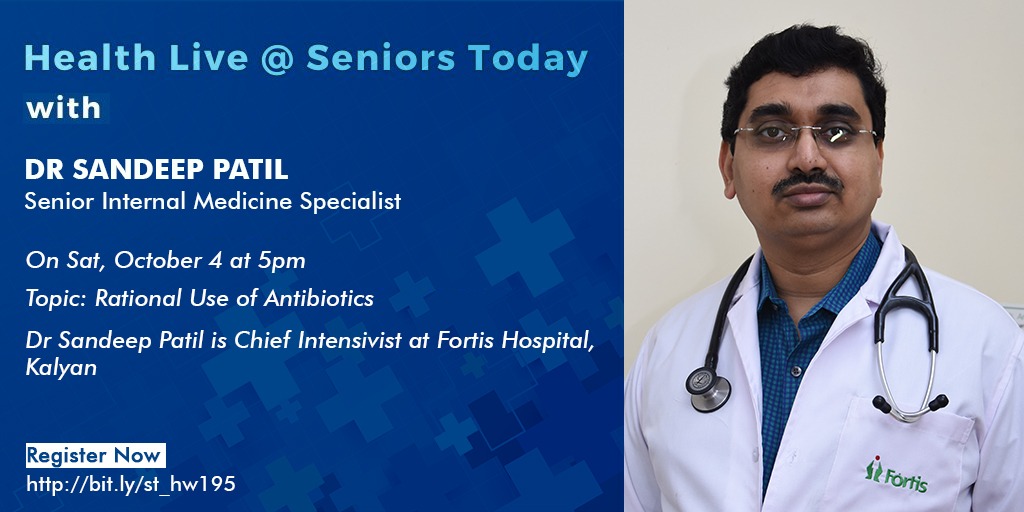
On 04 October, 2025 Seniors Today hosted their weekly health life webinar with Dr. Sandeep Patil, a Senior Internal Medicine Specialist who spoke on and answered questions about Rational Use of Antibiotics.
Dr Sandeep Patil has over 18 years of experience in Critical Care and Internal Medicine. He completed his MD in Internal Medicine from Dr VM Medical College, Solapur. Early in his career, he specialised in intensive care, earning the IDCCM and Indo-Australian Fellowship in Critical Care Medicine. He has held significant roles in the field of Critical Care and for the past 17 years, Dr Patil has been associated with Fortis Hospital, Kalyan, serving as the Chief Intensivist and Consulting Physician. Dr Patil is highly experienced in managing critically ill patients across medical, surgical, cardiological, and neurological conditions. He is proficient in advanced ICU procedures and Point-Of-Care Ultrasonography (POCUS). He also pioneered the non-transplant organ donation program in his region, demonstrating a strong commitment to public health advancement. His key areas of interest include Hypertension management, Diabetes management, Infectious Diseases, and ARDS (Acute Respiratory Distress Syndrome).
- Antimicrobials basically include antibiotics, antivirals, antifungals and anti-parasitic drugs. These are medicines used to prevent and treat infectious diseases in humans, animals and plants.
- Antimicrobial resistance (AMR) occurs when bacteria, viruses, fungi and parasites no longer respond to antimicrobial medicines.
- Anti microbial resistance is a natural process that happens over time through genetic changes in pathogens. As a result of drug resistance, antibiotics and other antimicrobial medicines become ineffective and infections become difficult and often impossible to treat.
- This increases the risk of spread of disease, severity of illness, disability, and possible death.
- Antimicrobial resistance has emerged and spread in an accelerated manner mainly due to the misuse and overuse of antibiotics to treat, prevntrol infections in humans, animals and plants.
- Antimicrobial resistance represents a global challenge. 4.95 million people who died in 2019 suffered from drug resistant infections.
- Antimicrobial resistance directly caused 1.27 million of those deaths.
- One out of five of those deaths occurred among children under five years of age.
- Resistance is a major concern due to the following reasons:
- a) resistant organisms lead to treatment failure and increased mortality
- b) resistant bacteria can spread in the community
- c) there is an added burden of healthcare cost
- Super bugs are microbes which are resistant to most of the class of antibiotics. These have a higher rate of morbidity and immortality.
- Super bugs are at a rise due to unjudicial antibiotic use, misuse of antibiotics and incomplete treatment with antibiotics.
- Antibiotics came into widespread use in the year of 1950 and the first case of antibiotic resistance was reported in the UK in 1962.
- Nearly 50% of antibiotic courses are unnecessary.
- Antibiotic resistance is a cause for concern in India because:
- India has a high disease burden and faces a significant burden of infectious diseases due to our high population and poor healthcare system. Antibiotics are crucial for treating these infections and rising drug resistance makes it difficult to combat common ailments and infections.
- Most of the hospitals are overcrowded with limited access to healthcare facilities in rural area contributing to misuse and overuse of antibiotics.
- Antibiotic resistance is also an economic burden. Expensive and prolonged treatment of drug resistance infections add to cost of treatment.
- There needs to be a judicious use of antibiotics.
- If we don’t fight antibiotic resistance by the year 2050 up to 10,000,000 people may die every year from untreatable infections. This will also lead to a reduction in the global GDP by 3.8% by the year 2050.
- WHO defines rational use of antibiotics as prescribing the correct drug for a patient’s clinical needs, in the right dose and for an appropriate duration at the lowest cost. This approach is critical for effective treatment.
- Rational use of drugs needs to be implemented by the ways of:
- Correct dose of the drug
- Right frequency of administration
- Correct route of administration
- Frequent and timely follow-up
- Usage of drug only when indicated
- Antimicrobial resistance can be prevented in the following manner:
- Following basic hand hygiene
- Staying up-to-date with recommended vaccines
- Preparing food safely and properly cooking the food items
- Avoiding improper use of antibiotics unless prescribed by a certified healthcare professional
- Strictly following your doctors advice while using antibiotics
- Never share or use leftover antibiotics