






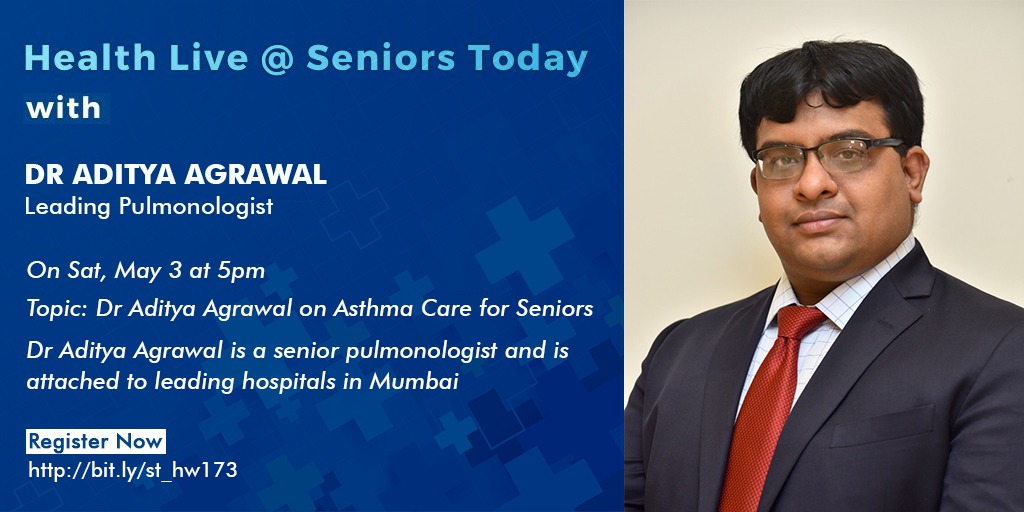
On 02 May, 2025, Seniors Today hosted their weekly Health Live Webinar with a Senior Pulmonologist, Dr Aditya Agrawal who spoke on and answered questions about Asthma Care for Seniors.
About Dr Aditya Agrawal
Dr Aditya Agrawal is a leading Consultant Pulmonologist attached to several large hospitals in Mumbai. He is extensively trained in respiratory diseases both in India and the US. His special interests are in difficult-to-treat cough, asthma, bronchitis and lung fibrosis, and runs a specialised clinic for patients with chronic cough. He is a dedicated researcher and a peer influencer in the management of respiratory diseases.
Asthma is usually a disease that starts in childhood.
We tend to misrepresent breathlessness for asthma.
Asthma most often causes breathlessness, which is why most people misinterpret breathlessness with dama, which is what asthma is called in Hindi. Which also leads to most people with breathlessness being diagnosed wrongly and hence mistreated.
Hence, making the right diagnosis for every cause for breathlessness matters.
Most people say that breathlessness is a part of ageing. This is not true. Breathlessness is not a normal part of ageing, it is a sign of something more. It is a sign of a cardiac or a respiratory disease, sometimes even muscle weakness.
Asthma is a condition where there is inflammation, swelling and constriction of the tubes of the lungs.
Patients with asthma have breathlessness because the air passing through these tubes reduces. As asthma worsens, there is even more constriction of the tubes, which becomes worse with phlegm collection around the tubes causing more obstruction in the airway.
It is a reversible obstruction which means that the obstruction and constriction of the tubes can be reversed, if treated right.
However, if not treated well and in time, it may not stay reversible forever. This results in remodelling where the tubes change their shape forever.
Asthma in seniors poses a significantly different
- Most elderly patient are often under diagnosed with asthma
- Elderly patients also have other comorbidities such as heart conditions and COPD which can be mistaken for asthma or vice versa
- There are significantly reduced perception of the symptoms
- Polypharmacy
Misconceptions about asthma are plenty:
- Asthma is a disease of the children
- Wheezing means asthma. Wheezing is the whistling sound coming from the chest. You can have several conditions where you may have wheeze.
- You can only have asthma if you have allergies. This is not a fact.
Common symptoms of a patient with asthma:
- Cough- this is usually aggravated at night and may wake you up from your sleep.
- Shortness of breath- it is impotent for the elderly to keep moving so they know if they start developing breathless to activities that were otherwise doable with a normal breathing
- Chest tightness- often happens when a lot of air is stuck in the lungs
- Wheezy or noisy breathing
Asthma triggers in daily life include an allergic reaction due to a foreign, noxious trigger. Some of these include:
- Indoor allergens such as dust mite, bed mites
- Molds
- Cold air
- Respiratory infections
- Medications such as aspirin and beta blockers
3 most important differential diagnosis while treating an elderly with breathless are:
- Asthma
- Chronic bronchitis
- Severe heart failure
The importance of correct and timely diagnosis is that the symptom control is quicker and better, adequate treatment.
Investigations frequently ordered:
- Spirometry also called Lung Function Test: it is a very simple, non-invasive test that identifies the obstructive respiratory diseases. It helps guide the treatment as well.
- Peak Flow
- Chest X ray
Treatment principles include:
- Controller medications
- Reliever medications
- Corticosteroids- these are the mainstay of treatment
It’s important that when someone has been diagnosed with asthma, there is also a proper demonstration of the technique of using an inhaler.