


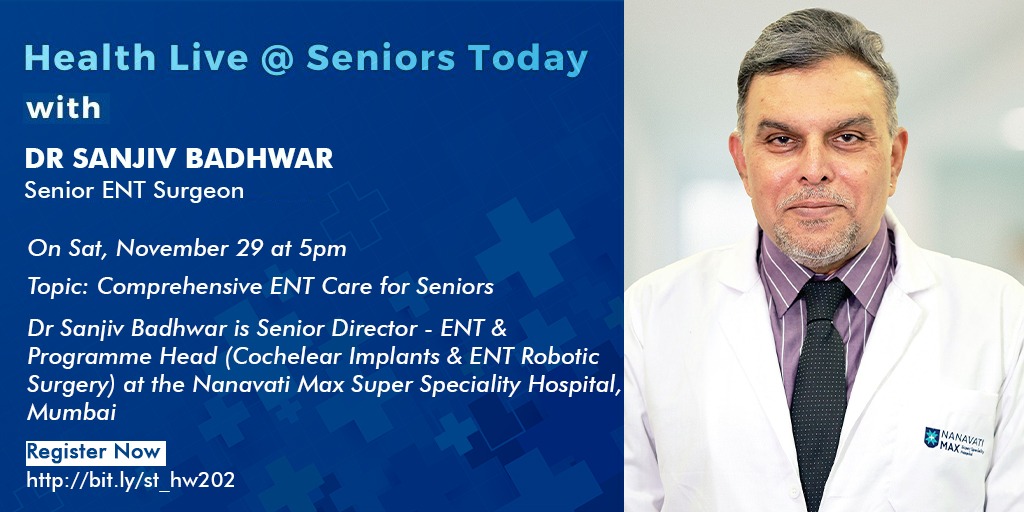
On 29 Nov, 2025, Seniors Today hosted their weekly Health Live Webinar with a Senior ENT Surgeon, Dr Sanjiv Badhwar who spoke on and answered questions about Comprehensive ENT Care for Seniors.
Dr Sanjiv Badhwar is Senior Director – ENT & Programme Head (Cochlear Implants & ENT Robotic Surgery) at the Nanavati Max Super Speciality Hospital, Mumbai. He did his MBBS from Armed Forces Medical Colleges, Pune. He did his MS ENT from the University of Mumbai. He has done fellowships and training from across the world. He spent time at the Indian Naval Hospital, Cochin as HOD of ENT. He has also spent time at INS, Ashwini, Mumbai. He has also had experience at Kokilaben hospital as Professor and Head of Department, ENT for 16 years. And now he is with the Max Health Care Group and working at Nanavati Max Super Speciality Hospital, Mumbai.
As medical professionals, there have been concerns with respect to hearing and hearing loss conditions, where it is considered as a stigma. However, it is something natural that happens as we age.
At times, it is extremely difficult to get someone to accept that he/ she has hearing loss. And also accept that there are solutions available in today’s time. Some of these can be non-invasive, others invasive- minimally so. And these solutions have been giving good results.
Hearing loss is extremely important, since as you age and your hearing becomes impaired, so does your social communication.
This can lead to limited or complete loss of interaction with friends, limited contact and communication with family and kids away/ abroad- on the telephone.
Modern medicine has shown that if you ignore hearing loss, dementia and early ageing sets in.
Hearing loss in ability to hear as well as someone with typical hearing. This may be:
- Mild
- Moderate
- Severe
- Profound
“Hard of hearing” refers to hearing loss which normally ranges from mild to severe.
Hearing solutions for age related hearing loss includes:
- Hearing aids: today we have hearing aids which are so small with AI, microchips which are not seen. Major problems associated with hearing aids include:
- Individuals don’t want the hearing aid to be seen.
- Changing the batteries of the hearing aids used to be a problem, nowadays we have chargeable hearing aids.
- Older generation of hearing aids used to amplify all sounds. Today we have digital hearing aids which amplify only the sound you need to hear, giving you a near natural hearing experience.
- They do not restore natural hearing
- Outcome varies from person to person
Hearing loss is prevalent and underrated.
Cochlear implants are done for children who are born without hearing. In this the mandate and a challenge is that the child should start speaking by the age of 5 years and go on to normal schools.
There are also paediatric interventions.
Whereas, the maximum interventions are over the age of 70 years.
If you have hearing loss, if you’re missing words- do NOT ignore it. Reach out to hearing professionals, reach out to ENT Surgeons, you are also welcome to Max Hospital which is a new jewel in western India.
Deafness and hearing loss are widespread and found in all regions of the country.
More than 1.5 billion people, nearly 20 % of the total global population, live with hearing loss.
30 million of these have disabling hearing loss ie 5% of the world’s population are disabled so they cannot interact with their caregivers or their children and the society.
It is seen that by 2050 there could be 700 million people with disabling hearing loss that is 1 in 4 people.
Hearing loss take place due to the following reasons/ causes:
- Ageing process
- Conditions like diabetes
It is recommended that in a quiet society/ residential area the ambient hearing should not be more than 60 dB. However in our cities especially during festivals it is sometimes over 120 dB.
Hearing loss affects all age groups.
- 1 in 200 children
- 1 in 5 teens
- 1 in 5 adults
Nowadays, you find people walking, exercising, sometimes even sleeping with AirPods- all these things are good in moderation, however excessive use of earphones, ear inserts, listening to loud music tend to damage your hearing.
1 in 3 of the people over the of 60 have hearing loss.
A recent study suggests for every 10dB loss in your hearing, the risk of Alzheimer’s increases by 20%.
Hearing loss is twice as common in adults with diabetes. Once in every 2 years, if you’re diabetic you should visit your ENT specialist.
Impact of hearing loss:
- Communication loss, frustration and strained relationships
- Social interactions become limited
- Withdrawal from community
- Depression, anxiety. People who suffer from hearing loss are twice as likely to suffer from depression and anxiety
- Cognitive decilen and dementia are 5 times more common
- Job impact
- Safety concern- falls are the number 1 cause for injuries in the elderly.
- Healthcare cost, more than 46% of healthcare cost is attributed to hearing loss
Treatment options include:
- Medical management- in cases of healing loss due to fluid collection in the ear, viral infections, other infections.
- In cases of nerve loss or sensorineural hearing loss the mode of management includes hearing aids. Hearing aids amplify sounds customised to the nature of hearing loss.
- Severe hearing loss or loss of clarity of speech/ sound- cochlear implant is the treatment modality. The hospital stay after a cochlear implant surgery has been cut down to 1 day with the surgery taking 1 hour.
- The cochlear implant system has 2 parts- an external sound processor and an internal implant.
- The sound is processed through the microphone present on sound processor and the processor converts those sounds into digital information. This information is transferred from the coil to the implant under skin. The implant sends electrical signals down to the electrode in the cochlea. The hearing nerve fibers in the cochlea pick up to signals and send them to the brain giving the sensation of sound.