






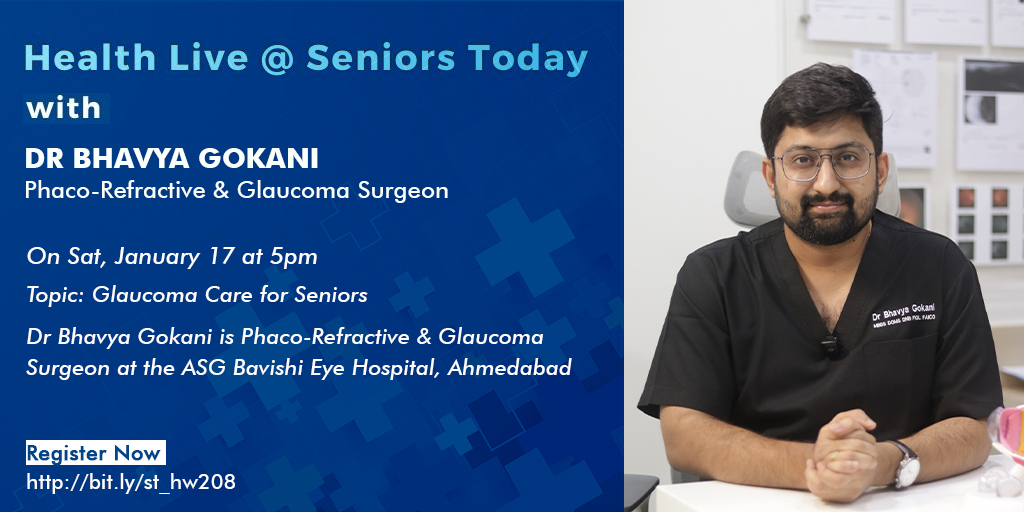
On 17 January, 2026, Seniors Today hosted their weekly Health Live Webinar with Dr Bhavya Gokani, a Phaco- refractive and Glaucoma Surgeon who spoke on and answered questions about Glaucoma Care for Seniors to mark Glaucoma Awareness month which is observed in January.
Dr Bhavya Gokani is a dedicated ophthalmic surgeon specialising in phacoemulsification, refractive surgery (e.g., LASIK) and glaucoma management. With a strong passion for restoring vision, he employs the latest techniques and technology to ensure safe, effective outcomes. His areas of expertise include- Cataract surgery & IOL implantation, LASIK & other refractive procedures, Glaucoma diagnosis & treatment and Comprehensive eye exams & vision correction
- Glaucoma in hindi is commonly referred to as “kala motiya”.
- In glaucoma, the pressure in your eyes increases and eventually causes the serious problem, which is glaucoma due to drain up of the nerves
- In glaucoma, your nerves start showing signs of degradation; they start drying up- eventually resulting in blindness.
- In glaucoma the affected parts of the eye are- optic nerve.
- When light falls on the eyes, it is filtered by the cornea. It then gets processed and falls on a screen which is the retina. From here, the processing of light takes place and goes to the brain. The image is processed in the brain.
- Glaucoma attacks your nerves, making your nerves weak.
- In most cases, glaucoma is an incidental finding. 70% of the glaucoma patients are diagnosed coincidentally.
- Glaucoma usable has no symptoms. In case there is a symptom, it is vague and is usually “diminished vision”.
- In the early stages, 20-30% of glaucoma patients have no symptoms.
- As the glaucoma progresses to further stages, your peripheral vision starts to get affected- this is called tunnel vision.
- Even in the worst cases of glaucoma, some amount of central vision is preserved.
- By the time the symptoms present, it is already too late.
- After the age of 50, you should get your eye pressure checked every 06 months.
- When you go to your eye doctor, ask them if your eye pressure is normal.
- The intra ocular pressure varies from person to person, but it should be less than 20 to 22 mm of Hg.
- If your intraocular pressure is in the range of 18 to 19 mm of Hg, it is an indicator that you are in a lesser risk zone.
- There are patients that might have glaucoma despite normal intraocular pressure.
- If you go to your ophthalmologist and get your glaucoma tests done- apart from checking your intra ocular pressure he might advise you 2 to 3 more investigations to help him visualise your nerves better. On the basis of these tests, your doctor will tell you if you have glaucoma or not.
- If you have glaucoma, most of the time, your ophthalmologist will start you on a topical medication in the form of an eye drop.
- These eyedrops help reduce the pressure in your eye.
- After prescribing the medication and use of the same for 15 days, your ophthalmologist will ask you to come for a follow up where he will check your intra ocular pressure. In this scenario, if your pressure is reduced to 19 to 20 mm of Hg, your battle is won. If not, they might increase the dose of mediation.
Misconception associated with glaucoma and the medication:
- Glaucoma medication and treatment continues for life.
This is a misconception, an attempt can always be made to stop the medication, however this must be done under the supervision of an ophthalmologist. Your ophthalmologist might use the method of drug titration.
- Patients tend to take a lot of second opinions.
Glaucoma is a disease of before and after- where you compare your tests for consecutive years and compare the degree of nerve damage.
Its better to have 1 doctor and stay with them throughout your treatment
- Glaucoma medications have severe side effects.
Glaucoma medication does have some side effects such as itching, watering and redness.
90% of the patients are comfortable with the medication started.
10% of the patients are either not compliant with the medication or not comfortable with it. In which case, you should go back to the same doctor and let them know your concerns.
- Often patients complain that they do not see any difference in their vision in comparison to their sight before starting the medication- it needs to be understood that the medication might not reverse the loss of vision, but it prevents further progression of the disease. If the medication is stopped, the disease could progress to further reducing the vision to little/ no vision in 6- 10 months.
- Glaucoma surgery is also possible and done.
- A small passage is made in the eye to help reduce the pressure in the eye.
- Surgical intervention is not the first line of action.
- Glaucoma in some cases can be connected to cataract. But cataract and glaucoma are completely different.
- A cataract surgery can be done with glaucoma however your medication for glaucoma continues even after your cat has surgery.
- Glaucoma is also hereditary. If you are diagnosed with glaucoma, make sure that you ask your relatives – kids and grand kids to get themselves evaluated.