






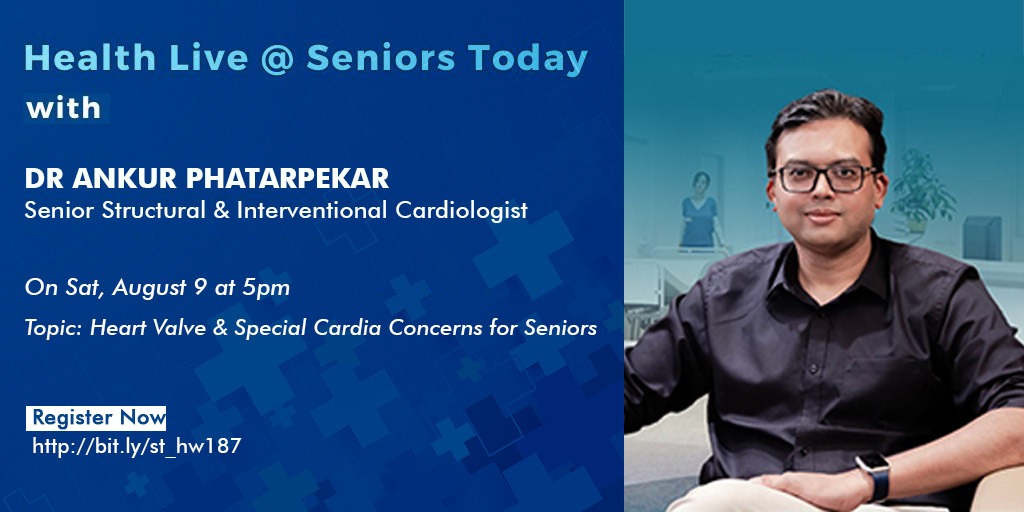
Health Live @ Seniors Today session, recorded on August 9, 2025, featured senior interventional cardiologist Dr Ankur Phatarpekar, head of the HVS Symbiosis chain of cardiac-only hospitals.
Dr Phatarpekar is an alumnus of the Seth GS Medical College. He has performed more than 300 PCI procedures as primary operator including 50 primary angioplasties in myocardial infarction (PAMI). He has significant experience in managing chronic total occlusions and use of intravascular ultrasonography (IVUS). Dr Phatarpekar has attended workshops on OCT in coronary arteries under Dr Guglielmo. He has before more than 100 balloon mitral and has performed device closures of ASD, PDA and VSD, balloon procedures of aortic and pulmonary valve, coarctoplasty.
He is also active in the upcoming field of oncocardiology, having experience of treating a special subset of cancer patients with long-term cardiac issues due to chemotherapy
He explained that the heart can be understood in four parts:
- the “pipes” or coronary arteries that can get blocked and cause heart attacks
- the “wiring” or electrical system that controls rhythm
- the “doors” or valves that open and close to regulate blood flow
- the “walls” or heart muscle itself
Dr Phatarpekar described a range of structural heart treatments he performs. These include clipping leaky valves in elderly patients who cannot undergo surgery, closing congenital holes in the heart such as ASD, PDA, and VSD with small plug devices, and ballooning narrowed valves to restore normal blood flow. He spoke about TAVI — transcatheter aortic valve implantation — which allows replacement of a diseased aortic valve without open-heart surgery, using a small puncture in the leg artery. For patients with atrial fibrillation at risk of stroke, he uses the Watchman device to seal off the left atrial appendage, preventing clot formation and allowing them to stop taking blood thinners.
On costs, Dr Phatarpekar noted that at his specialised cardiac hospitals, an Indian-made TAVI valve can be done for around ₹14 lakh and a top imported valve for ₹15–16 lakh, compared to ₹22–26 lakh in large multispecialty hospitals. They also work with charity funds, government health schemes, and offer EMI options to make procedures more affordable. He stressed that smaller cardiac hospitals can be more effective than big centres, as they offer state-of-the-art equipment — such as India’s first Abbott proprietary OCT machine in South Bombay — and are staffed entirely by cardiac-trained personnel, providing faster and more specialised care at lower cost.
In a short Q&A, he clarified that open-heart surgery simply means the heart is opened and could be for various purposes, whereas bypass surgery specifically refers to creating new blood routes around blockages. The lifespan of a bypass depends on the type of graft: all-artery grafts have a 90–95% patency rate even after 20 years, while vein grafts can see up to 60% blockage within five years.