






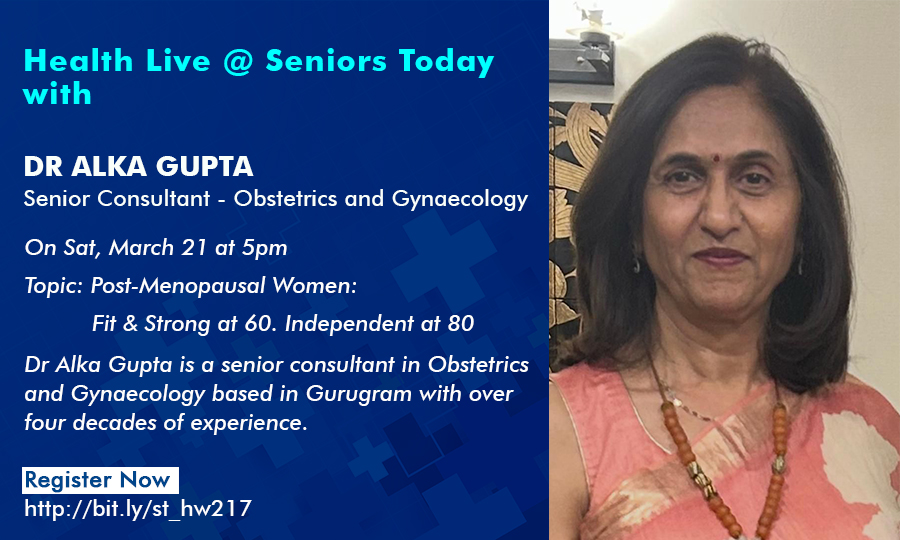
On 21 Mar, 2026, Seniors Today hosted their weekly Health Live Webinar with a Senior Consultant, Obstetrics and Gynaecology, Dr Alka Gupta who spoke on and answered questions on Post Menopausal Women: Fit and Strong at 60. Independent at 80.
About Dr Alka Gupta:
Dr Alka Gupta is a senior consultant in Obstetrics and Gynaecology based in Gurugram with over four decades of experience. Her academic journey began at Springdales School, which she completed in 1975. She then earned her MBBS from the Lady Hardinge Medical College in 1980, followed by an MD in Obstetrics and Gynaecology from Maulana Azad Medical College, Delhi, in 1985.
Dr. Gupta started her professional career at BL Kapoor Hospital and soon established herself in private practice in North Delhi. In 2005, she joined Max Hospital, Pitampura, and in 2009, moved to Fortis Hospital, Shalimar Bagh, continuing her journey of serving women with dedication and care.
Since 2020, she has been practising in Gurugram with the CK Birla Group of Hospitals, and also runs her own clinic in Gurugram offering trusted, personalised care to generations of women.
We have only one body and we need to fuel it properly, move it daily, rest it wisely and most importantly, we have to always respect it.
In this era of social media, we have all read a lot about ways to stay fit.
As women, we need to be aware of the changes that our body goes through as we age. If we are aware of these changes, it makes it easier to adapt to the new era/ phase of our life with much more ease.
The muscle of the uterus is the myometrium. It opens into the fallopian tubes which end in the ovaries which are called ande- daani in Hindi. The cervix forms the mouth of the uterus, followed by the vagina. Semen, during intercourse is deposited in the vagina.
Every month, an egg (known as the follicle which is a balloon-like structure with an egg inside) starts maturing and achieves a certain size and ruptures. The fallopian tube is operated from the ovary, picks up the egg anode and brings it to the tube. The egg, while it was maturing, the inner lining of the uterus, called the endometrium, was also increasing. Once the egg enters the tube, if there are sperms here, they come swimming up and meet the egg and one of them fertilise it. This is followed by the tubes moving the egg into the uterine cavity.
If no fertilisation occurs, a message goes to the brain that no pregnancy has occurred and the endometrial thickening has gone to waste. Then this endometrial lining gets necrosed and falls. Through the blood vessels, the endometrial lining falls except for its basal layer. The falling endometrium is what is called a “period”.
When one period is happening, another ovary starts making an egg.
Because there are a finite number of ovaries, one fine day these eggs finish. When the eggs finish, the brain continues to send the FSH (follicular Stimulating Hormone) and LH (Luteinising hormone) for the formation and maturation of the egg starts reducing their production, leading to a rise in the value of FSH and LH in our blood stream, due to lack of ovaries to act on.
Once the ovarian reserve empties, that is how we know we have entered into menopause.
When we have had no periods for 12 consecutive months and the ovaries have stopped releasing eggs is when we say the woman has achieved menopause. It is a retrospective diagnosis.
In the caucasian population it is attained by the age of 51 years.
In the Asian population, it is attained between 46-48 years of age for the majority of women.
The ovary which was earlier responsive is no longer responsive. It used to produce 2 hormones- oestrogen and progesterone.
Oestrogen is what keeps us young. Once the ovary is not producing oestrogen which is our happy hormone, many changes occur in the female body.
Oestrogen is a very powerful regulator of metabolism. Metabolism is the conversion of the food and liquid that we take into energy.
Before menopause, oestrogen directs fat to the hips and thighs, this is known as the pear shaped body. This is protective to our metabolism.
After menopause when our happy hormone is no longer being produced and the male androgens are rising, our fat shifts to the belly- leading to the apple shaped body. This belly fat silently triggers inflammation and fat overload in the organs. This raises the risk of diabetes, heart diseases, high blood pressure, high cholesterol, weak bones in women after menopause. This also leads to a decrease in the resting energy expenditure.
The REE falls by 200- 300 kCal/ day during the perimenopause and menopausal phase.
Resting Energy Expenditure (REE) or Basal Metabolic Rate (BMR) are the indices of the energy that we expend while we are resting- energy used in breathing, blood circulation, temperature regulation, etc.
The SWAN (Study of Women Across Nations) study and the WHI (World Health Initiative) have over the years given guidelines on peri menopause and menopause and beyond.
Metabolic syndrome:
You can identify if you have metabolic syndrome or not, regardless of whether you are male or female. If you have 3 or more of the undermentioned conditions, you have metabolic syndrome.
- High fasting blood sugar. Anything over 100 mg/dL
- High blood pressure
- High triglycerides. If more than 150 mg/dL, that is not good
- Low HDL (High Density Lipoprotein). It should be more than 40 mg/dL in men and more than 50 mg/dL in women
- Waist circumference. In men- 40 inches is permitted, in females it is 31.5 inches/ 80 cms (for asian women). You can measure it by placing the measuring tape between your ribs at and the pelvic bone, just above the umbilicus. Take the measurement during exhalation in the morning time, without clothes or very thin clothes.
If 3 of the above are more than the normal range, it is a silent indicator of a chronic disease. And this will need to be managed with age.
The LDL that rises post menopause needs to be kept in check.
The normal BMI is between 18.5 to 23 kg/m2 (in the Indian population).
BMI > 23 kg/m2 is over weight
BMI > 25 kg/m2 is obesity
The solution to all of this is to:
- Eat smart
- Exercise/ move daily
- Get adequate sleep and rest
- Get your regular check ups
As we age, our bones become weak. Spongy bones can lead to fragility and fractures.
Bone health is very important.
To prevent our bones from going weak, you should do weight bearing exercises, avoid smoking, limit your alcohol intake, and have a balanced diet with enough protein.
Fall prevention is very important. So is supplementation.
Post menopause, the daily requirement of calcium rises to 1200 mg/ day.
Vit D helps in absorption of calcium and the daily requirement is 600-800 IU/ day. The main source is sunlight; red meats, egg yolks are also sources. However, over the age of 50, it is not helpful because our body stops converting Vitamin D25 to D3 under our skin over the age of 50 years. By the age of 70, there is no conversion. Which gives rise to the need for supplementation.
The same holds true for Vit B12.
Some sources of calcium include:
- 250 ml of buffalo milk has 20 mg of calcium
- Lentils
- Dry fruits like almonds
- Sesame seeds
- Leaves- spinach, mustard, radish leaves, methi leaves, drumstick leaves
- Okra, cabbage
Muscle health is also just as important. It starts at 40, speeds up after 60- in both men and women. This can also lead to risk of fall and loss of independence.
We can fight it by staying active, eating enough protein, and doing regular strength exercise.
Because of thinning of the bladder and the lining of the vaginal tissues, it leads to frequent urination, urgency, and frequent urinary tract infections. 50% of women will have urinary incontinence.