



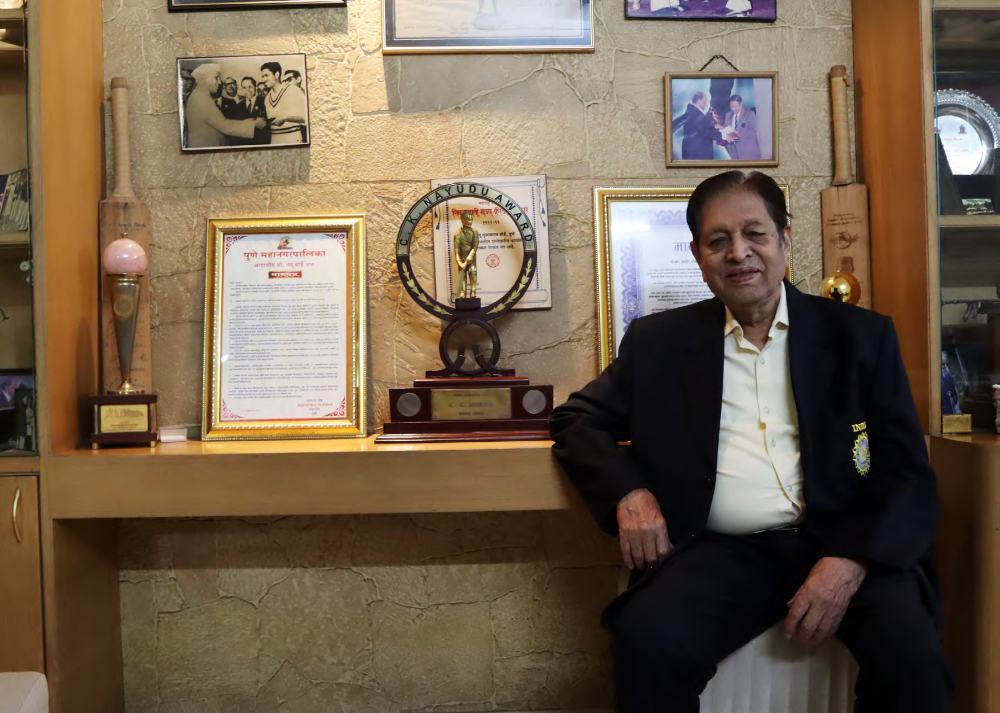
Chandrakant Gulabrao ‘Chandu’ Borde, who turns 91 on July 21, is the fourth and second-youngest living nonagenarian Indian Test cricketer. Others in this unique quintet are Chingleput Doraikannu Gopinath (95), Chandrakant Trimbak Patankar (94) and the redoubtable Nariman Jamshedji ‘Nari’ Contractor, who turned 91 on March 7 this year. Leg-spinner Vaman Viswanath Kumar turned 90 on June 22.
The list of oldest living Test cricketers is currently headed by 96-year-old Neil Harvey, the stylish top-order left-hand batsman who was part of Don Bradman’s team that played against Lala Amarnath’s side that toured Australia in 1947-48. This was independent India’s first cricket assignment. Harvey also toured India in 1956 and 1959-60.
Gopinath, the oldest Indian nonagenarian cricketer, was a stylish middle-order batsman from Chennai, making an impressive unbeaten 50 on Test debut against England at the Brabourne Stadium in 1951-52. He never quite lived up to the early promise and faded away after playing eight Tests.
Patankar, a wicketkeeper-batsman born in Pen, represented Maharashtra and Mumbai in domestic cricket and made a solitary Test appearance for India, against New Zealand at the Eden Gardens in Kolkata in 1955.
Kumar, who played for Madras/Tamil Nadu, was a leg-spinner and took five wickets in his debut Test against Pakistan in 1961. While he played in the first class format from 1955 to 1977, he wore the India cap in just two Tests.
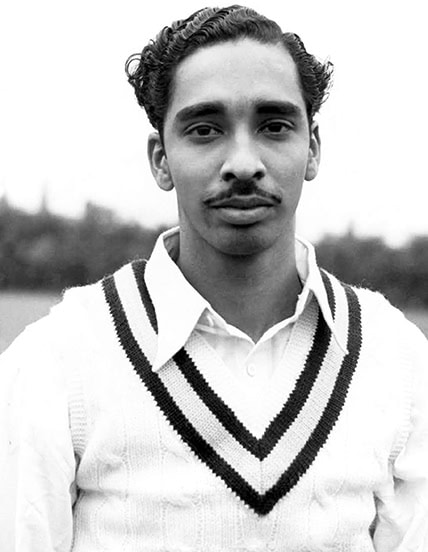

Nari Contractor, born in Godhra, has lived almost his entire life in Mumbai – at Rustom Baug in Colaba – but represented Gujarat and Railways in domestic cricket, primarily as an opening batsman.
More significantly, he played for India in 31 Tests, captaining in 12 of these – five v England, five v Pakistan, two v West Indies. Under his captaincy, India beat Ted Dexter’s England team 2-0 at home and drew all five Tests in a tense series against Pakistan in 1961-62.
Contractor batted left-handed and possessed sound technique and temperament. He led a fairly strong Indian team to the Caribbean in 1962 but could play in only two Tests before being felled by a vicious Charlie Griffith bouncer at Barbados.
This brought his flowering career to a sudden end in 1962. India were forced to find a new captain, and the mantle fell on 21-year-old Mansur Ali Khan Pataudi, heralding the start of a new era in Indian cricket.
The impact of the season ball on his temple had brought Contractor to the brink of death. Timely medical aid, including receiving a blood transfusion from rival captain Sir Frank Worrell, prayers of fans and divine benediction saw Contractor not only survive, but be an active participant in India’s cricket affairs in ensuing decades.
Contractor’s grievous injury and subsequent recovery make for one of the most poignant and remarkable stories, not just in Indian cricket, but the history of the sport.
He could never make it back into the Indian Test team, but after retiring, dedicated himself to administration, as national selector for a spell, and as conscience-keeper.


Of the Indian nonagenarian quintet, Borde is the most accomplished in terms of achievements. He played 55 Tests over a decade after his debut in 1958-59, scoring 3,061 runs with five centuries and bagging 52 wickets bowling leg-spin. He was also a brilliant fielder.
A Roman Catholic like his venerated predecessor Vijay Samuel Hazare, Borde showed fantastic all-round skills from a very young age to catch the attention of selectors.
Hazare was a top-order batsman with impeccable technique and a penchant for high scores, who also bowled smart medium-pace swing and seam. He is best remembered for making centuries in both innings of the Adelaide Test in 1947-48, a feat that was emulated by Virat Kohli in 2014-15.
Hazare was born in Sangli, played for Maharashtra, Baroda and Central India in domestic cricket.
Borde, born in Pune, played most of his cricket for Maharashtra and briefly for Baroda. He gave up bowling after back problems dogged him, concentrating on batting, and after Polly Umrigar’s retirement in 1962, was India’s mainstay in the top order. Sound in defence, and with a vast repertoire of attacking strokes, he was particularly good against fast bowling, one area in which Indian cricket had traditionally been found wanting.
Borde captained India in only one Test, at Melbourne against Australia in the first match of the 1967-68 series when Pataudi was injured. Many believed he should have been given the captaincy after Umrigar had shown reluctance to accept the post after Contractor was bounced out of the sport by Griffith in the West Indies.
But the selectors preferred Pataudi, and Borde spent the rest of his playing career as the Nawab’s deputy. In 1969, after India lost to Bill Lawry’s Australian team in the first Test at Bombay, Borde called time on his international career.
~ ~
Borde holds a special place in my association with cricket. My journey with the sport started in the 1964-65 season when Australia were touring India under Bob Simpson. India had lost the first Test at Madras. The second was at the Brabourne Stadium. I was lucky to get a ticket to the Islam Gymkhana stand courtesy of a relative.
I was 9, initiated into cricket in the past couple of years. My first heroes, Pataudi and M L Jaisimha, and Graham McKenzie and Norman O’Neill were to feature in the match. It was a dream come true.
I remember the match vividly. It was a taut match which swung one way, then the other, leading to a pulsating climax on the last day. When India, chasing 255 to win, lost their eighth wicket (Pataudi) at 224, it seemed all over bar the shouting. With only the tail remaining, Australia looked likely winners.
The one specialist batsman still in the middle was Borde. He had batted steadily, showing no nerves or panic, picking up runs without undue risk. Borde was now the focus of attention of all spectators, egging him on to do the unexpected. In Inderjit Singh, Borde found a plucky ally. Between them, the pair eked out the runs in a nail-biting finish. India won with two wickets to spare. The crowd went berserk. I had found a new hero.
Borde was to be India’s batting hero again in the second match that I saw. The mighty West Indies led by Sir Gary Sobers were touring. The first Test was at Brabourne Stadium. Against the formidable attack featuring the dreaded pace duo Hall and Griffith, with Sobers, Gibbs and Holford in support, India’s batting was under immense pressure very early, losing three wickets for a mere 14. In that situation, Borde came out to play one of the finest counter-attacking knocks seen, smacking 121 with 15 fours.
By this time, Borde had climbed many more notches in my estimation. By the end of the series, after notching up another century (125) at Madras, he had become my favourite Indian batsman.
~ ~
I got to know Borde personally, a year or two into my career writing on cricket. Sharad Kotnis, my first editor at Sportsweek magazine where I cut my teeth, once sent me on assignment to Pune to interview Professor D.B. Deodhar, popular then as the Grand Old Man of Indian cricket, and celebrated coach Kamal Bhandarkar, who had at one stage assisted Sunil Gavaskar with his game. “And while you are in Pune, also meet Chandu Borde,” said Kotnis. “He will make you see cricket in a new light.”
I was somewhat sceptical, but after meeting Borde, I realised that Kotnis was not being extravagant in his praise. The couple of hours I spent with Borde opened up new dimensions about playing cricket, both in the technical sense and the mental aptitude needed.
Over the next few decades, Borde was somehow at several significant inflection points in Indian cricket, and much sought out by the media.
For instance, he chaired the selection committee which picked the 1983 World Cup winning squad under Kapil Dev. It was largely on his insistence, as Kapil affirmed, that the Indian squad was packed with fast-bowling all-rounders like Mohinder Amarnath, Madan Lal and Roger Binny, apart from the captain himself. “His knowledge of English conditions helped make this decision,” Kapil acknowledges.
Things didn’t quite go in Kapil’s favour a year-and-a-half later when the selection committee, which included Borde, dropped the star all-rounder for playing a rash stroke in the Delhi Test. The third Test at Kolkata is the only one which Kapil missed in a stellar career. Borde says he was one of five selectors that took the decision which still invites criticism and controversy.
In 1989, Borde was manager of the Indian team which toured Pakistan under Krishnamachari Srikkanth. The youngest member of the team was 16-year-old prodigy Sachin Tendulkar. He took the task of mentoring and nurturing Tendulkar to heart. When the youngster was found sleepwalking, Borde, afraid that he might hurt himself more than anything, gave up his single room to sleep with Tendulkar and keep him under close watch, so to speak.
In 2007, when Greg Chappell gave up his post as chief coach of India, the BCCI leaned on Borde to take his place and assist skipper Rahul Dravid. India won the Test series after 21 barren years. Pertinently, India haven’t won a series in England since.
~ ~

Ever since I got to know Borde personally, I’ve kept the association intact and often leaned on him to understand issues and affairs pertaining to the sport. Over the 40-45 years I have known him first hand, what’s impressed me most about Borde is how he’s kept in tune with changes in cricket’s ethos, technique, trends. While he’s aged in years, he retains an inquiring mind, curious about new developments and new players.
I’ve moderated a few sessions involving him over the years and have admired his clarity of thought, his candour, and utter absence of bitterness. He is not one of those who says or thinks that the past was splendid and the present is unfulfilling.
“This attitude, taking each day as it comes, wanting to learn new things, is what keeps me going,” says Borde.
Of modest habits – he eats frugally, has the occasional glass of wine – what he enjoys most is his physical regimen. Till a decade back I remember he would be at the Poona Club, perambulating the cricket oval for a couple of hours. With advancing years, he’s cut down on the distance, but not on the frequency: he’s on his walk diligently, every morning.
“Every step is a challenge, in exercise, advanced sport or life. It gives me lofty thoughts,” he says. “Walking clears up my mind of any negativity, fills it with lofty thoughts.”
What better state of mind to be in?
Main pic by Anand Chaini

