






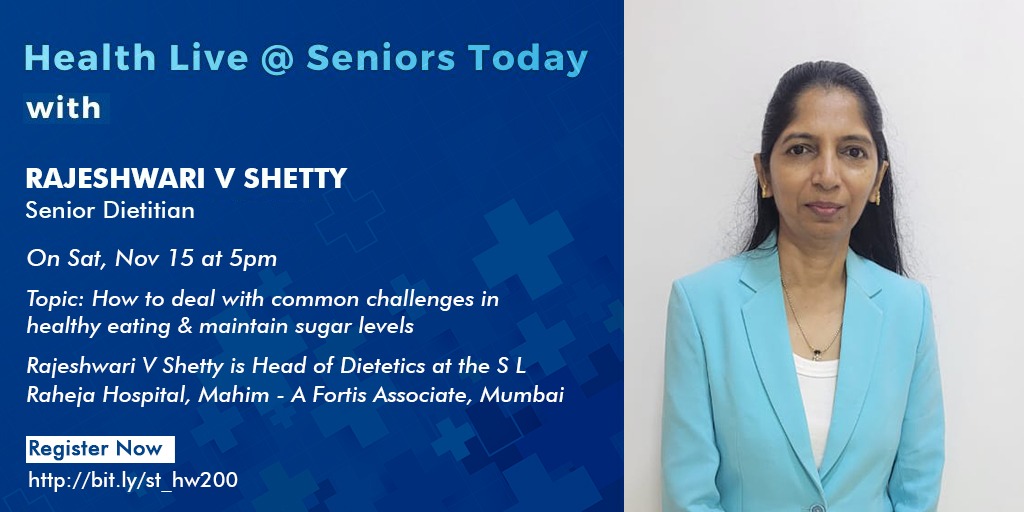
On 15 November, 2025, Seniors Today hosted their Weekly Health Live Webinar with a Senior Dietitian, Rajeshwari V Shetty who spoke on and answered questions on How to deal with common challenges in healthy eating & maintaining sugar levels.
Rajeshwari is the head of Dieticians at the SL Raheja Hospital, Mumbai, which is a Fortis Hospital associate. She is the HOD of Clinical Nutrition. She has over 3 decades of experience in clinical nutrition, patient care, research and training. She is a registered dietician and holds multiple post graduate qualifications including in healthcare Management, clinical research and dietetics. Additionally she has specialised training in oncology nutrition through a collaborative course with DBA Tata Memorial Hospital.
- When you’re diagnosed with diabetes, your Dietician takes a record of everything that you eat and makes a diet plan for you accordingly.
- As you age, you start finding it difficult to follow that diet plan. This is because one starts facing more challenges in their eating pattern as they age. This can include:
- Reduced appetite. Solution: have a one pot meal. Eg: khichdi, soups, etc.
- Reduced physical activity. Solution: try a small duration of exercise that is divided throughout the day.
- Oral/ dental issues. This results in the patient being unable to chew the food properly. Solution: have mashed/ pureed food items.
- Decreased thirst/ need for water intake. This can lead to an increase in the risk of urinary tract infection, kidney stones, leg cramps. Solution: instead of having water, have fluids all day in the form of soups, buttermilk, lemon water, nimbu pani etc. in addition to some amount of water. You can have 4-5 glasses of water in addition to the bone mentioned fluids.
- Loneliness sets in as you age. If you are alone, you lose interest in making food and in eating food as well. Solution: try attending religious functions (if you have a religious inclination) or senior programs and functions where there are community meals available. This not just ensures that you eat but also helps you socialise.
- Constipation or ingestion. Solution: Roasted flax seeds can be powdered and incorporated into your food items. Two teaspoons are enough. You can also have soups to ensure you get your fiber intake. Boiled vegetables can also be added to your diet.
- Malnutrition.
- With so many issues and concerns in the seniors, it is a challenge to maintain the blood sugar levels in senior citizens.
- Malnutrition can cause uncontrolled blood sugar levels, sepsis, and other serious health problems.
- Once malnutrition creeps in you are more susceptible to infections, your immunity goes down.
- You can add Ghee or butter to your one pot meals/soups/dals. You can also add omega-3 oil.
- Make use of nutritional supplements such as sprinklers which can be directly added into your food. This will add protein and calories to your meal, thus helping in your daily nutrition.
- To balance your sugar levels, you need to ensure that your meal contains protein. Protein can come in the form of milk and milk products (if you’re a vegetarian), eggs, chicken (if you’re non vegetarian)
- You also need to incorporate some amount of fibre. Fibre will come in the form of cooked dals and vegetables.
- Your meals should be low in fat and have complex carbohydrates.
- Avoid refined food items.
- Keep yourself well hydrated. 8-10 glasses are advised, but if you cannot have that, have other fluids as advised previously.