






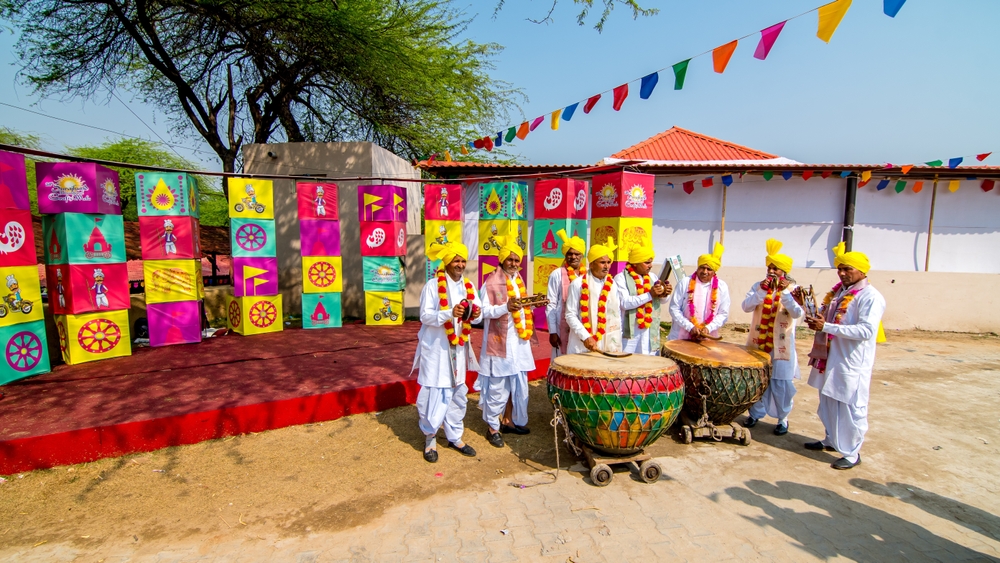
For generations of Indians, the annual mela was where communities came alive, memories were made and the simple joy of being together was celebrated, writes Vickram Sethi
Mele me le jaana hoga…
Jhumka dilaana hoga…
Nakhre uthaana hoga…
Sarpe bithaana hoga…
There was a time, not so very long ago, when the word mela carried a particular kind of magic. Close your eyes and you can probably still see it: dust rising beneath thousands of feet, makeshift stalls draped in bright cloth, the mingled scent of jalebis sizzling in great iron pans. Chaat stalls calling out to you, the smell of oil frying pakodas and kulchas, mithai stalls tempting the children, and parathas bigger than pizzas, meant to be eaten with halwa. There were aachars of every kind, from karela to bamboo, papads, phulwadis and all manner of eatables, sharbats and, of course, those wonderful soda bottles with marbles in them, giving you the satisfying burp of masala soda or even masala cola.
It promised something more than commerce or entertainment. It promised belonging.
Beyond the food stalls stood pavilions selling steel cupboards, furniture, kitchen utensils, dhurries, carpets, clothing, make up and all sorts of pretty kitsch. The local performers, the clowns, the tamasha artists and the Well of Death riders, so many of them have now lost their livelihoods, and one wonders where they have gone.
Unlike today’s highly personalised entertainment, where each of us stares at our own little screen, the mela encouraged people to participate together. Families laughed together, watched performances together and made memories together. For generations, the mela was the heartbeat of community life. It arrived with the changing seasons or the turning of the religious calendar, transforming ordinary fields and town squares into vibrant worlds of colour, sound and human connection.
Every local shrine, big or small, held its annual gathering in the form of a mela on a particular date in the season or religious calendar. Many of us grew up watching Hindi films with a mela scene where the boy meets the girl, or brothers get separated in the crowd, only to find each other years later. That was how deeply the mela was woven into our rural life.
Farmers travelled from distant villages. Artisans displayed their finest work. Children tugged at their parents’ hands, desperate for one more ride on the hand cranked Ferris wheel. And everywhere, people talked, laughed, gossiped, bargained and shared news about families from places they might never visit themselves. Distant relatives met each other at the mela, it was often the only occasion that made this possible. Eligible boys and girls caught sight of each other too, and many a match was quietly noticed there, if not quite arranged.
One of the loveliest things about the mela was how it brought everyone together. Families, neighbours and friends gathered in large numbers and spent hours enjoying the festivities. It was one of the few places where people from different backgrounds mingled freely. There were no membership fees, no exclusive sections and no barriers. Everyone was welcome. The mela helped create bonds that held communities together.
A mela was much more than a fair. It was a social occasion, a cultural celebration and a community event, all rolled into one.
Today, those memories feel increasingly fragile. The melas that once drew entire districts together are growing quieter, smaller or disappearing altogether. The fields where they stood now hold shopping complexes, or simply lie fallow. The craftsmen who once showcased their wares have grown old, and their skills have passed down to fewer and fewer successors. The communities that once gathered beneath those cloth canopies have scattered into cities, suburbs and the isolating glow of screens.
What, exactly, have we lost?
More than a marketplace
It would be easy to call the mela a market, and certainly trade was part of its purpose. But to call it merely a market would be to miss the point entirely. The mela was a social institution, a place where the fabric of community life was woven and rewoven each year. Its disappearance is about far more than the loss of a fair. We have lost a shared experience.
The mela also supported local craftspeople, performers and small traders. It gave people a chance to show their skills and their products directly to the public. Many traditional art forms have struggled as these platforms have quietly disappeared.
This erosion did not happen overnight. It has been a slow, steady process, shaped by forces both economic and cultural. Safety regulations, rising costs, complicated permissions, law and order concerns and changing lifestyles have all played their part.
Urbanisation, too, has had its effect. As families migrated to cities in search of work and education, the villages that once hosted melas grew emptier. The young people who might have carried the tradition forward are now office workers in distant cities, connected to their roots by the odd phone call rather than by annual gatherings.
The rise of modern retail has taken its toll as well. Why travel miles to a dusty fairground when the same goods, and many more besides, are available in air conditioned shopping centres or, these days, at the tap of a mobile phone? The convenience is undeniable. But something essential is lost when commerce is stripped of its social dimension, when buying becomes a solitary act rather than a shared ritual.
The melas have not vanished completely. In some regions, particularly those with strong religious and cultural traditions, large gatherings still take place. Some governments have made efforts to promote and preserve these local heritage events, recognising their value not only for tourism but also for social cohesion.
Whether or not the mela returns in any meaningful way, it is worth pausing to honour what it represented. It was a testament to our very human need for connection, for celebration and for the comfort of familiar rituals repeated across generations. It reminded us that we are not merely consumers, workers or individuals chasing our separate destinies. We are members of communities, bound together by shared history and shared experience.
Those of us who can still recall the melas of our youth carry something precious within us: the memory of what it felt like to belong to something larger than ourselves. That is worth passing on, in our stories if not in practice, to those who came after us.
For in the end, the mela was never really about the sweets, the bangles or the Ferris wheel. It was about us, gathered together under an open sky, remembering who we are and where we come from.