






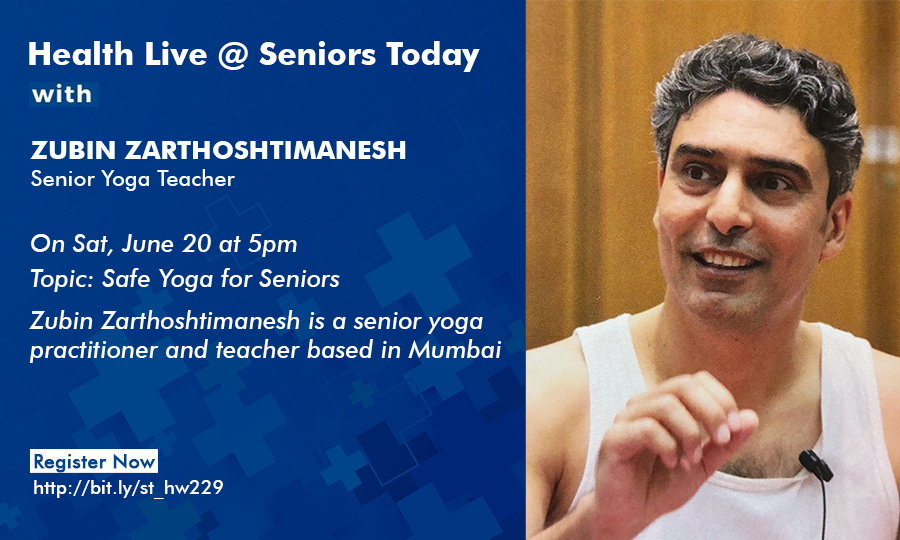
On 20 Jun, 2026, Seniors today hosted their weekly Health Live Webinar with Mr Zubin Zarthoshtimanesh, a Senior Yoga Teacher, to mark World Yoga Day which is celebrated on 21 Jun. Mr Zubin Zarthoshtimanesh spoke on and answered questions about Safe Yoga for Seniors.
For over 35 years, Zubin Zarthoshtimanesh has been a dedicated Iyengar Yoga practitioner and teacher, known for his depth of practice, precision in teaching, and unwavering commitment to the classical principles of yoga. Based in Mumbai, India, he has been teaching at his own centre for more than three decades, guiding generations of students with clarity, discipline, and compassion.
Mr Zarthoshtimanesh has been a direct student of Guruji B. K. S. Iyengar since 1988, and his teaching reflects the rigour, philosophy, and experiential wisdom of the Iyengar tradition. Over the years, he has emerged as one of the senior teachers invited to lead major national and international conventions.
Mr Zarthoshtimanesh has served as the principal teacher at several prestigious Iyengar Yoga conventions across the world, including:
- UK Iyengar Yoga National Conventions (2010, 2012)
- World Yoga Society, Reading, UK (2015, 2016)
- Indo‑China Yoga Convention, Chengdu, China (2015, 2016, 2017)
- Toronto Iyengar Yoga Centre, Canada (2016)
- Iyengar Yoga National Conventions in Germany and France (2018)
- National Convention in Hakone, Japan (2018)
Alongside his international work, Mr Zarthoshtimanesh has continued to teach a long‑running class in Matunga, Mumbai, which he has conducted consistently for 35 years, making it one of the most enduring teaching commitments in the Iyengar community.
- It is very important to look for a genuine yoga teacher, since in todays time, there are many trainers adn gym trainer who might claim to know yoga simply because certain exercises resemble some asanas.
- A yoga teacher not only should know the asanas, but should also have knowledge about the human body.
- When starting yoga, you need to understand that the body, mind and all the sensations that you have are an amalgamation of everything good inside of us. It is what makes us. You cannot exclusively work on one thing without working on the other.
- Yoga is not just about holding difficult poses and standing on your head. You need to start slow and work your way up to a point where you can do all of those things.
- Yoga helps mould your consciousness in different ways.
- Each and everyone of us has a different starting point, which is why there are so many variations in yoga as well.
In yoga, and generally in life as well, there are only 3 positions:
- Standing
- Sitting
- Lying down
- It is only in these 3 positions that we exist in our whole life.
- This also tells us about the narrowness of our range of movements.
- Yoga helps dwell deeper on the above statement. This is how the asanas are born.
- We know so much about the things outside of us, but the question remains, how much do we know about the things that reside within.
- Yoga is an art, a piece of heritage which has been passed down to us through generations.
- Yoga talks about enriching our subjective consciousness.
- A genuine yoga teacher will help you penetrate these depths and understand them better.
- The starting point for us all might be different but the idea is the same- exploration.
- Yoga has something for all.
- There are 300 asanas in yoga.
- Asana and exercise is not the same. There is a lot of depth and philosophy in asana which is found absent in exercise.
- The philosophy of yoga was put together by Patanjali, in the 3rd Century A.D. and that is where he mentions Ashdhanga Yoga. It spoke about the 8 folds of yoga.
- Yamas- social ethics
- Niyamans- personal practices
- Asanas- poses/ postures. It includes exploration of the body as whole.
- Pranayama- mindful breathing
- Prathyahara- turning inwards. How to organise and work with your senses
- Dharana- concentration. Concentrated mind
- Dhyana- de concentration. Evolved mind
- Samadhi- pure bliss. Realisation
- Through asana, you are exploring all the limbs of yoga. You are exploring the principles, the breath, and senses.
This was followed by a live demonstration of some universally safe asanas by Mr Zubin Zarthoshtimanesh.
- Tadasan
- Stand with your feet together, your head and heel in 1 line against a wall.
- See where your shoulders fall, how and where is your spine positioned, the back of your legs- are they toughing the wall or not?
- This will help give you a good idea as to how you’re carrying yourself everyday as you walk, stand and function everyday. Become sensitive to your standing position.
- Sitting can do a lot of harm to your back and your spine.
- The spine is the home of the nerves. Yoga focuses on the spine.
- Adho Mukha Svanasna (Downward facing dog)
- Get down on all fours and put your hands out, as wide as your shoulders.
- Then lift yourself up and move the spinal muscles.
- Move towards the legs, extending your arms and legs.
- Try not bending at the knees and keep your legs straight.
- While doing this asana, you are removing the load from your spine.
- You can make use of props to help maintain better position and posture while doing asanas.
- Your body adapts with time.
- There are many people who may know the asanas, but they might not be aware of what is going on in their body during the asanas.
- Virabhadrasan:
- Spread your legs shoulder width apart and turn to one side with 1 foot out. 1 foot should face you, the other will face the side.
- Bend the leg facing in front, in such a way that upon bending the knee, the thigh comes parallel to the floor.
- Spread your arms wide apart
- Keep switching your legs
- The knee and hip should be in 1 line when you’re practicing these asanas
- Supta Padangusthasan:
- Lie down
- Take the help of a belt/ dupatta to access your foot
- Keep your back leg against the floor and foot against the wall
- Lift the other leg up and try to pull the dupatta/ belt with your hands
- While doing this, try to connect with your hips
- Change the leg and repeat
- Veerasan:
- Sit between the feet whilst keeping a pillow between your leg and thigh at your knee.
- Keep a pillow under your back and lie down straight on the floor.
- This position helps you to inhale more.
- Similarly, you can keep the pillow below your legs, that will help you exhale more.
- You can learn to inhale and exhale more or less.