






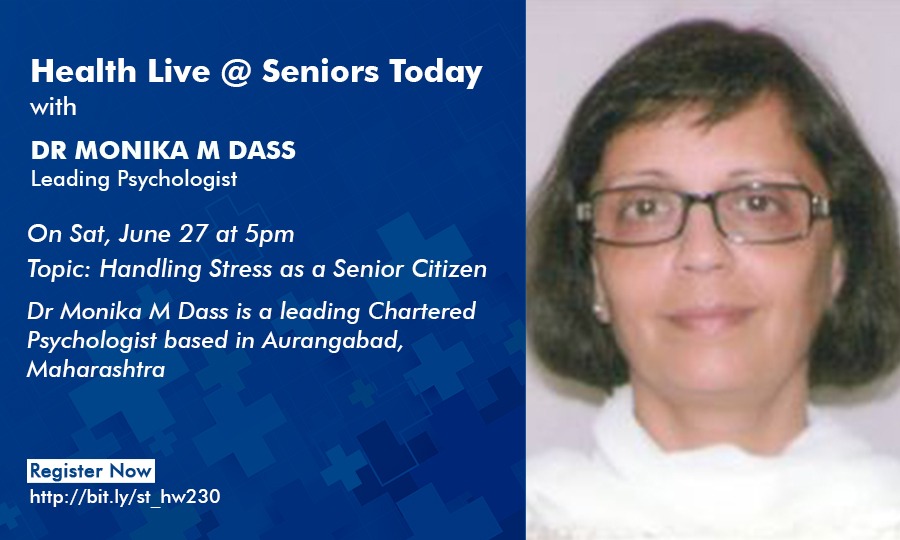
On 27 June 2026 Senior’s Today hosted their weekly Health Live Webinar with a Leading Psychologist, Dr Monika M Das who spoke on and answered questions about Handling Stress as a Senior Citizen.
Dr Monika Dass is a Chartered Psychologist, a Chartered Scientist and an Associate Fellow of the British Psychological Society, UK. Professionally, she has counselled around 15,000 individuals in a span of 20 years and has published several papers in both Indian and international journals.
A trained pianist and vocalist from the Trinity College of Music, London, Dr Dass has influenced many lives with the joyful learning of music. She has been actively involved in several popular musicals such as The Sound of Music, Joseph and His Amazing Technicolour Dreamcoat and so on…with her expertise in developing children through drama. She firmly believes that any extracurricular activity can help tap into one’s potential and bring out the best in an individual.
Handling stress as a senior citizen relies on an actionable blend of daily physical movement, consistent social connections and proactive mental relaxation to help manage late-in-life transitions.
You need to be socially connected with not just your family but also your friends and people around you, people in society. You need to stay mobile and try to meet people. Being Proactively involved for your own mental relaxation is extremely important to be able to manage the transition to becoming a senior citizen in his retirement years.
Managing late life transitions is a major issue and the 3 things that will help you ease that transition are mentioned above I.e.
- Daily Physical Movement
- Consistent Social Connections
- Proactive mental relaxation
Some targeted strategies include
- Move your body daily : Gentle Physical Activity like long nature walks, swimming, or light yoga helps regulate your stress hormones and helps in releasing physical tension without straining your joints.
- Practice Mindfulness : Incorporating intentional deep breathing exercises or guided meditation for just a few minutes each day can easily calm a racing heart and also help clear racing thoughts. Meditation immediately relaxes your heart rate and brings down whatever tension is there in your body thereby helping you focus better.
- Combat Isolation : Stay connected with your loved ones or try joining peer support groups to share your feelings with people who might understand. It is important that you find like-minded people going through the same transition so you can enjoy your time with them and not solely depend on your family.
- Adjust to retirement : Adjusting to retirement is not easy, it is a huge life change. Retirement is a state of mind. You can retire from your main job but you can get involved in something else and keep yourself busy by doing things that you enjoy. Retirement is not merely about sitting in your chair watching TV all day and just doing mundane things. You need to keep your mind going and it is important to remember that you may retire from your world of work into things that you enjoy and keep yourself extremely busy, such that you don’t have time to think or feel sorry for yourself.
Signs of stress in people over 60 years of age include:
- Physical signs :
- Frequently experiencing headaches
- Muscle Tension
- Upset Stomach
- Chest Pain
- Persistent Fatigue
- Increased frequency of minor illnesses (Common Cold) due to a weakened immune system
- Behavioural Signs :
- Noticeable changes in sleep pattern (Such as trouble falling asleep or waking up at night)
- Changes in eating habit – overeating or loss of appetite
- Lack of interest in previously enjoyed activities
- Magnesium solution/ Lotion application at night helps you sleep better. It is particularly important for those who are suffering from sleepless nights
- Cognitive Signs
- Increased Forgetfulness
- Poor Concentration
- Difficulty in making decisions
- Emotional Signs
- Uncharacteristic mood swings
- Increased Irritability
- General Sadness
- Expressions of feeling overwhelmed and helplessness- these feelings arise mostly when you are in a situation when you are not in control.
Physical movement can include:
- Gentle exercises: exercises like Tai- Chi are excellent for boosting balance and also help in lowering stress. For individuals suffering from mobility issues chair yoga and sitting stretches provide great benefits without the additional strain on the body.
- Stress balls: Physical tension can be related while also increasing your dexterity and grip strength with stress balls or exercise balls.
- Nature walks: they are simple, unhurried walks in nature that help establish a daily routine and also helps keep anxiety at bay.
Mind and body relaxation activities include:
- Deep breathing: taking slow, intentional deep breaths for just four minutes can help in reducing your cortisol levels significantly and also activates the body’s natural calming response.
- Mindfulness and Reflection: practicing guided meditation, listening to nature sounds or spending quiet time alone, or unplugged time journalling helps promote metal clarity.
- Stimulus reduction: limit your caffeine intake, alcohol intake and excessive combustion of bad/ negative news. These are proven to aggravate symptoms of anxiety and also cause disrupted sleep.
Social and emotional support can include:
- Maintaining connections: fostering a community and connection through regular phone calls, joining your local seniors clubs or participating in community groups helps ward off isolation and keep you better connected.
- Professional support: to help you overcome persistent worry, licensed online therapy/ counselling can be game changers
- Consider a pet: the companionship of a pet can significantly lower your stress levels, all of this is provided the physical and financial logistics of pet ownership are feasible.
Cognitive engagement:
- Creative hobbies: Engaging in activities like gardening, painting, or listening to music provides personal fulfilment and a healthy outlet for expressing emotions.
- Brain Games: Keeping the brain active and focused through diverse exercises in large print helps improve mental well-being and quality of life. You can also do the daily crossword or sudoku.
If you are in a stressful situation, such as a distressing conversation or argument, you can do the following to help relax yourself:
- Folding your arms across
- Crossing your legs, in case your sitting.
- Folding your hands on your lap and crossing your legs slightly.
- Finger fists, thumb enclosed, hands in pocket — looks rude but helps with defending yourself when being attacked by anyone close to you (not physical closeness).
- Moving out of the firing zone quickly. Smile slightly and move away. Create distance… use furniture etc, if in the house.
- Watching for known signals of attack. Learn to protect yourself.
- Breathing Technique: breathe in for 5 counts with your eyes closed very slowly. Hold your breath for another 5 counts and then exhale for 5 counts slowly.
- Defocus on your Emotions.
- Do not argue. Try and calm the person down, if you can.
- Take a half stance; do not stand face-front fully.
- Call for help, if you cannot manage.
Some quotes that caught Dr Monika’s eye and could be helpful to our audiences:
- Breathe. Let go. And remind yourself that this very moment is the only one you know you have for sure
- It’s not the load that breaks you down, it’s the way you carry it. A good way to overcome stress is to help others out of theirs.
- No work is stressful. It is your inability to manage your body, mind and emotions that makes it stressful.
- 90% of what you’re stressing about right now won’t even matter a year from now. Take a deep breath.
- The greatest weapon against stress is our ability to choose one thought over another.