






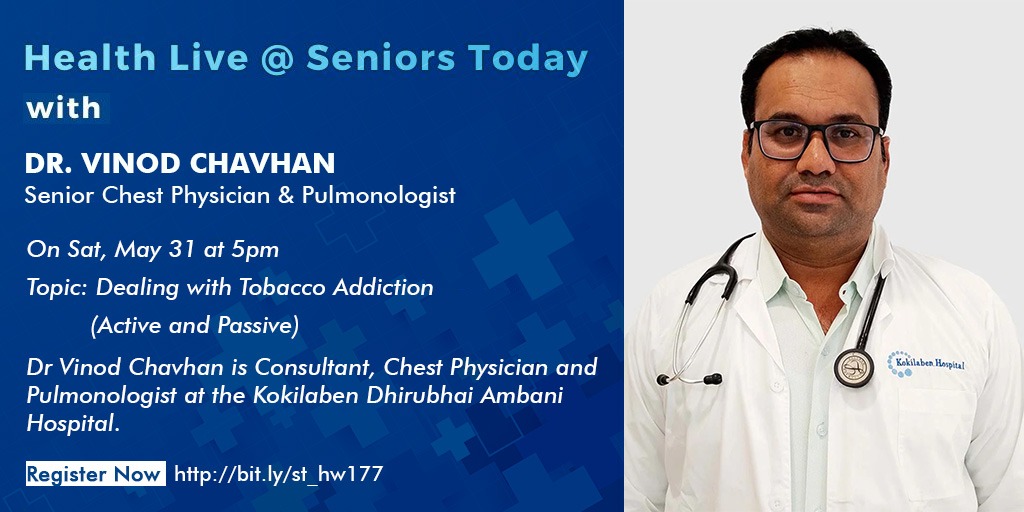
On 31 May 2025, Seniors Today hosted their weekly Health Live Webinar with a Senior Chest Physician and Pulmonologist Dr Vinod Chauhan, who’s spoke on and answered questions about Dealing with Tobacco Addiction.
About Dr Vinod Chavhan
Dr Vinod Chavhan is Consultant, Chest Physician and Pulmonologist at the Kokilaben Dhirubhai Ambani Hospital.
He has done his MBBS from the MGM Medical College, Navi Mumbai. He also holds a fellowship in the College of Chest Physicians, USA. Additionally, he has a Diploma in Chest Medicine from Nanavati Max Hospital, Mumbai. He has performed over 500 flexible bronchoscopies showcasing his expertise and dedication to patient care. He is experienced in various areas including bronchoscopy, lung biopsy, interstitial lung diseases (ILD) and asthma. His knowledge and proficiency in these areas ensures that the patients get the best care.
Tobacco consumption is a big problem, not only in our country but all over the world, which makes it important to spread awareness and knowledge to everyone, in all age groups.
Tobacco is available in various forms, including:
- Smoked tobacco
- Cigarettes
- Cigars
- Bidhi
- Hookah
- B) Smokeless tobacco
- Chewing tobacco
- Snuff
- Gutka
- Pan masala with tobacco
- C) Emerging Products
- E cigarettes/ vapes
- Heated tobacco products (HTPs)
The smoked tobacco is prominently affecting our lung capacity.
Smokeless tobacco are consumed through the oral cavity, thus they cause oral pathologies such as oral cancer
E-cigarettes are also problematic
Smoking is the most common form of tobacco consumption. Smoking is a global epidemic, especially in low and middle-income countries.
Tobacco consumption is a leading cause of preventable disease and death.
Over 8 million people die annually due to tobacco use. All of these deaths are not directly due to tobacco consumption but also due to the effects of tobacco consumption of the cardiovascular, respiratory, cancers and other systems.
People usually start smoking in adolescence and early adulthood. This can be reduced by spreading awareness and educating the children and young adults.
Types of smoking:
- Active smoking: direct inhalation by the smoker
- Passive smoking: also called Secondhand smoke. This is the smoke inhaled by non- smokers when they are around active smokers.
- passive smoke contains over 7000 chemicals, hundreds of which are toxic.
- passive smoking can cause diseases such as asthma, heart diseases in children and adults
Some health related issues associated to smoking:
- Lungs: lung cancer, COPD (Chronic Obstructive Pulmonary Disease), Asthma
- Heart: Heart attack, stroke
- Other cancers: smoking Cana also cause cancer in parts other than the lungs, such as mouth, throat, bladder, pancreas
- Reproductive system: infertility, complications in pregnancy
- Children of a smoking mother can be born with low birth weight, Sudden Infant Death Syndrome (SIDS)
Benefits of smoking cessation:
- If you quit smoking, your heart rate drops within 20 minutes.
- In 2 weeks to 3 months, your lung function improves.
- Within a year, your risk of heart related diseases drops to half
It is the nicotine in the tobacco that causes the addiction.
Methods to help you quit smoking:
- nicotine replacement therapy which is available in the form of patches, gums, etc. It is the easiest way for smoking cessation.
- Medications such as Bupropion, Varenicline
- Behavioural therapy and support groups. Morale and motivation play a very important role
- Mobile applications and quit lines
Quitting is totally possible. It will save your life.