

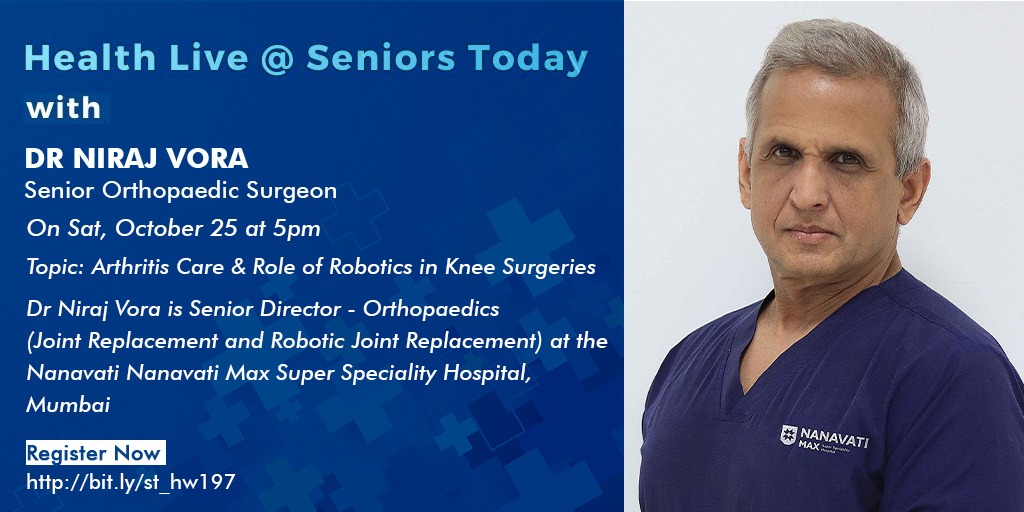
On 25 October 2025 Health Live @ Seniors Today hosted Dr Niraj Vora. He spoke on – Arthritis Care & Role of Robotics in Knee Surgeries.
Dr Niraj Vora is Senior Director – Orthopaedics (Joint Replacement and Robotic Joint Replacement) at the Nanavati Max Super Speciality Hospital, Mumbai.
He is one of Mumbai’s and the country’s top orthopaedic surgeons. He’s a specialist in joint replacement, trauma surgery and robotic surgery. He is also a specialist in total replacement and trauma surgery. His specialisation includes primary hip and knee replacement surgery, revision hip knee replacement surgery, robotic hip knee replacement surgery, trauma surgery.
There are many types of arthritis, the main and the most prevalent is osteoarthritis. Osteoarthritis is age related wear and tear.
There are other types of arthritis:
- Rheumatoid arthritis
- Psoriatic arthritis
The knee is divided into 3 compartments and when there is wear and tear of the articular cartilage, which is the smooth coating of the joint which also helps in the smooth and free movement of the joint, is known as arthritis.
The three compartments are
- Lateral compartment- outer aspect of knee
- Medial compartment- inner aspect of knee
- Patellar compartment- this is the mobile bone over your knee. It is also called the knee cap.
Arthritis can be caused due to multiple reasons. There is no one specific or particular reason/ single cause resulting in arthritis.
Wear and tear of the cartilage, even in small amounts can cause pain and it only increases overtime.
The rate of progression of the disease is variable from one person to another. But we know for sure that it will get worse.
Risk factors for arthritis include:
- Progressing age
- Women > Men (especially in the Indian population)
- Obesity
- History of previous injury to knee
- Lower extremity malalignments
- Repetitive knee bending activities
Not all knee pain is arthritis. If you have pain in your knee associated with 3 out of the below mentioned 6 symptoms, the chances of arthritis are higher.
- More than 50 years of age
- Morning stiffness in the knee lasts for more than 10-15 mins
- Crepetus in the knee- you hear sounds from your knee
- Bony tenderness- pain in knee on movement
- Bony enlargement- bone will look swollen
- Local warmth on the knee- this could mean you might have infection
Intervention is possible at every stage of arthritis, in an attempt to slow down the progression of the disease to the next stage.
This is done by:
- Lifestyle management: this includes weight loss, eating a healthy and nutritious diet, regular exercise and physical activity and impact training for bone strength.
- Tab Glucosamine – it is a health supplement that makes the knee cartilage stronger and makes the wear and tear slower. As the cartilage gets stronger, it also helps in turn reducing the pain in the knee.
- NSAIDs: this can result in gastric irritation and prolonged use and abuse can also harm your kidneys
- Opioids: these are morphine derivatives which are reserved for patients with severe post operative pain since it is addictive
- Injections-
- Steroidal injections in the knee, their benefits however vary. These injections are given to patients who are ideal candidates for surgery however do not want to have surgery.
- Gel injections are used for patients with moderate amounts of wear and tear. These injections help lubricate the joint and help strengthen the cartilage
- Surgery: you should consider surgery when your knee pain has not responded to the standard, conventional treatment and their quality of life and standard of living is being affected. This is different for different people.
When is knee replacement done/ advised:
- When the entire joint is affected
- You have severe pain
- Functional impairment
You should consider knee replacement surgery for relief if your pain is too severe.
Knee replacement surgery should help you with:
- Relief in pain
- Improved mobility
- Restoration of quality of life
Occasionally, after surgery, the patients still complain of pain upto one year after the surgery even though nothing is wrong. This pain at the end of 15 months or so usually settles down.