

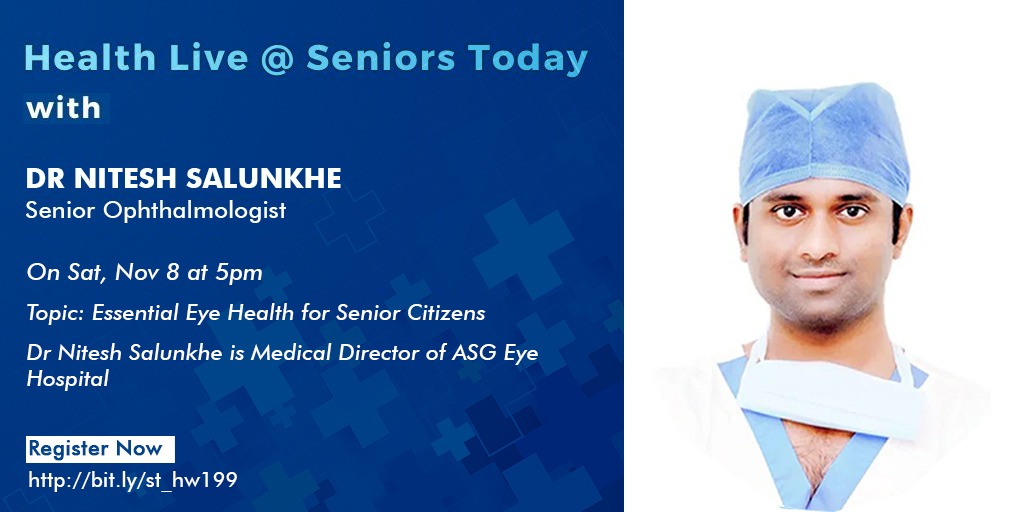
On 08 Nov, 2025, Seniors Today hosted their weekly Health Live Webinar with a Senior Ophthalmologist, Dr Nilesh Salunkhe who spoke on and answered questions about Essentials of Eye Care.
Dr Nilesh Salunkhe is a Medical Director at the ASG Eye Hospital. ASG Eye Hospitals is a chain of eye hospitals in the country. He is the Senior Ophthalmologist and Medical Director at the ASG Eye Hospital. He has an experience of over a decade and a half in ophthalmology. He did his MBBS from MUHS University, Nasik before joining AIIMS, New Delhi to pursue his MD in Ophthalmology. Dr Nilesh has a keen interest in diabetic eye diseases and RoP. He has an exhaustive experience of examining over 10,000 retina patients. He performed over 3000 diabetic vitrectomy surgeries along with complex retinal detachment surgeries.
There are a lot of changes that happen in the body as we age and eyes are no exception.
There are individuals who have not had any refractive concerns or worn any corrective lens, but after the age of 40 start complaining of blurring of vision, inability to use phone and see small text/ font.
A few things and tips for people over the age of 60 years for eye care:
- Get a proper eye check up done
- Get correct and proper spectacles made for the purpose of reading or doing near work
- There is a habit of sharing the same spectacles by all elderly members of the family, and this is not recommended/ advisable. This is because everyone has a unique/ different refractive correction and you need to use different glasses made especially for you based on your refractive error and needs.
- If one keeps using the same glasses for different purposes i.e. for short and far sighted purposes, it puts an undue strain on the eye resulting in frequent change in the number or an abnormal increase in the power.
- In patients/ people with other comorbidities such as diabetes, hypertension, etc. it is advised that you also get your regular eye check up done.
- If a person has diabetes, 3 systems in the body are affected- eyes, nervous tissues, kidneys. Which is why apart from keeping your blood sugar levels under control, it is also advised to get regular eye check ups, to detect any diabetic changes in the eye or retina early.
- If you are freshly diagnosed with diabetes, your first screening for diabetic retinopathy/ first eye check ups should be done at the time of diagnosis. If any changes are detected at any point of time, you need to make the necessary lifestyle changes and take the medication that is advised to you to avoid further progression of the disease.
- If there are no diabetic changes, your ophthalmologist will advise you to get an annual eye check up.
- In case of minor/ moderate diabetic changes, the consultant may advise frequent follow ups.
- If the diabetic changes in the eye are so much that they are causing changes in the vision, you may need to get some procedures for the eye like injections to relieve the swelling in the eye/ retina, control bleeding from hemorrhages- if noticed/present; to prevent sudden loss of vision.
- Diabetes, hypertension and other diseases also need to be carefully monitored for eye changes.
Another problem that affects people over the age of 60 is age related macular degeneration. This is seen more commonly in:
- Smokers
- History of outdoor work
- Exposure to direct sunlight
They might start developing certain degenerative changes in the retina which might present as small yellowish dots over the retina, called dry age related macular degeneration
Sometimes those dots may be surrounded by swelling, this is called wet age related macular degeneration
Age retakes macular degeneration is something we need to be watchful of since it can cause a drop in vision. And this dimension in vision if not treated timely can lead to permanent loss of vision.
Treatment for dry age related macular degeneration includes antioxidant medication that prevents further degeneration on the retinal surface.
Treatment for wet age related macular degeneration aims at preserving the rest of the vision and preventing further deterioration of the vision and avails further damage to the vision. The treatment may include long term medication or even timely injections to reduce the chances of macular oedema, swelling and permanent visual disability.
Early detection of this condition is very important to prevent irreversible visual damage.
- Glaucoma affects both young and old but is more commonly seen in people over the age of 60.
- The most common variety of glaucoma seen in the elderly population is primary open angle glaucoma.
- The eye is a structure that maintains the pressure and the structure of the eye with the help of a fluid called the aqueous humor. In people where the balance between production of the humor and its circulation and drainage, resulting in an imbalance. The fluid does not get a chance to leave the eye, gets accumulated in the eye itself, causing an increase in the intra ocular pressure (pressure inside the eye).
- The rise in the pressure inside the eye is transmitted to the optic nerve head. The optic nerve is the main nerve that carries transmissions from the eye to the brain. A pressure build up in the eye results in pressure on the optic nerve leading to impaired blood flow to the eye and nerve fibers.
- It is a silent disease.
- It is a painless, irreversible condition.
- The progression of eye damage is very slow and first affects our peripheral vision, resulting in tunnel vision
- When you visit an ophthalmologist and he feels like your visual field is compromised, ocular pressure is raised or there are changes in the shape of your optic nerve head, he might suspect glaucoma and advise further evaluation and investigation.
- The treatment includes drops which help by reducing the pressure in the eye by reducing the aqueous production in the eyes
- Surgery is also an option in patients in whom the pressure inside the eye is not getting controlled despite maximum medication
- Cataract is also an age related disease caused due to opacification of the lens.
- Cataracts have to be treated with surgery