






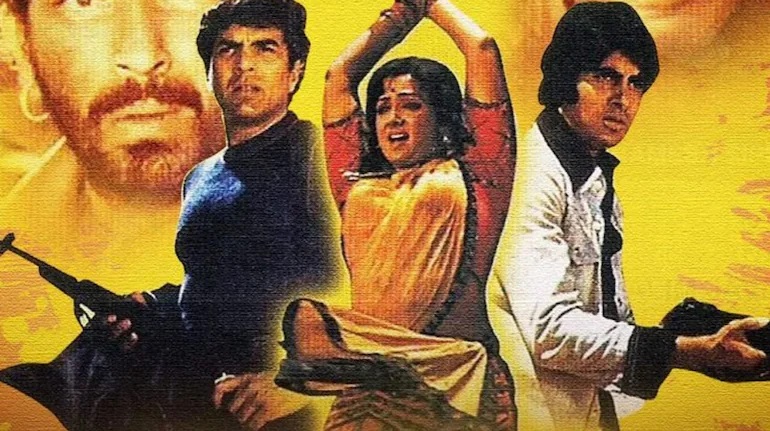
Anyone who has not seen (or at least heard of) Ramesh Sippy’s Sholay (1975) would have been living under a rock for 50 years– the film’s dialogue (by Salim-Javed) has passed into common usage, and some of the best lines were written for Gabbar Singh, played by Amjad Khan.
When the film released, it got lukewarm to poor reviews, and low opening at the box-office. Soon, word-of-mouth led to ticket sales booming, and the film went on to become a cult classic, the impact of which has not dulled over half a century.
As plot ideas go, it was Japanese master Akira Kurosawa who’s Seven Samurai (1954) about a village, oppressed by ruthless bandits, that hires samurai to fight them off. The film was remade in Hollywood by John Sturges as The Magnificent Seven (1960) set in the Wild West, with gunslingers replacing cowboys. The film became a template for remakes and inspired films all over the world. In India, Mera Gaon Mera Desh, and eventually Sholay, transcended cultural barriers to tell a story with thrilling action, emotion, music, major stars and the best dialogue ever written. It was not just a hit, it was a phenomenon that influenced Indian cinema for decades.
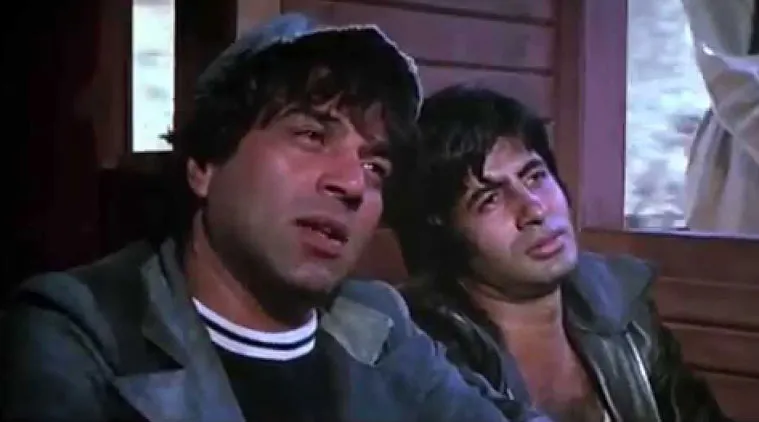
Petty criminals Jai (Amitabh Bachchan) and Veeru are hired by Thakur Baldev Singh (Sanjeev Kumar) of the fictional Ramgarh (shot in Karnataka), to fight the cruel dacoit Gabbar Singh (Amjad Khan), whose men often raid the village and steal their crops. It is gradually revealed that Gabbar had escaped from prison, massacred the police officer Baldev Singh’s entire family—only a daughter-in-law Radha (Jaya Bachchan) who was out of the house was spared—as revenge for arresting him. He later chopped off Thakur’s hands with vicious sadism. Jai and Veeru initially take this rural adventure lightly—Veeru flirts with the garrulous taangewali Basanti (Hema Malini). But once they see the brutality that Gabbar is capable of unleashing, they are determined to end his terror.
The movie’s impact on cinema is evident in its innovative filmmaking techniques. Sholay was one of the first Indian films to be shot in 70mm and stereophonic sound; the action sequences, choreographed by Veeru Devgan, set a new benchmark for Indian stuntwork—the train sequence is still copied by others.
Sholay successfully fused the conventions of Hollywood’s Spaghetti Westerns with traditional Indian themes of friendship, revenge, and justice, creating the Curry Western genre. Director Ramesh Sippy shot it on an epic scale, but even the small characters and moments were well thought out by Salim-Javed. For instance, the coin that Jai tosses is a cheat, with heads on both sides. Veeru’s drunken suicide scene atop the water tank was a comedic gem. Characters like the Jailor and Soorma Bhopali were one of a kind.
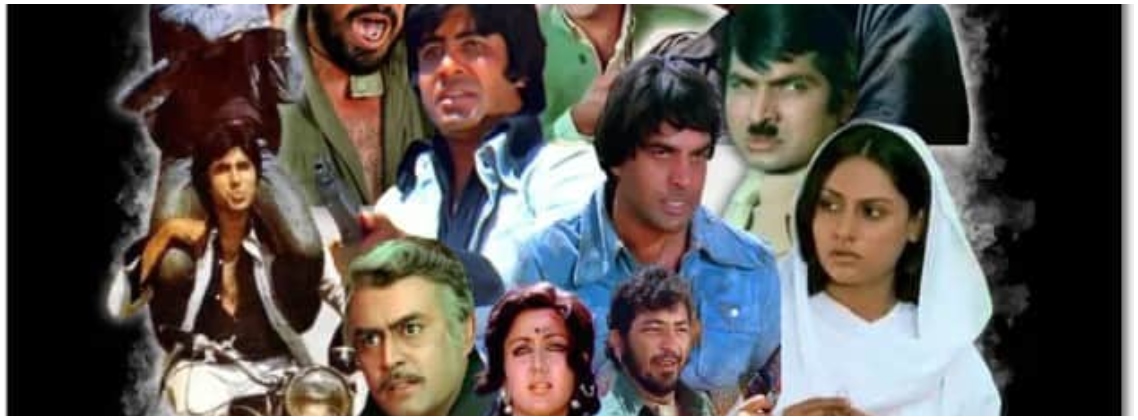
Sholay reflected and influenced the changing landscape of India. The film’s narrative of two small-time criminals fighting a powerful dacoit resonated with the public’s desire for justice. Gabbar Singh became the ultimate symbol of evil, and his name is still used to refer to a nasty person.The film’s themes of friendship, loyalty, and justice continue to be relevant. The depiction of strong female characters like Basanti and Radha challenged the traditional portrayals of women in cinema.
The film introduced a villain, the kind of which had never been seen in Indian films. Sippy had offered the role of Gabbar to Danny Denzongpa, who turned it down, so a new actor (son of actor Jayant) was signed up and became a star. Till then, dacoits in Hindi films wore dhotis and lived in the Chambal ravines. Gabbar wore army fatigues with a bandolier, his teeth were tobacco stained, his eyes dripped with amusement and evil in equal measure. He spoke with a peculiar lift and had a laugh that could make the blood freeze. He was the kind of sadist who would wipe out an entire family, including women and children, would chop off his enemy’s hands, shoot down his own men when they failed in their mission and make a woman dance on pieces of glass.
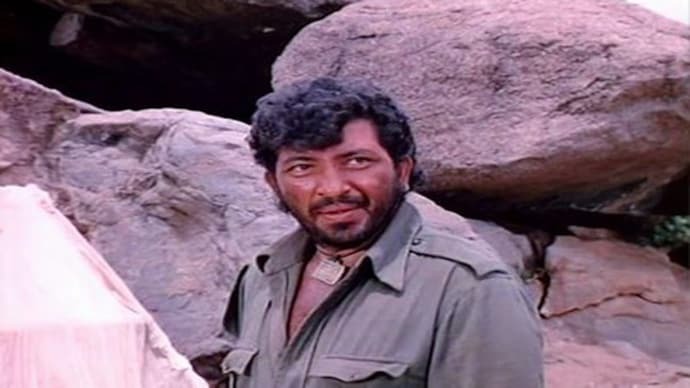
His hideout was the rock-strewn Ramgarh, he was given no back story and there was no explanation for his cruelty. No Indian film villain till then had been so gleefully, unapologetically vile. Amjad Khan’s Gabbar was inspired somewhat by Jabbar, played by Vinod Khanna in Raj Khosla’s Mera Gaon Mera Desh (1971), but so unique was Gabbar that when Amitabh Bachchan tried to get into his shoes in Ram Gopal Varma Ki Aag (2007), an ill-advised remake of Sholay, he failed to recreate the Gabbar effect.
Ironically, Gabbar Singh became the film’s most popular character– even today, his lines are repeated in a kind of ongoing homage: Kitne aadmi the; Ab tere kya hoga Kaliya; Arey O Samba; Bahut yaarana lagta hai; Joh dar gaya … samjho mar gaya and the one that best defines Gabbar’s arrogance Yahan se pachas pachas kos door gaon mein, jab bachcha raat ko rota hai, to maa kehti hai bete so ja … so ja nahi to Gabbar Singh aa jayega. At the time, Amjad Khan as Gabbar, actually modelled for glucose biscuits. Records with Sholay’s dialogues were released.

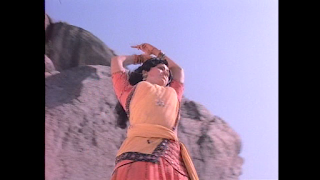
In keeping with conventions of popular Hindi cinema of the 1970’s, Sippy included songs, composed by RD Burman, that included the all-time favourite friendship number Yeh dosti hum nahin todenge, the festive song, Holi ke din dil mil jaate hain, the romantic Koi haseena jab rooth jaati hai, an item dance Mehbooba Mehbooba (performed by Helen) and Hema Malini’s dance on glass, Haan jab tak hai jaan main nachungi. Burman also composed the film’s distinctive background score, Jai’s harmonica and that eerie howling that accompanied Gabbar’s scenes.
Sholay was released at the time of the Emergency, and strict censorship, so the ending had to be changed from Thakur killing Gabbar with hob-nailed shoes, to just an attack and arrest. Reportedly, Sippy also considered shooting an alternative ending in which Jai survives, but then retained the version in which he dies.
The film broke box-office records across India, and ran for more than five years at Mumbai’s Minerva theatre. It was the highest-grossing Indian film ever, at the time, till Hum Aapke Hain Koun overtook it in 1994.
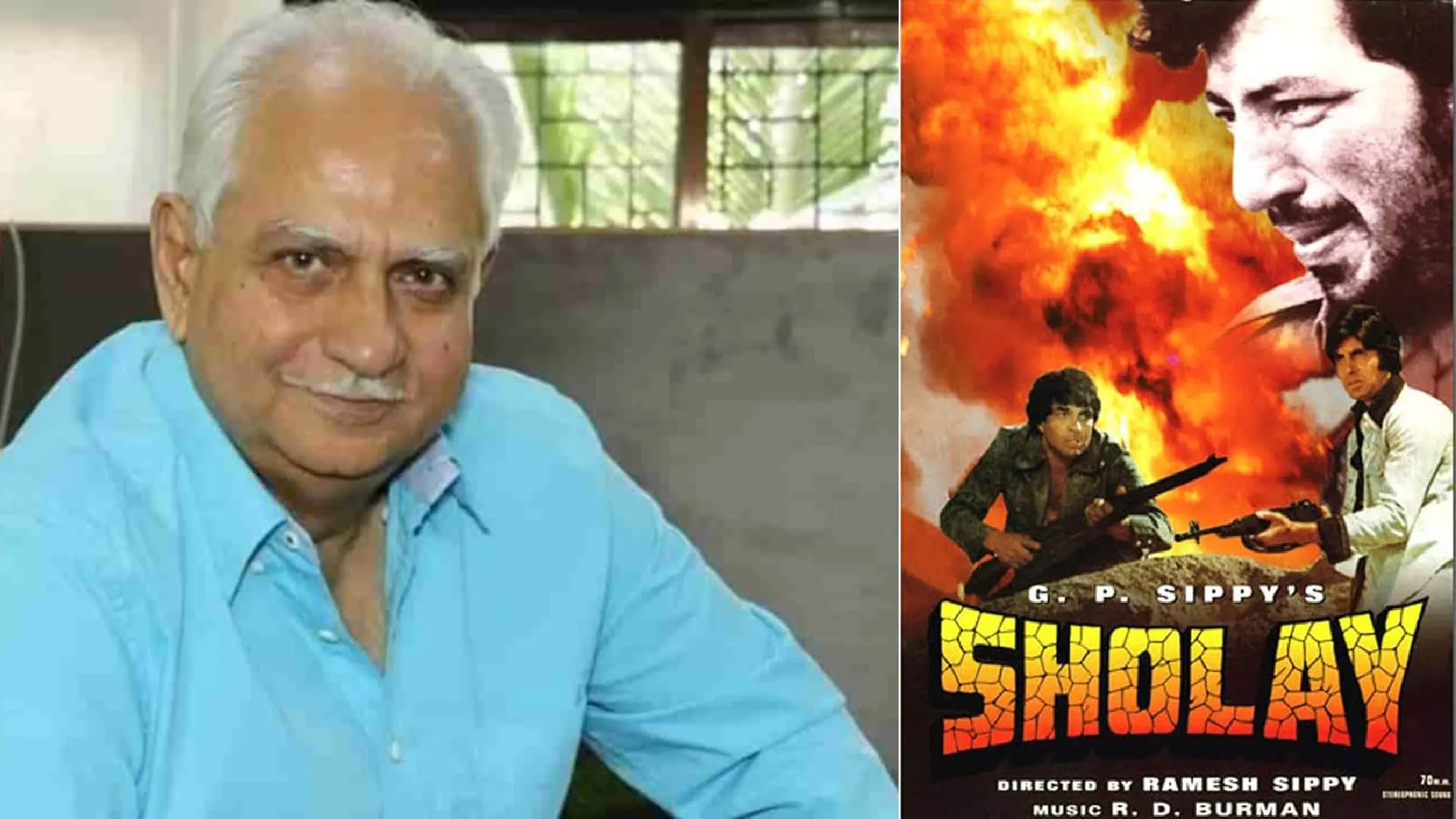
Filmmaker Ramesh Sippy had said in an interview, “Cult movies are not made, they are happy accidents waiting to happen.” A film like Sholay can make a director’s career; it can also destroy it. After a film like Sholay, what can be made to match that high? “Cult movies are not made, they are happy accidents waiting to happen,” Sippy said in an interview in 2015 with a leading daily.
Indeed.