






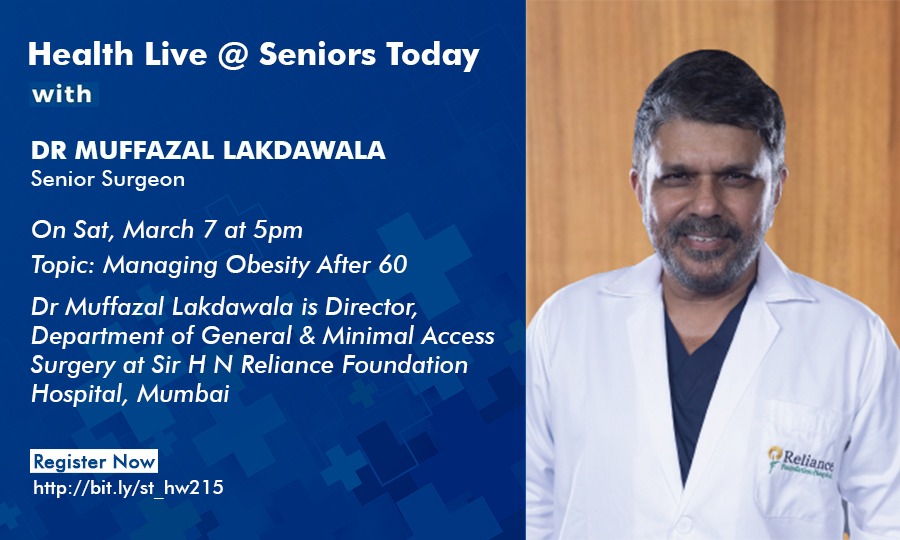
On 07 Mar, 2026, Seniors Today hosted their weekly Health Live Webinar with a Senior Surgeon, Dr Muffazal Lakdawala who spoke on and answered question about Managing Obesity after 60.
About Dr Muffazal Lakdawala
Dr Muffazal Lakdawala is the Director of the Department of General & Minimal Access Surgery at Sir H N Reliance Foundation Hospital. He received specialised training in bariatric surgery at the University of Ghent Hospital in Belgium and the Cleveland Clinic in the USA under Dr. Raul Rosenthal. Additionally, he trained in advanced laparoscopic colorectal surgery with Prof. Seon Hahn Kim in Seoul, Korea.
He was the first surgeon in India to establish ‘The Center for Excellence (ICE)’ for Bariatric Surgery, certified by the Surgical Review Corporation, USA. Additionally, he is the only surgeon in India to have demonstrated live surgeries in all countries of Asia, Europe, and the Middle East. He has been awarded honorary memberships by the South Korean, Japanese, Philippine, Saudi Arabian, and Chinese Societies of Surgery. He specialises in single-incision bariatric surgeries and has treated the largest number of cases in the world. He has mentored and trained young surgeons across Asia and the Middle East.
He is the Honorary Surgeon to the Vice President of India, Venkaiah Naidu. He also conceptualised and headed the NSCI Dome Covid-19 Hospital from its inception in April till now. He is currently an Adviser to the BMC for all Jumbo facilities set up for COVID-19.
His academic contributions have been extensive, and he has published almost 20 international papers in peer-reviewed journals and a Silver Book on sleeve gastrectomy. He has authored a crossword bestseller, ‘The Eat Right Prescription’. He also serves as Professor Emeritus at the BYL Nair Hospital and Professor at the Maharashtra University of Health Sciences (MUHS), teaching minimal access surgery. His expertise extends globally, having mentored Fellows from countries like Saudi Arabia, Oman, Dubai, South Africa, Singapore, China, Sri Lanka, Malaysia, Hong Kong, Thailand, Philippines, and Kuwait.
- Obesity slowly creeps up to you by the age of 60.
- It is even more difficult for post menopausal women to lose weight. And the same is the case with men with a slower/ sedentary lifestyle after 60.
- After the age of 60, the goal is not just weight loss, it is also:
- Fat loss
- Muscle preservation
- Metabolic healthy
- Preserving one’s own physical independence
- Reducing metabolic risk with diseases such as type II diabetes, hypertension, dyslipidemia, reducing the risk of ischaemic heart disease, etc.
- After 60, you have to be gentler with your training options.
- You’ll have to be supervised.
- There are at least 30 different types of cancers that are directly linked with obesity.
- Obesity is focused not just on your BMI but also with your body composition.
- There is a huge hormonal shift for women over the age of 50.
- Over the age of 50, there is even reduced physical activity resulting in muscle loss and increase in the visceral fat.
- Risk of obesity is also a harbinger if various illnesses such as:
- Type II diabetes
- Hypertension
- Cardiovascular diseases
- Osteoarthritis and mobility loss
- Gouty arthritis
- Sleep apnoea
- Increase risk of surgeries and fractures
- The key principle which should be followed is- avoiding rapid weight loss. Since that worsens sarcopenia (muscle loss)
- Your weight loss goal should be 5-10% of your total body weight in 6-12 months.
- BMI of 25-30 kg/m2 is acceptable for people over the age of 60 years.
- Waist circumference of less than 102 cm in men and less than 88 cm in women is acceptable as per the WHO guidelines.
- Nutrition strategy is the most important in anybody’s weight loss journey.
- 80% is what you eat, 20% is what you exercise.
- You food should contain:
- 25% whole grain and mixed carbohydrates
- 50% fruits and vegetables- try and avoid fruit juices, whole fruits are preferred. Avoid deep fried vegetables
- 15% protein- vegetarians and vegans should take some form of protein supplementation- unless you have been recommended to avoid protein (as is seen in patients with kidney disease, cirrhosis, high uric acid)
- 10% dairy is our sole source of calcium
- Calorie strategy where in a moderate deficiency of 300- 500 kCal deficiency per day should help you reduce a deficiency. Every perps calorie requirement is different and should be calculated by a dietician/ physician based on the make up of your body and then you go 300- 500 kCal deficient in it.
- Your diet even then should contain 25-30% of protein and healthy fat is also required for the absorption of Vit A, D, E and K.
- 40-45% of carbohydrates should be taken in your diet- more during the day time, preferably mixed carbohydrates that can last, especially for diabetic patients.
- The older adults require more protein than the younger adults. The recommended quantity is 1 to 1.5 kCal/ gm/ day. Your protein sources can be eggs, chicken, fish. If you are vegetarian you can have greek yogurt. For vegan options you can have paneer and tofu. If none of these options work for you, remember to replace it with whey protein. Lentils can add to some extent as a source of protein.
- Other important micro nutrients that we do need:
- Vit D
- Vit B12
- Calcium
- All of which are essential for muscle and bone mass, prevention of osteoporosis, anti inflammatory function
- Do not keep taking Vit D3 and calcium without supervision, since high levels of calcium or Vitamin D3 can land you in a state of coma.
- Vit B12 deficiency is common in vegetarians
- Exercise is a very important aspect. The most common form of exercise in adults should include resistance training at least 2- 3 times per week- it helps prevent muscle loss.
- Aerobic exercises such as 50 minutes of walking per day is also good enough. This could be brisk walking.
- If you can swim, swimming is the best form of exercise and so is static cycling
- Yoga- it is one of the best ways to burn calories and in the meantime stay flexible at this age
- Tai chi can also help after the age of 50
- Fall prevention exercises
Medications for obesity:
- GLP 1 agonist such as Simaglutide also known as Ozempic- results in 15% of total body weight loss can be expected
- Terzipitide also known as Munjaro- causes 15- 20% total body weigh loss
Their benefits include:
- Appetite suppression
- Increased diabetes control
- Improves your cardiovascular function and health
Concerns with these drugs include:
- Sarcopenia
- Muscle loss if you do not exercise or take protein
- Nausea and diarrhoea- let common side effects
These drugs should be taken only under supervision
Bariatric surgery is a great tool for people who are massively obese and find it difficult to walk and have lost their independence. These are also patients who have crippling leg oedema, struggling with sleep apnoea and cannot be recommended the drugs for whatever reason.
The benefits include:
- Long term diabetes remission
- Mobility improvement
- Decrease in NASH
- Decrease in gout
- Decrease in cardiovascular risk
- Decrease in the overall functioning
The BMI of the individual should be more than. 40 kg/m2 for this surgery to be attempted