






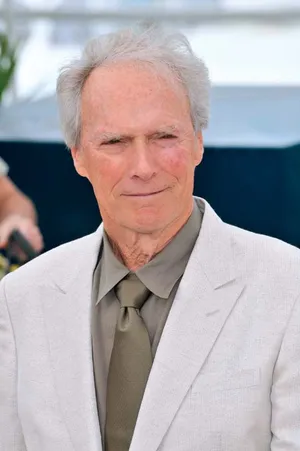
One of the oldest and most enduring stars of Hollywood completed 95 in May this year, and is, from all accounts, busy directing a new film, as his latest Juror#2, awaits release.
Born on May 31, 1930, in San Francisco, California, Clint Eastwood grew up with a passion for music and film. After serving in the Korean War, he began his acting career, landing small roles in films and TV shows. The rugged actor, who made his early reputation playing a cowboy named Rowdy Yates in a TV series Rawhide (1959-65), became an international star in Sergio Leone spaghetti Westerns– the famous Dollars Trilogy—A Fistful of Dollars (1964), For a Few Dollars More (1965), and The Good, the Bad and the Ugly (1966).
Discussing the trilogy in an interview with Feature Story, quoted in a profile by Brent Furdyk in the site nikkiswift.com, “Clint Eastwood confirmed a rumour that he wore the same poncho in all three movies — and that it had never been washed. “If you washed it, it would fall apart,” Eastwood said with a laugh. “Yeah, I still have that poncho.”
“Asked if he’d ever had the poncho laundered, he admitted he had not. “No. It was folded up after The Good, the Bad and the Ugly and it hasn’t been unfolded yet.”
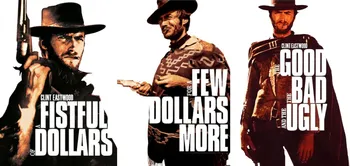
Caption: The famous – Dollars Trilogy
The actor with those enviable chiselled looks, was once rejected by a Hollywood studio because of a prominent Adam’s apple, which he refused to fix. Leone’s films helped create the on-screen legend of the stoic hero, who became an archetype for the movie cowboy, and Eastwood appeared in dozens of Westerns, most of them hits, which also typecast him as the taciturn, macho hero, with a sullen glare and a cigar between his lips. Leone is said to have commented that Eastwood had “only two facial expressions: with the hat and without the hat.” Clintwood said of the Man With No Name character he helped create in A Fistful of Dollars. “I wanted to play it with an economy of words and create this whole feeling through attitude and movement. It was just the kind of character I had envisioned for a long time, keep to the mystery and allude to what happened in the past. It came about after the frustration of doing Rawhide for so long. I felt the less he said, the stronger he became and the more he grew in the imagination of the audience.”
Using money earned from the Dollars trilogy, Eastwood’s advisor Irving Leonard helped establish Eastwood’s own production company, Malpaso Productions named after Malpaso Creek, on Eastwood’s California property. 1971 was a major turning point in Eastwood’s career, the year when he played another iconic character, the cop in Dirty Harry, who uttered the immortal line, “Go ahead, and make my day.” The role was originally meant for Frank Sinatra, who was allegedly replaced, because he could not hold a gun! The same year, Eastwood turned to direction, with Play Misty For Me The film about a jazz disc jockey named Dave (Eastwood), who has a casual affair with a listener called Evelyn, who turns into a crazed, murderous stalker, when he breaks up with her. The film was praised by critics and Walter was nominated for a Golden Globe Best Actress Award (Drama), for her performance in the film.
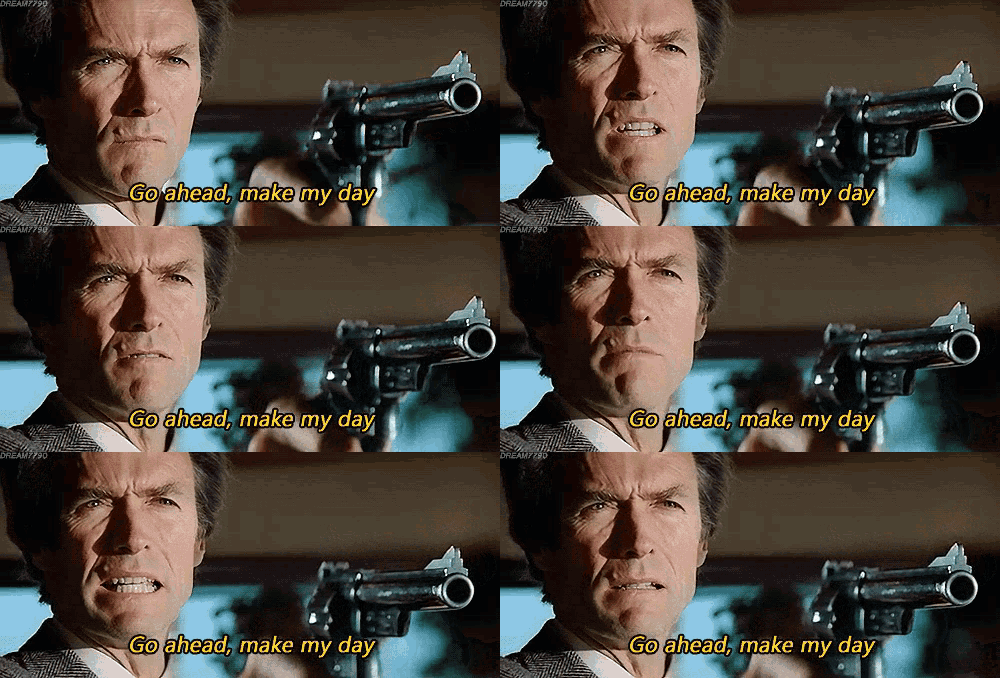
Caption: The unforgettable cop in Dirty Harry
Once Eastwood started directing, he just never stopped, even when age caught with him. If his output as an actor is prodigious (73 films), his work as a director (45 films) is enviably diverse and totally unpredictable. Joe Queenan, in a profile of Eastwood in The Guardian, wrote, “A true child of the Depression, Eastwood understood that the only unforgivable crime was to stop working. So he never did. He made all kinds of movies and he made them fast. He didn’t waste much money on co-stars and he didn’t spend much money on special effects. He brought his films in under budget and on time. If a film flopped he’d make another one, and if that flopped, he’d try something different. Then, if his career as a director stalled, he’d hire himself out as an actor. Unlike (Warren) Beatty and (Orson) Welles, he does not seem to have been terribly afraid of failure, and nor does one get the impression that he ever cared much what the critics thought of his work. His biggest-grossing films – the stupid ones with the orangutan (Every Which Way But Loose in 1978, and two sequels) – are among his greatest box-office coups. So there.”
 Caption: One of Eastwood’s most forgettable films
What went behind Eastwood’s almost unbreakable chain of success? Queenan analyses, “Eastwood resembles the great directors who preceded him, such as Hitchcock and John Huston and Don Siegel, in that he never stopped punching the clock. Unlike sensitive auteurs, who will take a few years off to contemplate their next project, Eastwood has not stopped making films since his debut in 1971. Working with the same collaborators, he has made arty films such as Bird and White Hunter, Black Heart, creepy films such as Play Misty for Me, offbeat comedies such as Bronco Billy and Space Cowboys, sentimental films such as Honkytonk Man and Invictus, and epics like Flags of Our Fathers. He has taken a great book and made a great movie (Mystic River), but more impressively he has taken a terrible book and made a great movie (The Bridges of Madison County). Eastwood went through a few stretches where it seemed he might be washed up, but he always found a way to drag himself up off the canvas. Midnight in the Garden of Good and Evil, True Crimes and Bloodwork appeared in rapid succession. They were all duds. Then came Mystic River and Million-Dollar Baby, which were not. The number of truly bad films Eastwood either starred in or directed is surprisingly small. This is mostly because he avoided comedies: cop movies can only be so bad, but with comedies, the sky’s the limit.”
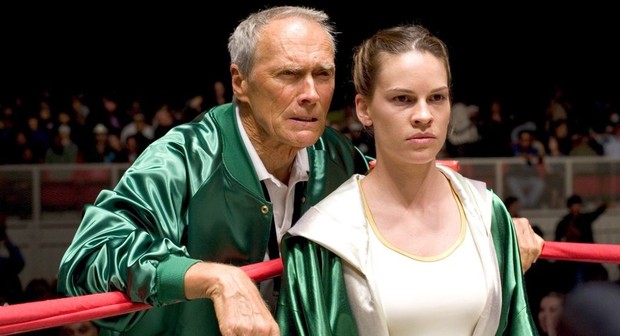
Caption: An Oscar-winning performance – Million Dollar Baby
Unforgiven (1992) and Million Dollar Baby (2004), won him directing Oscars, and a rather late acting Oscar for Million Dollar Baby, in which he played a boxing coach, who takes on the job of training a woman (Hilary Swank) into a professional. In 2008, came Gran Torino, in which he directed himself in the role of an old, cantankerous, recently widowed war veteran.
The stories may be different, but there is a Clint Eastwood stamp on all his films. In an Esquire profile, Tom Junod asked and answered the question. “Exactly what constitutes a Clint Movie turns out to have an easy answer: A Clint Movie is a movie shot by Clint Eastwood’s crew. He gives them more freedom than most other filmmakers give their crews, and they give him greater constancy. He waits on line with them at the catering truck instead of eating lunch in his trailer; he moves equipment with them; he generally starts the workday after nine and ends it before five so that they can have breakfast and dinner with their families. He readily admits that his method of making movies depends almost entirely on their experience and skill, and so in return, “They would jump into traffic for him,” says Matt Damon.
In the same piece, co-star in The Bridges Of Madison County, Meryl Streep tries to figure out what makes Clint Eastwood tick. “”He banked an enormous amount of credit with the male audience in the early part of his career, when they were eager to imagine themselves as whatever character he was playing. And then he sort of brought them into material that they never would have gone to. Starting with maybe Unforgiven, he started bringing them along on a left-hand turn, where violence wasn’t the thing you got your rocks off with. It was something horrible. And only he could bring them there.”
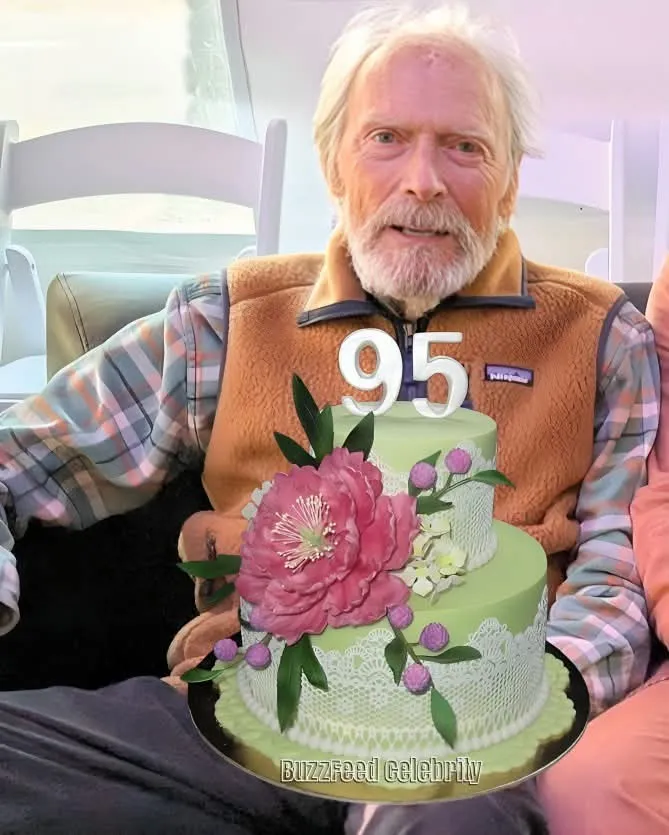
Caption: Clint@95!
To which Eastwood responded, “I like Meryl. She’s a smart woman and a pleasure to act with. But I don’t know if I’m that aware. I’m not that self-examining. I’ve always felt that if I examine myself too much, I’ll find out what I know and don’t know, and I’ll burst the bubble. I’ve gotten so lucky relying on my animal instincts, I’d rather keep a little bit of the animal alive.”
He reportedly turned down roles of James Bond, Superman, Rambo and films like Apocalypse Now, Die Hard, Blade Runner and Men in Black. Had he starred in them the course of Hollywood history would have been altered.
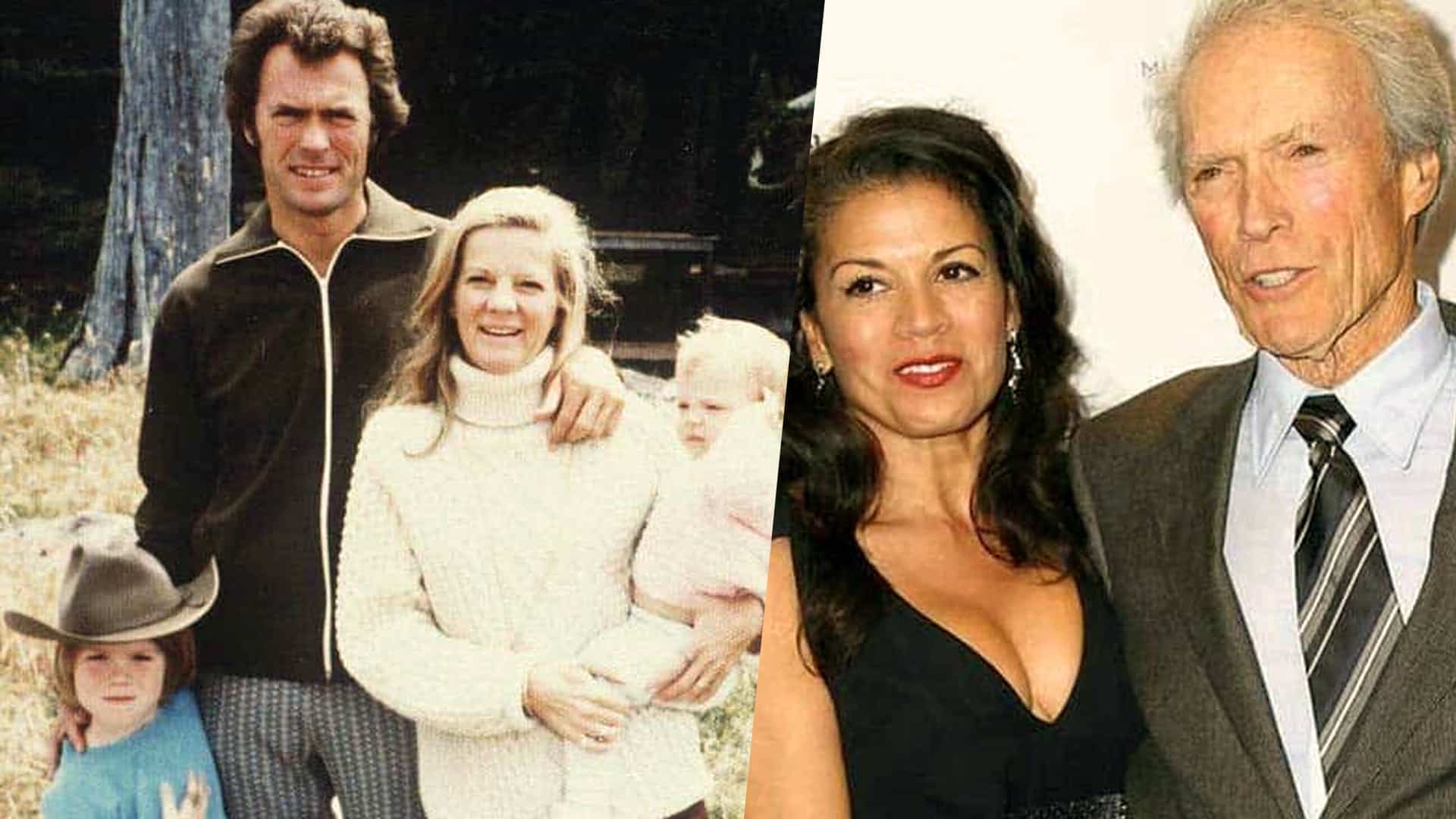
Caption: Two marriages, several affairs and scandals
A man so good-looking and talented—he is also a musician—was bound to have a colourful personal life that could be the subject of a book by itself. He has been married twice, first to Maggie Johnson from 1953 to 1984, and then to Dina Ruiz from 1996 to 2014 and has had multiple relationships, from which he has fathered eight children he acknowledges and others, allegedly illegitimate.
Eastwood’s legacy extends beyond his films. He has influenced generations of filmmakers, including Quentin Tarantino, James Mangold, and many others. His dedication to his craft and his willingness to take creative risks have made him a true Hollywood icon.