Watch out for Fakes

2

In the internet age, crooks find innovative ways to dupe senior citizens. Some tips on how to stay safe, by Deepak Gagrani

Financial fraud targeting senior citizens has become a widespread phenomenon today. Senior citizens are susceptible to such frauds on account of sizeable money lying in their accounts, lack of technical knowledge and their isolation which makes them more gullible targets of such fraudsters.

Most schemes against senior citizens are performed over e-mail, smartphones or obtaining their signatures as consent. A lot of times, these scams go unreported. But the impact of such frauds is devastating and can leave senior people quite vulnerable with little or no legal recourse. Let’s understand a few common techniques used for seniors.

– Being friendly, attentive and helpful to gain someone’s trust and create an impression that the person is aligned to the interests of senior citizen

– Generating a sense of panic and urgency, such that the senior person is unable to rationalize and ends up making a hasty decision

– Pretending to be associated with banks/government agencies/ charitable organizations etc

– Being ambiguous, silent or unnecessarily complicate investment proposals to be able to hide features that are detrimental to the interests of senior citizens.

Highlighted below are some typical forms of financial frauds and how they are targeted towards naive and innocent senior citizens.

Net Banking Transactions

One of the most common frauds targeted against senior citizens is in the form of net banking transactions, including credit-card-related frauds. The modus operandi typically involves obtaining passwords/ OTP/ CVV numbers from senior citizens through phone calls/emails, with the fraudster posing as a bank official/government officer and creating a panic situation, forcing them to part with critical information. Given their discomfort with technology, they are less likely to react to email/SMS sent by the banks as soon as their account is debited. By the time it is realized, the money trail is often lost.

The easiest way to protect oneself is to simply ignore such calls/emails. No banks or any governmental agencies will ever ask for any form of password or other such critical information on the phone/email. If there are still some concerns, it is prudent to visit the nearest bank branch or call the bank on the numbers listed on its website, directly.

Investment Proposals

Another very common form of financial fraud widely prevalent is to mis-sell investment products by making false return claims or hiding critical information and obtaining investors’ consent (through multiple signed documents). The communication pattern is such that most of the important information is discussed verbally and there is no written trail of such a discussion. It is quite possible that what was actually mentioned in the documents signed by the investor is significantly different from what was communicated to them verbally. The trick used here is ‘trust’ and ‘emotional connect’ to be able to mis-sell an investment proposal not suitable for the investor, in the lure of higher commissions. This is an even more tricky situation, as there is very little recourse left given that everything happened in the ‘legal’ course of business.

A simple way of not falling prey to such frauds is to ensure that all investments are routed through a certified and reliable financial advisor, instead of blindly relying on the friendly relationship managers of financial institutions. Besides qualification, an important factor that can help to highlight the intent is the stability of the person guiding on investments. Typically, the ability of a person to ‘mis-sell’ increases if he/she knows that they do not have to face the investor in the future and is more focused on short term benefits.

Lottery and Fake Prize Scams

In such forms of fraud, the victim (often, senior citizens) are made to believe that they have won a large sum of money through a lottery or some attractive business proposal which could help them make a big corpus. To receive the funds, they have to wire some money as ‘taxes & handling charges’. As the entire setup was fake, once the money is transferred, there is absolutely no chance of receiving anything since most of it is operated through offshore accounts and overseas countries outside the jurisdiction of legal authorities.

As an informed senior citizen, one must simply ignore all such traps. Remember that what is too good to be true is always actually false in such cases.

Conclusion

Fraudsters targeting elderly people rely heavily on the assumption that elderly people are not familiar with changing technology and that they are more gullible once their trust is formed. While financial frauds are not restricted to senior citizens only, it is more important to safeguard them as the impact is more devastating on senior citizens. Capital once lost cannot be earned back in such cases. It is important to be aware and diligent, especially when finances and personal information are involved. Whenever there is even a small doubt, it is prudent to cross verify with credible sources or individuals.

Be Aware, Be Safe!

A Scandal and a Flop

0

Deepa Gahlot muses on the stunning Devika Rani, who set Indian movie screens afire with a kiss back in 1933

Devika Rani is in focus at present due to Lillette Dubey’s play based on her life. The actress-producer, the great-grand-niece of Rabindranath Tagore, was known for her stunning beauty. She was the first female superstar of Indian cinema, at a time when educated women from cultured families did not work in films. Along with her husband Himanshu Rai, she established Bombay Talkies in 1934–India’s first professionally run studio, that she continued to manage after Rai’s death (in 1940), the first woman to head a studio.

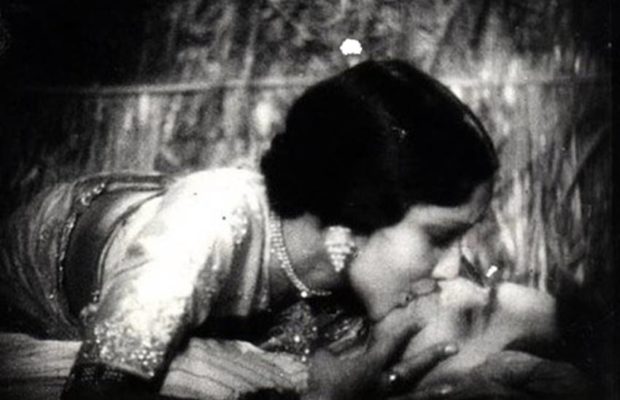
Looking back then, at her debut film Karma (1933), that has gone down in movie history as the film that had a four-minute kiss.

Karma was produced by Rai just two years after the advent of the talkie (Alam Ara 1931), and he had the foresight to make an English version for western audiences—his fourth international production, after the silent films, The Light Of Asia, Shiraz and A Throw of Dice (1929).

Directed by J. L. Freer-Hunt, the bilingual film (Fate aka Song Of The Serpent in English) the film had a crew made up of both Indians and Westerners. It premiered in England (with a special screening arranged for the royal family) and was a critical and commercial success, perhaps because it had just the kind of exotica—beautiful locations and exquisite costumes— the West would appreciate. Not surprisingly, the simplistic love story was rejected by Indian audiences back home when the Hindi version was released a year later.

Devika Rani played the Maharani of Sitapur, who is in love with the prince (Himanshu Rai) of the neighboring kingdom of Jayanagar. His father, the elderly maharaja (played by Dewan Sharar who was also the film’s co-writer with Rupert Browning) disapproves of the maharani, because of her modern ideas on education and healthcare for all. The prince, however, defies his father to woo her.

The Maharaja of Jahanagar loves to hunt, but there are no tigers on his land so the maharani decides to hold a tiger hunt in her kingdom and invite the king to participate, hoping this will make him change his mind about her. The idea doesn’t go down well with the good people of Sitapur whose religious views forbid them from killing animals. A determined maharani decides to go ahead anyway and organizes a big festival for the disgruntled populace hoping it will soften their mood.

During the hunt, the prince accidentally kills a man and is also bitten by a cobra; The maharani rushes to her unconscious beloved’s side and kisses him in a fit of desperation (cue the famous kissing scene) pleading to the Gods for her prayers to be answered. The snake charmer goes off to look for the snake—he believes if the snake bites the prince again it will work as an antidote to the poison. The maharaja placates the angry public and his bad karma by giving alms to the poor. The snake is found, the prince is saved and the film ends on an abrupt but happy note.

After it flopped, Rai quit acting and concentrated on movie-making. Bombay Talkies produced over a hundred films and launched dozens of careers. A major scandal ensued when Devika Rani eloped with the handsome actor Najmul Hassan. She was eventually persuaded to return, but because of this incident, Hassan’s career as a leading man was ruined. His loss proved to be Ashok Kumar’s gain when Himanshu Rai chose a laboratory assistant, Kumudlal Kunjilal Ganguly, renamed him, and made him the new hero of Jeevan Naiya (1936). To Devika Rani goes the credit of discovering a fruit merchant’s handsome son, Yusuf Khan, better known as Dilip Kumar, and casting him in Jwar Bhata (1944). She was also instrumental in the making of Kismet (1943), one of the biggest blockbusters of Indian cinema.

In 1945, she married the Russian painter Svetoslav Roerich and retired from the industry. She was the first recipient of the Dadasaheb Phalke Award, when it was instituted in 1970.

Those Five-Star Days

Advertising,  Rock‘n’roll and jam sessions – Prabhakar Mundkur rewinds back to the 1970s

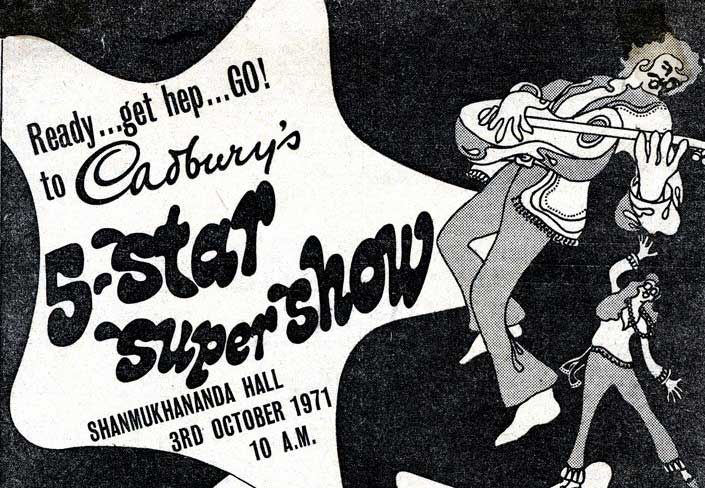
When one of my friends sent me this 5-star advertisement for a rock show at Shanmukhananda in 1971 I couldn’t help reminiscing. Time was when people in Mumbai were happy to see a rock show early in the morning at 10 am at a traditional auditorium like Shanmukhananda Hall at Sion. One can’t see the auditorium, built to seat over 2700 people, going full house to a Western music pop show today, especially if it was a Sunday morning at 10 am. But times have changed.

The ’60s and ’70s still celebrated Western pop music – although if one were to assume that appreciation of English pop music might be correlated with the familiarity of the English language, people speaking English in the country has only increased over the last few decades but I am not sure rock music is any more popular. So that argument does not hold. I think there is another reason. Hindi pop music was almost entirely Hindi film music in the ’70s and it didn’t have an existence of its own as a genre, except to be associated with Hindi films.

For some reason, English pop music had an active morning audience. I remember in the ’60s, Biddu Appaiah – then known as the Lone Trojan, having broken away from the band called the Trojans – used to take the stage at the Hotel Astoria in Churchgate for a jam session that lasted from 11 am to 1 pm. And a daytime discotheque called Bullock Cart at Rampart Row (Kala Ghoda now) was a full house for their morning jam session, largely occupied by Elphistonians, Xavierites, and students from the other South Mumbai colleges. In many ways, it was still an innocent pastime because people were willing to get high on Coca-Cola and coffee rather than beer and spirits. It meant that young people were coming there primarily for the music and the atmosphere with Coke and coffee providing the social glue for a get-together. And of course, perhaps the sheer thrill of missing a few lectures at college often referred to as ‘bunking’ in those days. I sometimes wonder what it is called now.

The English pop scene was also fuelled by HMV which managed to bring a fair range of English titles into the country. In fact, my first 45 RPM record, ‘I want to hold your hand’ by The Beatles, gifted to me by my mother, was bought at an HMV store on Ranade Road quite close to Dadar Station – and Dadar was by no means a hub for Western pop music and it still isn’t. Later in 1970, Polydor entered the country and that increased our repertoire of Western pop music. Even AIR, that stoic representation of a government radio station, played Western pop music on a program called Saturday Date every Saturday evening. This was the English equivalent of the Binaca Geeta Mala but not half as good and it was not exactly a hit parade.

In many ways, the Cadbury’s Five Star ad above is a social mirror of the times. If we think that attending a western music pop concert on a Sunday morning at 10 am is brave, take a look again at the ad. It was the days when advertising folk were not afraid to think creatively on sales promotions. Wonder if anyone would do that today? Accept product wrappers in lieu of tickets? Our household used Binaca toothpaste only so that I could get those little plastic animals that came with the pack. And we ate A1 bubble gum only because a collection of the stickers inside the pack would entitle us to a cricket scrapbook of famous crickets of that age. Polly Umrigar, Abbas Ali Baig and ML Jaisimha, to name a few. Although advertising was later accused of being very English-biased and talking only to the living rooms of Cumballa Hill and Peddar Road, and the equivalents of Cumballa Hill in other cities, many of the Hindi taglines were born long before that accusation. “Sirf ek Saridon aur Sardard se Aaraam”, “Lifebuoy hai jahaan, tandurusti hai wahaan”, “Lux filmi sitaron ka saundarya sabun” were slogans that we all grew up with.

Hinglish, which is increasingly become the advertising lingua franca of today, was not yet born. People had not started mixing English and Hindi freely even in common-speak. It is not unusual, though. In the Philippines, people speak a mixture of Tagalog and English called Taglish. It only means that people are almost equally familiar with both languages when they do that.

But the late ’60s and the early ’70s were different and this 5-star ad is only a reflection of the times. We were fewer people, life was less busy and we didn’t have the internet or mobile phones to distract us. We still had a hangover from our independence. True we had only two cars, the Fiat and the Ambassador to travel in, and many other restrictions, but I can’t help feeling that in many ways we were a happy lot that looked to our future with anticipation and optimism.

Emotions in an envelope

Writing, reading and the special joy of receiving letters in bygone days. By Vandana Kanoria

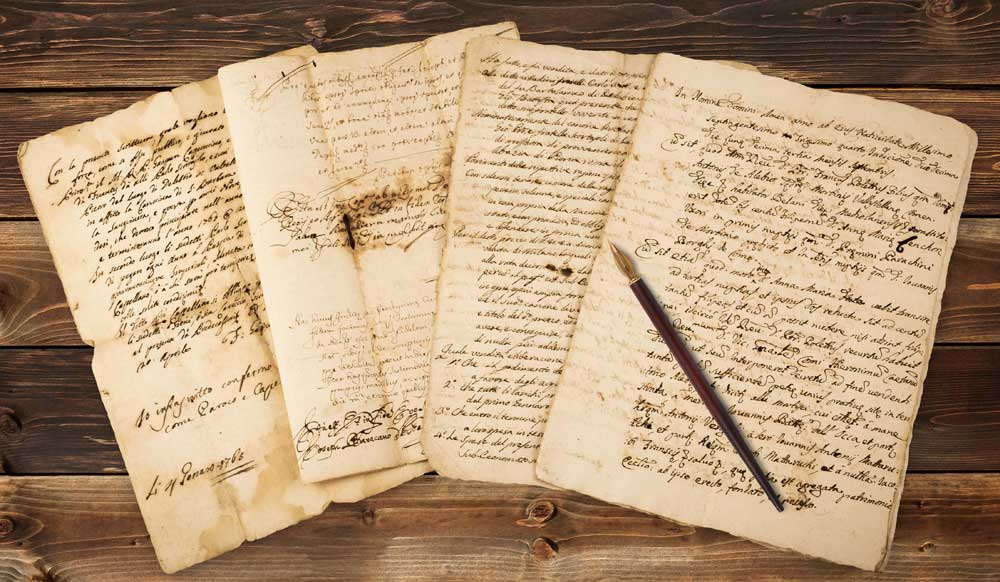
For a long time they lay forgotten and unread in rusted trunks, in attics of my childhood home in Kolkata – tied up in string, slipping and sliding out of files, they stayed quiet and uncomplaining, until one day, gripped by a wave of nostalgia, I took them out and began a journey back to my childhood. Yes, they were letters – in envelopes with decorative stamps, airmail letters in their wispy envelopes, with airplanes flying in the corner and “Par Avion” under the wings, and on the inside, news written on onion-skin paper. Others came from less exotic destinations. These came from cousins and friends – inland letters written on lined sheets torn from notebooks, with little doodles and drawings to better illustrate the feelings contained in words. In those days, emotions triumphed over emojis!

I loved writing letters to my friends, cousins, pen-pals. I waited eagerly for their letters, wondering what surprises they would hold within their pages. I looked for details in the lilt of a heart instead of an ‘o’ in love, the flourish of the ‘v’ in my name. I could see who was wired on the high of first love, or weighed down by despair and pain and therefore how the words staggered and stumbled, how the lines crawled up and down the page. When I wrote letters, I would be under the spell of phrases – the magic and mystery of words. These letters are the marks left behind, the tracks of an earlier journey through times long lost.

Sometimes the envelopes were heavy; containing postcards of distant lands, photographs of never-seen friends, or little keepsakes from cousins. Sometimes the letters would be redolent with the fragrance of pressed flowers, tucked in pages, grown in a little garden in some corner of the world…

And the heaviest were those that carried the weight of secrets never to be told! Today when I read them a wave of nostalgia engulfs me – nostalgia for the laughter and innocence of childhood, for the girl I was then, with her whole life ahead of her.

Letters are physical objects, with all the tactility and uniqueness. Writing one is an activity of leisure, a contemplative practice. On its pages we argue, say goodbye, dream, forgive and tell our secrets. We slow down, sit with pen and paper and thoughts of the person we are writing to. There’s a lot of one’s self in a letter – there is depth, detail, intimacy. These ‘little signatures of time’ are what distinguish them from emails and other forms of digital correspondence.

And this is why emailing and texting do not feel as special. In the age of rapid-fire, efficiency-obsessed, typed-with-one-finger-on-a-keyboard and one-eye–on-the-clock, things happen on a screen — emails fly in and pile up, texts come and go, information crisscrosses and on its way often gets lost or deleted. The bulk of the correspondence is forgotten, which just goes to show how all of these technological “advancements” have weakened communication as much as they’ve strengthened them.

There’s something profound about being able to reread a letter, to hear the voice of friends and loved ones in the words they wrote, and imagine how they’d say the phrases. When we save and treasure letters, we preserve a part of that person and feel the love they felt for us. Can you see yourself rereading a letter someone wrote to you after that person has gone and as you gently move your fingers over the handwriting, you almost feel the touch that loved one? A handwritten letter is a creative act, a deliberate form of exposure, an expression of vulnerability because handwriting opens a window to the soul in a way that cyber communication can never do. What Kazuo Ishiguro says about stories, applies equally to letters because they too contain, “small scruffy moments and quiet private sparks of revelation.”

There is no other form that is so close to our private lives as letters are, for they are only for the eyes of a few friends and it is this revealing-all character that makes them so attractive. There is no thought of their publication, and thus the restraint of the feeling that a thousand eyes are peering over the writer’s shoulder and scrutinizing every word is absent. They create an intimacy that can only be forged one-on-one, written in one person’s distinctive style to another.

Thinking about the lost art of letter-writing, I am reminded of a heart-rending story. In the famous Hindi short story ‘Kaki’ a little boy Shyamu, too young to understand what death means, has been told that his beloved Kaki “Ram ke ghar gayi hai”, which is higher than the clouds. He misses her terribly and wonders why she does not return. Watching kites flying on the occasion of Makar Sankranti, he decides to use these joyously coloured kites to send a letter to Kaki imploring her to return. He attaches strong ropes that would not break and on which Kaki can easily slide down. All this information is contained in his letter, pasted on the kite. The envelope is simply addressed as ‘Kaki.”

A letter is a place where we all become storytellers, where moments are transformed into memories of love and friendship, family and care, so that that future generations will know what we valued and believed and achieved.

Long after we are gone, no one will care about the million texts we may have sent. But a letter will last, will be passed down to generations. Letters are timeless and a legacy. Thus, we are able to create eternity with words.

The Kashmir Document

12

The Story behind the Instrument of Accession and its signing, by India’s first war correspondent, the late Sati Sahni, who was there.

The Instrument of Accession signed by Sir Hari Singh, Maharaja of Jammu & Kashmir State on 26 October 1947 is legally and constitutionally a valid document. Time and again this is questioned by many people and having been in Kashmir at that crucial time, I have observed and have also written about the events closely. Here are the facts;

In 1947 and before the partition of India, the constitutional relationship between British India and the Government of India Act of 1935 was on a federal basis. Under this act accession by states was to be voluntary while for provinces it was automatic. The ruler of a state had the power to sign the Instrument of Accession and the Paramount Power signified its acceptance. It was the Cabinet Mission Memorandum of 12 May 1946, announced by Lord Mountbatten, which was to be the basis of the policy of the government towards the states to decide on the partition. This document provided that the paramountcy of the British over the Indian States would lapse on 15 August 1947. “This void could be filled over either by the states entering into a federal relationship with the Successor Government or Governments

in British India, or failing this, entering into particular political arrangements with it or them.” The Indian Independence Act 1947 accepted this as its guiding and main principle. Except for a few states, all 562 states acceded either to India or Pakistan before 15 August 1947.


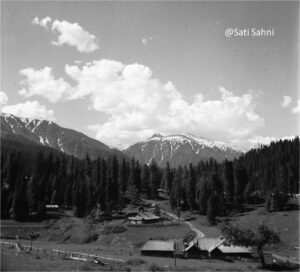
Sat Paul (Sati) Sahni, who was born in Rawalpindi in 1922,
participated in the Indian freedom struggle and later became
one of the few multimedia journalists of his generation.
He was a pioneer photojournalist, and worked for leading
international publications and news agencies. An 
experienced war correspondent, he covered all the four major
wars India was involved in, and has written many 
books – his last book was titled Nehru’s
Kashmir. He passed away in October 2010.

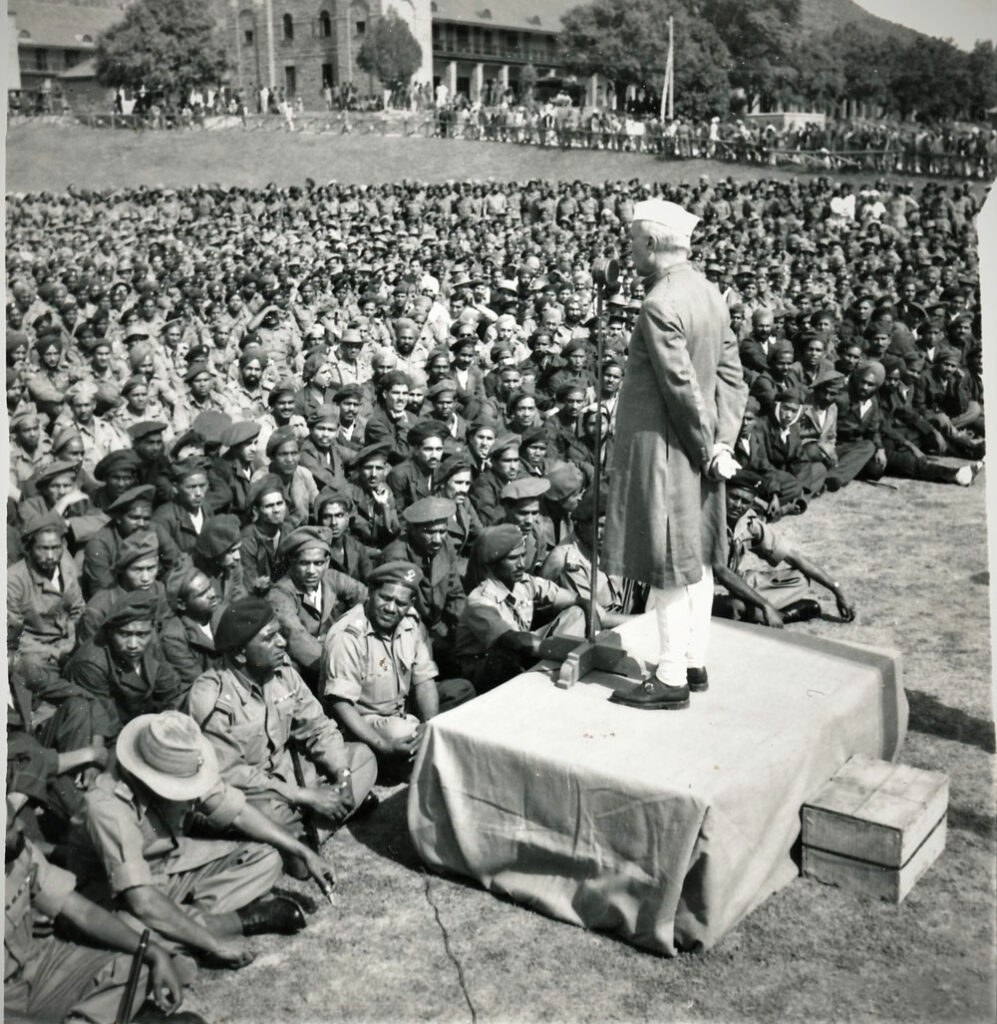
One such state was Jammu & Kashmir which failed to take a decision as Maharaja Hari Singh could not make up his mind. In June 1947 it was Lord Mountbatten who travelled to Srinagar and attempted to persuade the Maharaja to decide between one of the two dominions before 15 Aug 1947. Mahatma Gandhi too travelled to Srinagar two weeks before that date in another attempt to enable the Maharaja to make up his mind. I have been told that the Viceroy
had conveyed to the Maharaja that the Indian Government would not mind if it acceded to Pakistan but felt that the only trouble that could have been raised was by non – accession and this was the very course followed by the Maharaja. Barrister Mohammad Ali Jinnah, President of the Muslim League, subsequently the creator of Pakistan and later its Governor General, had clearly accepted the absolute right of the ruler of a state to decide on choosing one of the two dominions. In June, 1947 he had said “Constitutionally and legally, the states will be independent sovereign states on the termination of paramountcy and they will be free to decide for themselves to adopt any course they like. It is open to them to join the Hindustan or Pakistan Constituent Assembly or to remain independent. I am clearly of the opinion that the Cabinet Mission’s memorandum of 12 May ’46 does not in any way limit them in this choice.” In August ’47 he spoke at a Muslim League meeting about the rulers of the Indian states, saying, “They are free to join either of the two dominions or remain independent. The Muslim League recognises the right of each state to its own destiny.”

The Standstill Agreement

The Indian Independence Act 1947 had provided that a state could conclude a “standstill agreement” with either of the dominions or both. Taking advantage of that, the Prime Minister of Jammu & Kashmir at that time, M.C Mahajan, sent on 12 August ’47 two telegrams, one to Karachi and another to New Delhi, requesting for continuance of existing arrangements under this agreement. In reply the Indian Government desired an authorised representative to be deputed to visit New Delhi and finalise this agreement. Very strangely no one was deputed from Srinagar to go to Delhi.
However the Pakistan Government agreed telegraphically to the standstill agreement with the State of Jammu & Kashmir. The Indian government continued all services and supplies to the state even when there was no standstill
agreement signed or accepted; however, the Pakistan Government which had accepted the agreement, started to restrict the supply of essential commodities and in some cases to stop it completely in a bid to “strangulate the state”, creating untold hardships for the people. It must be remembered that the main road to the Kashmir valley was through what is now Pakistan. By starving the state for essential supplies, Pakistan had hoped to be able to coerce the Maharaja to accede to Pakistan. Along with this strangulation they started to make armed incursions all along the Jammu border. New Delhi and particularly Mr Nehru feared that the strategy of Pakistan was to inflict sporadic incursions till winters when a big attack would take place. This prophecy proved correct as by making small but determined forays into
the J&K state territory, Pakistan managed to disperse the limited state forces to penny packets so that at no one place would they be able to hold back a full frontal attack. The state was mostly starved of petrol which was most essential for transportation.

Pakistan’s Persuasion

Pakistan deftly moved on two counts, governmental and political, to “persuade” the Maharaja to accede to it. Apart from the Maharaja the other obstacle in their paths was Sheikh Abdullah. In early October, the Muslim League sent two emissaries to meet Sheikh Saheb and persuade him to align with Pakistan. The two were Sheikh Sadiq Hassan (President
of the Punjab Provincial Muslim League) and an intellectual, Dr Mohammad Din Taseer (who was the Principal of my alma mater, the Sri Pratap College in Srinagar, and so well known in Kashmir circles). There was a long meeting where they hoped to win over Sheikh Saheb– the then tallest leader of the largest political party of Jammu & Kashmir. Sheikh Abdullah stuck to his long-standing principle that unless the people of Jammu & Kashmir achieved selfrule, no decision could be taken by its people to join either of the two dominions. Obviously the two emissaries failed to persuade him, it was well known that Sheikh Saheb was threatened by Dr. Taseer that if required “other means could would be used”. They also “advised” him to visit Karachi and meet Mr Jinnah. Sheikh Saheb did not travel but instead sent his close
colleague Mr Ghulam Mohammad Sadiq to Lahore for these talks and discussions. Nothing much came about as Mr Sadiq could only meet the middle rung of the Muslim League, and not the deciding hierarchy. It was fortunate that he returned to Srinagar just in time (a day) before Pakistan launched an attack in the Uri area to test the defences. It was as if was all pre-determined and pre-meditated. Some say that there was a plan to detain Sheikh Saheb in Pakistan and forcibly get him to agree to what the Muslim League wanted of him. In October ’47, Pakistani Prime Minister Liaquat Ali Khan asked Col A S B Shah, Joint Secretary, Ministry of Foreign Affairs, Government of Pakistan, to travel to Srinagar
to meet with senior officials of the state. There he met with the state Prime Minister, Meher Chand Mahajan. It is known that Col Shah had brought with him a duly drawn up Instrument of Accession to be signed by the Maharaja. On
his failure to get that signature, he returned to Pakistan. Soon after, a full-scale invasion of Jammu & Kashmir was launched on 22 October ’47.

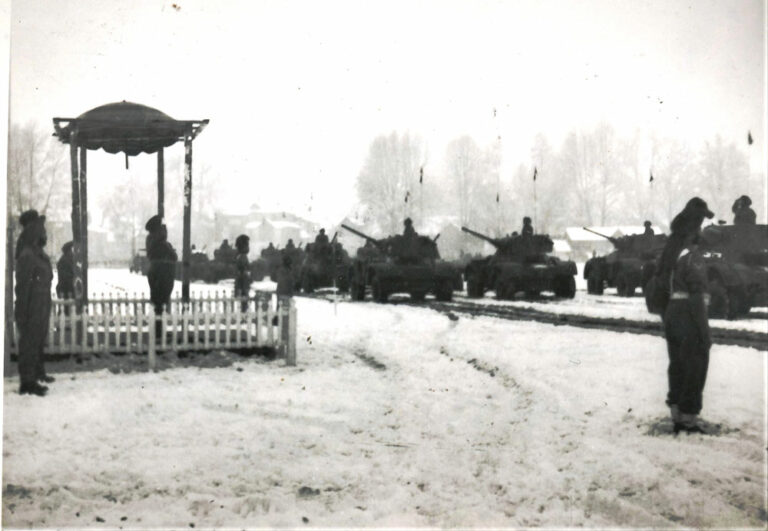
In the forenoon of 24 October, New Delhi received a request from the J&K government for armed assistance against an “organised invasion from Pakistan”. The next day the Defence committee considered this request and felt that arms and ammunition needed to be rushed to Srinagar for its defence immediately. It was pointed out at that meeting that it would lead to a full-scale war with Pakistan if such assistance was given before the Maharaja of Jammu & Kashmir had formally signed on the Instrument of Accession and acceded to the Union of India. The chiefs of the Indian Army (General R.M.M Lockhart), Navy (Rear Adm J T S Hall) and Air Force (Air Marshall T W Elmhirst, all British officers) were given directions “to examine and prepare plans for sending troops to Kashmir by air and road in case it became necessary to stop the incursion”. Around the same time V P Menon of the State Ministry was flown to Srinagar to take an on-the-spot assessment, meet the Prime Minster and the Maharaja of the state, and return the same evening to New
Delhi to report on the situation. On Mr Menon’s advice the Maharaja and his family left Srinagar for Jammu that same night – 25 October ’47. Mr Menon and Mr Mahajan flew to New Delhi at dawn on 26 October ’47 and went straight to the Defence Committee meeting where he reported the critical ground situation. Apparently, Mr Mahajan met the PM Mr Nehru and Sardar Patel immediately upon arrival. Mr Mahajan requested immediate assistance on any terms as the town of Srinagar had to be saved at any cost. Seeing Mr Nehru’s hesitation (ostensibly needing time to arrange
for the army’s airlift) Mr Mahajan offered to get the Instrument of Accession signed immediately, however on condition that the airlift of troops must begin that day itself. Upon instructions from the Maharaja himself it was conveyed to Mr Nehru that Mr Mahajan was to decide on the spot depending on whether Mr Nehru was willing or not to do the needful.
In case Mr Nehru refused, Mr Mahajan was to go straight to Pakistan and to Mr Jinnah to negotiate. Sardar Patel and Sheik Saheb (who was in the next room) prevailed and the die was seemingly cast. Sardar Baldev Singh, the then Indian defence minister, informed Mr Mahajan that a decision had been taken to send two companies of Indian troops to Srinagar immediately. Later that evening Mr Menon and Mr Mahajan were asked to fly back to Jammu immediately
to get the Instrument of Accession and some supplementary documents signed from the Maharaja. In Jammu the Maharaja gave a letter to Mr Menon addressed to Governor General Lord Mountbatten asking for urgent armed
assistance from the Indian Government. This letter along with the Instrument of Accession was brought back immediately to Delhi by Mr Menon where it was presented to the Defence Committee by Sardar Patel. On 27 October,
the actual airlift of the Indian troops began for the defence of Kashmir. The decision of the Maharaja to accede to India and for New Delhi to send in troops for the defence of Kashmir had the full support of Sheikh Abdullah, the leader
of the largest political party of the state.

No Plebiscite Condition
Pakistan and some others have been alleging that the Accession was conditional on holding of a plebiscite. They also said that the Maharaja’s accession was a violation of the standstill agreement with Pakistan and that it was secured under force and by fraud. On 30 October ’47 Pakistan issued a statement that the state’s accession was “based on fraud and violence and as such cannot be recognised”. The facts are as follows: The standstill agreement (under the India Independence Act of 1947) was an interim arrangement which put no curbs on the legal and constitutional rights of the Maharaja. Thus there was no question of barring the Maharaja from signing the Instrument of Accession, as it automatically revoked the standstill agreement. In any case, Pakistan had failed to abide and discharge her obligations of the standstill agreement and thus lost the moral authority. Thus, under the Government of India Act 1935, the Memorandum of the Cabinet Mission of 12 May 1946 and the Indian Independence Act 1947, the Instrument of Accession once signed by the competent authority (the ruler of the state), and accepted by the designated authority, completed the accession. Conditional accession was not even envisaged anywhere. The signing of the Instrument of Accession is neither revocable nor can it be annulled. There was nothing in the Instrument itself to force the Indian Government to a plebiscite on confirming this accession. Legally the offer of accession by the Maharaja and its acceptance by the Dominion of India completed the Instrument of Accession. It created a union within a federation of states. It is the same for all federations including the United States of America.

Allegations Refuted

The allegation of having secured the accession by use of force and fraud was laid to rest by the three British chiefs of the armed forces when they recorded that the decision to send the Indian troops was only taken after the Instrument of Accession was received at the Defence Committee in Delhi. This “statement of events” was later handed over to Mr Jinnah by Lord Mountbatten when the accession was questioned by him. The news of the state’s accession to India reached Mr Jinnah (Governor General of Pakistan), who ordered the acting Commander in Chief of the Pakistan Army, General Sir Douglas Gracy, to send two Brigades of the Pakistan army to Jammu & Kashmir. General Gracy reportedly refused to move any troops till he received approval from Supreme Commander Field Marshal Sir Claude Auchinleck. The Field Marshal flew to Lahore on 28 October and informed Mr Jinnah that “in the event of Pakistani troops entering Kashmir, which was now legally a part of India, every British officer (and there was a large number) would automatically and immediately be withdrawn. Mr Jinnah immediately withdrew the order, thus accepting the legality of the Accession to India.

It is important to point out that the legality of Accession was not questioned at any time by the UN Security Council and the UN Commission for India & Pakistan, or any of its representatives or mediators like Dr Graham,
Sir Owen, General McNoughton and Mr Jarring. If the Accession is considered to be illegal, incomplete or invalid, then I am afraid that all that flows out of the Government of India Act 1935, Memorandum of the Cabinet Mission and the Indian Independence Act 1947 would be illegal, unconstitutional and invalid. This would also include the creation of two
separate dominions of India and Pakistan, The Constitutions of India and Pakistan, the State of Jammu & Kashmir, and all actions of the Governments of India and Pakistan since they were created under this Act of 1935. Matters such as the ceasefire line of 1949, the Tashkent agreement of 1966 and the Simla agreement of 1972 would also then be unconstitutional as they all stem from those acts.

Guru Par Excellence

12

Legendary classical vocalist Kishori Amonkar’s first disciple, Dr Arun Dravid, looks back on a beautiful connection between teacher and student

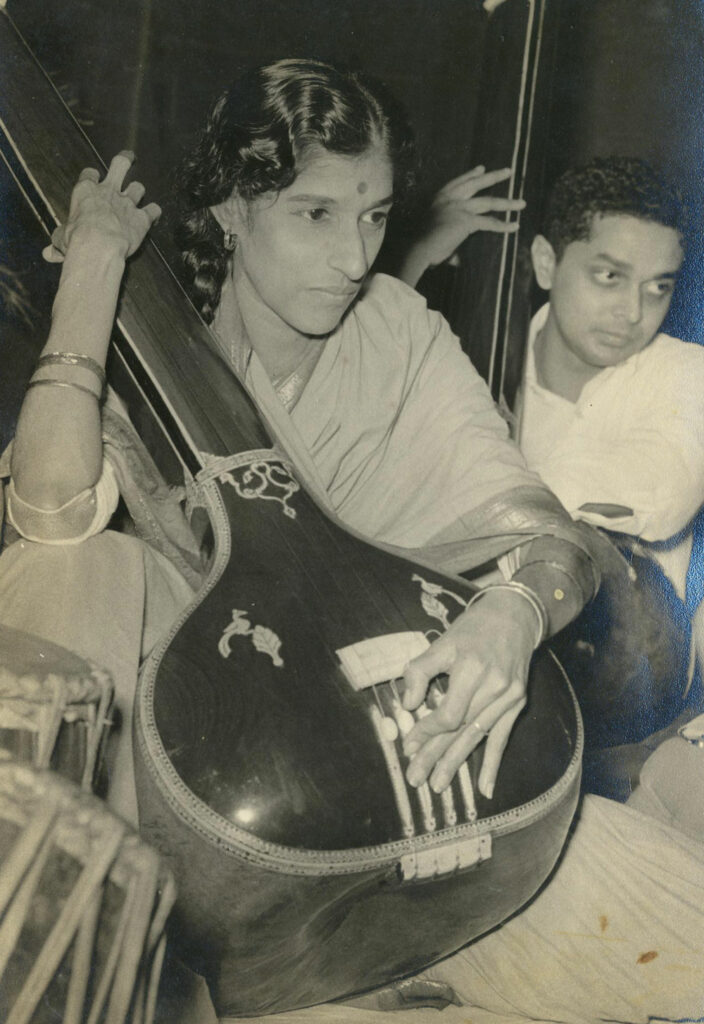
I have had the privilege to be the first disciple of the legendary Padmavibhushan late Gaan-Saraswati Kishori Amonkar (whom I shall address as Kishoritai or Tai hereafter). Kishoritai lived an accomplished life as an avant-garde vocalist of the Jaipur-Atrauli gharana of Hindustani classical music during her illustrious 86-year life. What follows are some reminiscences of a devoted disciple, friend and philosopher, a role I had played for about 50 years in her life. Kishoritai was only 12 years older than me, and therefore these three roles inter-mingled rather easily in the long journey of our lives. However, the most prominent role was that of her disciple, and I shall primarily dwell on it in this narration.

My initiation as Kishoritai’s disciple happened somewhat accidentally. When I was hardly 12 years old, I had a chance encounter with her when I had visited her mother and Guru, late Padmabhushan Gaan-Tapaswini Mogubai Kurdikar (whom I shall call Mai, as we all used to call her) just to see what the legend looked like, and to pay my respects to her. I was undergoing training under Ustaad Abdul Majid Khansaheb at that time. Mai made me sing for her during that visit, so she was aware of who I was. Many years later, at the age of 17, when I approached Mai to ask if she would take me under her tutelage, she politely declined, but knowing of my preparation in vocal music from five years earlier, she suggested her daughter Kishoritai, not so famous then, to play that role. I readily accepted, and thus was the beginning of what was to be the most scintillating musical relationship for the next five decades!

My first year of training began with Raag Bhairav. I had finished First Year at college and was into the intermediate science year. Music practically became my second, equally time-consuming, activity during that time. The lessons were regular, about three to four times a week. Tai started with me for fees of Rs. 50 per month, but in a couple of months, she stopped accepting any fees. Her reasoning was that she herself liked the challenge she faced while teaching me, to stay a step ahead of me, and that enriched her own music. So from then on she never accepted from me a single paisa for all the wealth of music she showered upon me!

In 1962, I stood first at the University, and took the decision to join IIT Bombay at Powai for my B.Tech. in chemical engineering. Since the campus was residential, with rules not allowing students to go home on weekends, this meant an end of my further music training. But Tai gave me a strict ultimatum: Either you come for music lessons every weekend, or terminate your training! I had no option but to seek special permission from the Director of IIT to go home to Mumbai every weekend. He gave me that permission with the condition that it would be withdrawn if I ever lost my first rank in the class. With God’s grace I managed studies, and weekends and holidays of full-time music lessons. I not only maintained first rank each year, but won the President of India Gold Medal at the final B.Tech. year, having stood first amongst all branches of engineering. Needless to say, Kishoritai was mighty pleased, and even attended my convocation.

Rigorous routine

I am tempted to write about the music lesson routine during each weekend. After the practicals on Friday afternoon, I would take the bus from the campus to Vikhroli station, and then after a long train journey, reach Tai’s home at Gowalia Tank in the evening. I would then have five sessions – One on Friday evening and two each on Saturday and Sunday mornings and evenings. I would then take off for Powai late in the evening on Sunday, reach the hostel sometimes as late as 11 pm after a two mile uphill walk from Vikhroli station, as there would be no bus service at that hour! I would miss dinner, and fill-up on biscuits and water. And the classes would begin on Monday morning. The reason I have mentioned this ordeal each weekend is to emphasize the fire in my belly that drove me to satisfy Kishoritai’s strict, rigorous demands of learning the authentic Jaipur Gharana Raagas as fast as possible. Of course, during Diwali and summer holidays, the training would happen each day morning and evening. Thus, I had almost no life left other than music and academic studies. In hindsight, I feel very blessed that I could assimilate the essence of Kishoritai’s avant-garde treatment of a large number of complex Raagas of Jaipur Gharana.

Kishoritai was a perfectionist when it came to teaching. It was mostly one-on-one with me, but sometime together with Mrs. Manik Bhide (mother of Vidushi Ashwini Bhide Deshpande). She would normally alternate “Avartans” (cycles) between me and herself. However, when a phrase did not come out right, she would make me repeat it several times until it came to her satisfaction. She was not as patient as her mother (who also taught me many times when Tai was unable to sit for a lesson or was out of Mumbai). If I could not reproduce a given phrase quickly, she would get upset. So there was always pressure to get things right. The Asthai and Antara of any new Raaga had to be learnt precisely. There were no electronic pocket recorders or smart phones. So I found myself vigorously reciting those verses in the bus going home after the lesson, much to the curiosity of fellow passengers!

Much of the world saw Kishoritai as a stern, hard-driving, demanding, and temperamental artist. However, my personal relationship with her as a disciple was very different. There was a very loving, caring and soft side to her persona that co-existed with her demanding and strict teaching style. I remember vividly a touching occasion which I am tempted to share here. Once I had taken ill with high fever at IIT campus and was hospitalized at the IIT hospital in Powai. When I phoned Tai that I would not be able to come for the weekend lessons, she became so worried about me, that she came all the way in a taxi to my hospital, got me discharged under her care, and took me home, covering me with the Pallav of her Sari to shield me from the breeze! Such was her loving and caring side.

Early years

During those early years of my music training, Kishoritai was not the same celebrity as she became in later years. This was to my advantage, as I used to get her undivided attention one-on-one during the entire lesson. Also, since she was living with her mother, my training was indirectly under Mai’s keen ear and supervision. I therefore received the beautiful blend of the structural beauty of the Jaipur Gharana Raagas, but also the romantic beauty that was the hallmark of Tai’s own temperament. This golden mean did not reach most other disciples of Tai who came 20 years after me, by which time Tai had started to de-emphasise the grammatical or structural rigidity of the Raag and replace it with an emotional touch to the rendering. The most significant feature of her treatment of any Raag was her very special attention to the Shrutis (microtones) of the notes that formed the Raag. For example, The extra flat treatment of Komal Re in Raagas like Marwa and all varieties of Todi, Dha in Bibhas that is neither Komal nor Shuddh, but three quarters of the way from Komal to Shuddh Dha! Similarly, her treatment of Komal Ga and Komal Ni in Kaushi Kanada is an example of the control she had mastered in singing different Shrutis of the same two notes. These two notes have different Shrutis depending on whether one shows the Malkauns component or Darbari Kanada component of Kaushi Kanada. Thus, we, the senior disciples had to strive to master these Shruti differences, and she would get annoyed whenever we could not achieve consistency in singing those Shrutis! Such sessions were always a challenge and source of immense happiness when I satisfied Tai with the right Shrutis.

Since there was only a 12-year difference between my age and Tai’s, apart from rigorous one-on-one training, we used to spend hours discussing nuances of Raagas, their specific Shrutis (microtones of main notes), aesthetic treatment of singing the Asthayi Aantaras, tandem relationship between Sur and Taal, and the special way in which words had to be pronounced interlinked with the rhythm, which actually was a specialty of Mai. Tai was so open-minded with me, that she had given me standing instructions to note any occasions on which she made any grammatical error during a performance, and then discuss it with her later at home. I vividly remember such interactions with respect to Raagas like Yaman, Bahaduri Todi, Bageshri, Basant Kedar, Shree, etc. It is interesting to note that during my active decades of training, Kishoritai did not sing much devotional music, but rather sang semi-classical varieties like Thumris and Dadras. I therefore learnt some Thumris from her, but not any Bhajans and Abhangs which she began singing more regularly from the mid-eighties and nineties.

After my initial two decades, I began to find less time to devote to active learning because of my employment. However, as luck would have it, my office was located within a few yards of her house, and I was a frequent visitor to her home after my office. There were many other students by this time, and my active learning had slowed down. Regardless, I found myself more and more in the role of a friend and adviser to her to guide her and solve many ticklish family issues, health issues, and social issues that used to cause her undue stress much of the time. By the nineties, Mai began to show signs of old-age, and much of Tai’s attention and energy began to be consumed with Mai’s health issues. I shared these challenges much of the time with Tai, and gave her much needed relief and solace.

Lasting tribute

Since Kishoritai did not accept any fees for the wealth of music she gave me for four decades, I always had an uneasy feeling about how I could repay my debt to her. Years passed by, and on April 3, 2017, she suddenly departed for her heavenly abode, leaving countless disciples, family members and music-lovers orphans. After much thought I finally decided to create an award in her memory, called “Gaan-Saraswati Puraskar” as a humble tribute to her. I donated a corpus to Dadar Matunga Cultural Centre in Mumbai to fund Rs. 1 lakh in annual award money plus expenses for administering the award. The award will be given annually to an accomplished Hindustani Classical Vocalist under the age of 50. The process of selection of the awardee and the procedure for applying for it are described at www.gspuraskar.in.

Art On A Plate

0

Discovering Japan, one bite at a time. By Vandana Kanoria

In her gorgeous essay ‘In Praise of the Cooks’, Midori Snyder says, “The very best of cooks are sorcerers, wizards, shamans and tricksters. They must be, for they are capable of powerful acts of transformation. All manner of life, mammal, aquatic, vegetable, seeds and nuts pass through their hands and are transformed by spells — some secret, some written in books annotated with splashes of grease and broth.”

Traditional Japanese cuisine, or Washoku, is one of the only three national food traditions recognised by the UN for its cultural significance. Tokyo was added to the Michelin Guide in 2007 and has since blazed forth, becoming the most-starred city in the world with 234 places listed in 2018.

The depth and variety of the deliciousness of Tokyo’s culinary world can be summed up in one word – Shokunin. Fresh and delicate, whilst there is simplicity about the food, one realises while eating how much details matter.

An 80-year-old tempura man who has spent six decades discovering the subtle differences yielded by temperature and motion; the 12-generation yakitori sage who uses metal skewers like an acupuncturist uses needles; the young man who has grown old at his father’s side, measuring his age in kitchen lessons, will know exactly what to do when it is his turn to be the master. This is Shokunin, or specialisation — artisans deeply dedicated to their craft. It is at the core of Japanese culture, as are ingredient obsession, technical precision and thousands of years of meticulous refinement. The most famous Shokunin is of course Jiro Ono, immortalised in the film Jiro Dreams of Sushi.

Tapas Molecular Bar
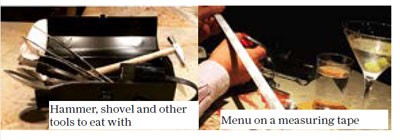
Don’t expect a typical night at Tapas Molecular Bar. From the moment you are seated, you enter the creative realm of highly entertaining food theatre by chef Kento Ushikobu, who takes you on a culinary journey that feels part-science, part-magic, and is unbelievably delicious. A mysterious bandanna-wrapped black box contains tools with the bandanna serving as a napkin, the menu… inside the measuring tape! Deconstructed Japanese classics using seasonal ingredients, and oh yes… all vegetarian!!

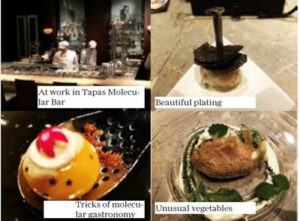
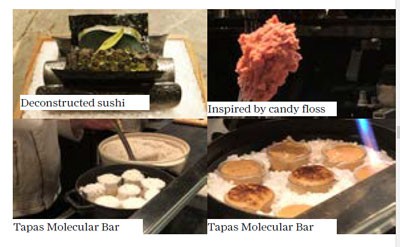
The usual basics of molecular cuisine – sous-vide cooking, effervescent foams, chemistry-lab equipment – transform things we eat as if by a wizard’s wand, conjuring, in unconventional ways, familiar ingredients. Master cooks are alchemists, turning gnarled root vegetables into delicate sea foam, hazelnuts into digestive liqueur, combining spices and chilies into a paste that burns and soothes at the same time. Dinner is interactive and inventive, full of surprises, as objects transform, liquid nitrogen floats across the counter, a mint meringue soaked in liquid nitrogen explodes in your mouth and the resultant smoke is exhaled out of the nostrils. Different tools like hammers and shovels are used to prepare and consume each dish. Although the experience – for an intimate group of just eight diners per seating – makes this Michelin-starred restaurant exclusive, the atmosphere is casual and comfortable. Chefs chat enthusiastically, explaining preparation techniques, concepts and stories behind each dish, satisfying our curiosity about this show of wizardry and whimsy.
Narisawa
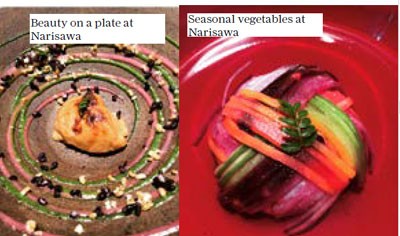
Narisawa and his groundbreaking cuisine at his iconic restaurant, has become a must do for visiting gastronomes. Narisawa melds classical French gastronomy with Japanese principles, local ingredients and molecular techniques. Taro potatoes from Ishikawa, lotus root from Hokkaido, strawberry and yame matcha from Fukuoka, are just some of the ingredients in the deliciously rich fourteen-course omakase vegetarian menu. Responding to seasons and landscape, his recipes are ground breaking, especially the ‘Satoyama Scenery and Essence of the Forest’, an elaborate edible landscape, evoking the forests and fields of rural Japan. The ‘Soil Soup’ which is, to quote him, “a dish that contains my conviction for a natural environment so safe, you can eat the soil itself.” Combining the deep, earthy flavor of actual soil from the pristine mountains of Nagano Prefecture, the food is “beneficial to both body and spirit and a continuously sustainable environment which we call Innovative Satoyama Cuisine.”
Hajime

“Pay homage to nature” says Hajime.

Universe, harmony, circulation, life and love describe the chef ’s culinary philosophy. His greatest inspiration is the interconnectedness of things. Hajime has achieved three Michelin stars in the shortest period of time in the history of Michelin ratings.
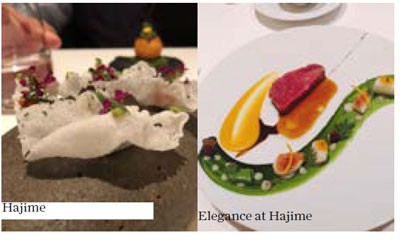
Combining French classics with his Japanese heritage, Chef Hajime Yoneda is a meticulously skilled culinary master. Transitioning from being an electronic components designer to becoming a professional chef, he has an artist’s eye and a poet’s vision of the world. A painter, Hajime’s food is pure art. He is deeply affected by the equilibrium and harmony that exist in nature. The 2019 menu called Chikyu Tono Taiwa or ‘Dialogue with the Earth’, includes approximately seventeen dishes, some of which are evocatively called:

Life – cauliflower, black olive, tomato and rice;

Inshore – seaweed, sansho, hatcho miso, white kidney beans;

Mountain – rizoni, asparagus, broad beans, romanesco broccoli, green beans;

Assimilation and Destruction – avocado, Asian hazel, pumpkin, black pepper.

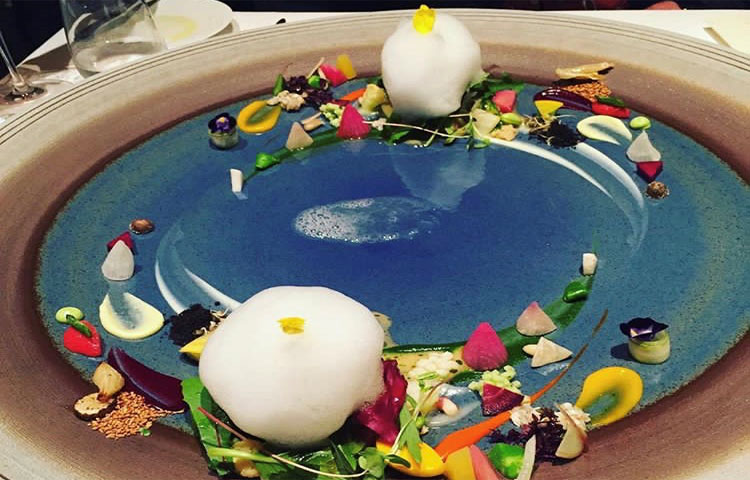
His reverence for nature is reflected in the most innovative and beautiful dish that I have ever seen or eaten. Called ‘Chikyu’ or Earth, it represents the cycle of life, and the reconstruction of the planet in miniature, through hundred and ten different vegetables, grains, herbs and sea foam. “Fallen leaves from the forest enrich the earth, and the nutrients flow into the sea,” he explains. His aim? To show a culinary story about nature and time. (pics 21-25)

Daigo

Nomura Yoshiko, who founded the two-Michelin-star Daigo in 1950, remained the

Okami, or lady of the establishment, until recently. Family run, the current Okami, Nomura Satoko, keeps the tradition of Japanese hospitality alive and Nomura Daisuke, the head chef, is one of her three sons.

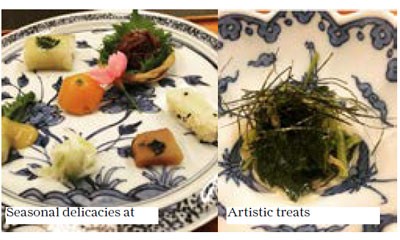
Seated in traditional style in one of the eight sparsely furnished private dining rooms, with a large glass window looking into a garden, we feasted on fifteen jaw-dropping, artistically crafted courses served Kaiseki style. From bite size nibbles, to a hearty bowl of soup with rice and mushrooms, each plate was decorated keeping in mind Buddhist principles and aesthetics. Ceramic dishes and lacquer bowls coordinated beautifully with food, heightening the sensory experience of eating and fulfilling Daigo’s mission to stimulate the five senses with each bite. Delicate bites of different tofu preparations – a Daigo speciality – soya, matcha and seasonal Japanese fruits and vegetables, are designed to allow the diner to appreciate the Tanmi or the subtlety of flavours, which progress from lighter to bolder, allowing you to savour the essence of each main ingredient. (pics 26, 27)
A vegetarian in Japan

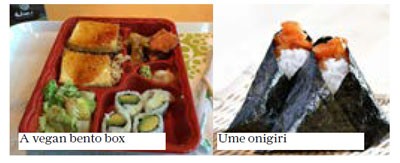
Someone once said Japan is a vegetarian paradise wrapped in a vegetarian hell! Being a vegetarian in Japan can be difficult, although, in recent years, thanks to apps such as Happy Cow, Tokyo Veg Guide, and Uber Eats finding meatless meals has become much easier. The ever-resourceful Google Translate helps to navigate the intricacies of the language. Courtesy JustHungry.com, a vegetarian/vegan can print a card stating a no meat, fish, dashi, egg meal for the waiter. A growing number of cafes and restaurants, including traditional Japanese ones, offer vegetarian options and English menus. Inconvenience stores and bakeries, vegan snacks like dried fruits, nuts, red bean pretzels, edamame rolls, black sesame and cheese bagels satisfy hunger pangs. As do the wonderfully flavourful Ume Onigiris, which are rice with plums wrapped in seaweed. Even Shinkansens or bullet trains serve vegan ekiben or bento boxes!
Kaiseki is the most elegant and extraordinary of all Japanese cuisine. Beautiful yet austere, ancient yet innovative, the ingredients are cooked or left raw, leading to a perfect balance of taste, texture, appearance and colour. The meals have moments of great beauty and taste. White miso with black sesame, foraged vegetables and herbs, a confounding variety of tofu, the sharp and sour pickled vegetables, are all served in heirloom lacquer bowls. Pine needles and fallen leaves cover grilled gingko nuts and sit on centuries old ceramic plates. Gohan, or rice is served with a simple splash of colour, sometimes hiding a nest of grilled wild mushroom, sometimes crisp, with herbs, served in its own broth with seasonal flowers.

It is easy for a vegetarian to feast on this awesomeness in Michelin starred restaurants and ryokans by simply emailing food preferences. The chefs are only too happy to stretch their culinary creativity.
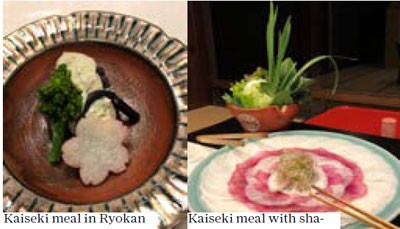
Izakaya Yakitori and Shojin Ryori

Izakaya and Yakitori often have vegetarian options – brightly coloured root vegetables like daikon, yam, sweet potato, are grilled on sticks with mochi rice cakes. Tempura, which is actually a Portuguese import, uses seasonal and aromatic vegetables such as renkon or lotus, satsumaimo or sweet potato and sansai or wild mountain greens, which are a spring speciality.
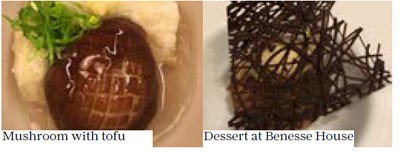
The influence of Shojin Ryori – a traditional Buddhist vegetarian cuisine – is evident in modern Japanese food. Humble, yet elaborate, these meals grew around Buddhist temples. They feature seasonal, local vegetables and a mind-boggling variety of tofu, to create beautiful dishes using light cooking and preserving techniques. (pics 37-40)

Food, a love story

Eating good food, be it in a humble roadside shack, or in Michelin starred restaurants is a passion. Often our dates of travel are fixed around reservations in hard-to-get restaurants.

Add to this my deep love of Japan – its culture, its aesthetics, and the beautiful simplicity of everyday things. Travelling in Japan, I feel I am time travelling between the future and the past, between the ephemeral and the permanent. Centuries old Buddhist temples exist peace fully with current fads, be it cat cafes or robot restaurants. It is a place of contrasts – cherry blossoms and autumn leaves fall softly, and tsunamis rage and ravage the coasts. This reconciliation of opposites I felt most keenly while eating in Japan. Dishes, prepared using the most cutting edge technology, are served in traditional kaiseki feasts, often on heirloom plates and bowls. Local ingredients are interpreted, absorbing the latest in international food trends, creating something distinctively Japanese.

And with apologies to Ibn Battuta, Japanese gastronomy – it leaves you speechless, then turns you into a storyteller.


How does your garden grow?

0

You don’t need oodles of space or fancy equipment to nurture lovely flowers or luscious veggies, writes Sheila Jain.

I will be 70 soon, but I don’t feel it because my hobbies keep me going. Among other hobbies, gardening is my passion. I work for four hours regularly in my small garden.

Gardening is meditation to me. It is my joy time, gratitude time. I forget myself when I am surrounded by plants. I talk to them, bathe them, feed them and even dress them by shaping or putting a knot or stitch to make it straight.

If you have a hobby in your old age your mind will be alert. You will keep planning to do so much in the garden that you will not age suddenly.

What do you need?

 You don’t need a garden to do gardening. In a flat you have balconies, where you can grow multiple hanging baskets and pots. You don’t even have to buy baskets, you must be having old plastic colanders. Put coconut fibre all around or a fine mesh that you get from potato vendors.


If you don’t want to buy soil, you can even make your own compost in a covered bucket or earthen ghada. Fill this container with kitchen waste but not cooked food, all raw vegetable and fruit peels, eggshells, tea leaves, even dry flowers from a bouquet can be put. Cover with a layer of soil, cover the lid and keep aside.  In 2-3 months, compost will be ready.

What about plants?

There is no urgent need to buy plants, as it is not always possible for you to go to a nursery. In fact, your kitchen is your seed house. You can grow mint, methi, haldi, karela, tomato, red, yellow and green peppers, coriander, ginger, onion, potato and green chilli easily.

You can dry and use as seeds, the puja flowers that you get. Grow these in baskets or pots. You can be very creative.

The benefits

Every time you achieve something you will feel so happy, and in return you will be grateful so keep thanking God for all these creations. When you are in contact with Mother Earth you will get energy from there.

For gardening, reuse and utilise things that are lying as waste.

Always grow vegetables of one type in 2-3 pots so that you get some yield.

When I get 5-6 bhindi from my garden, I am on top of this world and enjoy every bite of it.

Gardening is so much fun

I keep looking for overripe vegetables and take out the seeds, wash and dry them, and then plant them.

Potatoes get “eyes”, that is new shoots are coming out. Plant it in the soil; if the potato is big cut into two pieces and put in the soil.

When you cut an onion, cut the root side a bit thick, place it on soil and water. Tulsi (holy basil) can also easily be grown.

You can use soaked chana, rajma, dry mutter, peanuts, and tamarind seeds as well as china orange seeds.

Don’t use any chemical pesticide or fertilizer; compost is the best.

For pesticides, in an empty 1-litre Colin bottle add 1 tsp white vinegar and juice of a half lemon. Mix and spray on plants.

If there are no fruit or flowers, then add 1 tsp soda bicarb in one-liter water and spray.

When plants are growing fine and healthy, it feels as if your children are healthy and happy.

I share my plants with my friends and also get plants from them.

My family

I have created a family of plants. I am a mother and granny to so many plants and my friends who give me plants are also Nani and aunts. When we talk of those plants we say Nani is coming today, look nice to receive them. The plants respond to my talking to them.

One day I scolded a plant saying, “You don’t behave well even after so much caring and love; I will throw you out of my family.” You won’t believe that next week it flowered and since then it is my pet plant.

All this keeps me so happy and calm.

In the morning I see small colorful birds sitting on my plants, and I thank God for getting me interested in gardening.

I don’t get to eat any fruits that grow in my garden, but I feel happy that I am growing anar, guava, custard apple, peach, etc for them. Squirrels, parrots and other birds come and eat them and I enjoy watching them. I feel as if grandma has served a special lunch for her grandchildren. The thought never comes that I am not eating the fruits I have grown.

Multi-colored butterflies come and sit on the flowers, and I bless them saying take as much as you can take. I have a purple flowering plant, and when it flowers tiny yellow butterflies in the hundreds sit on the flowers and the plant looks as if purple and yellow flowers are blooming.

Ladybugs walk around freely.

These days our children don’t get to see and enjoy nature. When my grand-children visit me I keep the pots ready and give them seeds from the kitchen to sow them in pots. They water them regularly, and watch them sprout, then getting leaves and then slowly growing.

They enjoy, and I enjoy watching them and listening to their conversation with the plants. It’s an overwhelming feeling.

In short, I can only say that gardening is fun and very satisfying. Enjoy gardening!

Advance Directive – A Living Will

0

If you are seriously ill or incapacitated, it is a good idea to leave instructions for your care, writes Sonavi Kher Desai

With increasing longevity, it is common today to find people suffering from terminal illnesses or from varying forms of dementia.Bodily functions decline and people are unable to care for themselves physically or to use their mental faculties. In such situations of total dependency and inability to take informed decisions for themselves, the one way by which a person can take his/her own decision regarding his/her treatment is by means of an “Advance Directive” or a “Living Will”. It is a document prepared in advance by a person, expressing his/her directions with regard to medical treatment in case of a situation of total dependency.

The Supreme Court judgement delivered on 9 March 2018 states the requirements for executing an Advance Directive.

Who can execute it and how? 

The Advance Directive can be executed only by an adult who is of sound mind and in a position to understand and communicate the purpose and consequences of executing the document.It must be executed voluntarily by the person without any undue influence or coercion. It must be in writing, clearly stating as to when medical treatment may be withdrawn or that no specific medical treatment shall be given which will only delay the process of death, that may otherwise cause him/her pain and suffering and put him/her in a state of indignity.

Contents of the Directive

The directive should clearly state the circumstances for withholding or withdrawal of medical treatment. The instructions must be specific, clear and unambiguous.It should also:

  1. mention that the executor may revoke the instructions at any time.
  2. state that the executor has understood the consequences of executing the document.
  3. specify the name of a guardian or close relative who, in the event of the executor becoming incapable of taking decision at the relevant time, will be authorised to give consent to refuse or withdraw medical treatment in accordance with the Directive.

In the event that there is more than one valid Advance Directive, none of which have been revoked, the most recently signed Advance Directive will be considered as the last expression of the patient’s wishes and will be given effect to.

Procedure for recording the Advance Directive

  1. The document should be signed by the executor in the presence of two attesting witnesses, preferably independent, and countersigned by the jurisdictional Judicial Magistrate of First Class (JMFC) so designated by the concerned District Judge.
  2. The witnesses and the jurisdictional JMFC shall record their satisfaction that the document has been executed voluntarily and without any coercion or inducement or compulsion and with a full understanding of all the relevant information and consequences.
  3. The JMFC shall preserve one copy of the document in his office, in addition to keeping it in digital format.
  4. The JMFC shall forward one copy of the document to the Registry of the jurisdictional District Court for being preserved. Additionally, the Registry of the District Judge shall retain the document in digital format.
  5. The JMFC shall cause to inform the immediate family members of the executor, if not present at the time of execution, and make them aware of the execution of the document.
  6. A copy shall be handed over to the competent officer of the Local Government or the Municipal Corporation or Municipality or Panchayat, as the case may be. The aforesaid authorities shall nominate a competent official in that regard who shall be the custodian of the said document.
  7. The JMFC shall cause to hand over a copy of the Advance Directive to the family physician if any.

The Taste of Green Peas

When children forget how to love and care for their elders, what does one do? By Vickram Sethi

A true story from the 1960s. Two friends, Arun and Jagat, lived in Delhi around Rajendra Nagar. Arun was a civil engineer attached to the central government, and his wife Shakuntala was a successful gynecologist. Jagat was a chemical engineer, and his wife Kamala was a homemaker.

Shakuntala had inherited a flourishing practice from her parents, who were doctors as well. Slowly her practice grew,and she became a gynaecologist in great demand around Patel Nagar and Rajendra Nagar areas. She kept herself abreast of the latest technology and helped couples in conception. As the practice grew, she had two assistant women doctors whom she trained and ran a small hospital with 10 rooms. Arun in the meantime, retired and helped in the administration of the hospital.

Arun had two sons. As life went by the boys grew up, and Arun bought two plots of land 600 sq yards each in the new upcoming colonies of New Delhi. With Jagat’s help, he built four-bedroom houses with a lawn for each of them. The boys got married and had children of their own. Jagat had three children, two boys, and a girl. Both his boys worked for the Indian railways, and his daughter was married at an appropriate time.

Shakuntala had decided that she would retire at sixty, and both husband and wife would go around the world on, as most Punjabis say it, a “world tour.” It wasn’t easy to shut down her hospital, but slowly, she reduced the number of patients and passed them on to her two assistants. Somewhere she fell ill and as a doctor she knew that something was not correct in her body. After various tests and X-rays, she discovered that she had cancer, and from that day, she shut her practice and moved to Mumbai (Bombay) to the Tata Hospital. One of Jagat’s sons was posted in Mumbai (Bombay) Arun and his wife stayed with him. Shakuntala realised that the cancer was not curable and the doctors gave her six months. She convinced Arun that whatever time was left for her, they would spend it in Delhi in their own home at Rajendra Nagar. It was a slow and painful end, but morphine eased the pain.

Once all the rituals of death were over, Arun decided to sell the Rajendra Nagar house and move in with his boys. Arun and his wife had spent a considerable part of their savings on constructing and furnishing the houses for the boys. He planned to transfer the sale proceeds to the boys so that after his death his children would not have to pay estate duty. Shakuntala had a large holding of gold from her parents. Arun received a central government pension which he reasoned was enough for him, his medicines and his club expenses. He held back the gold. Jagat was dead against this move and reasoned with Arun that after his death the estate duty payment should not bother him since it would come out from the sale proceeds of the house. Besides Arun had given his children enough and an estate duty payment would not be such a big deal. However, Arun felt this was a selfish view, and he would be happy living with both his boys six months at a time.

The boys welcomed him and were delighted that he was with them. Grandchildren and his daughter-in-laws doted on him, and Daddyji as he was called was a loved figure. Arun got into a routine of life going for a walk, reading his papers and listening to the news. At 4 o’clock in the evening he went to the club, played cards and returned home by 9 pm for dinner; an hour later he would be asleep. During winters, Arun spent the morning sitting in the sun, soaking in the heat. His spot was below the kitchen window. He ate a little bit of dry fruit and some jaggery sweets.

Years passed by and he was pretty much happy spending six months with each of his boys. Both of them lived within a mile of each other. One day he told his elder daughter-in-law that there were fresh green peas in the market and asked her to get some. A week went by, and he gently reminded her again about the green peas. Two weeks later there were still no green peas on the table. The third time he told her and asked her why she hadn’t brought them. That morning he was sitting outside the kitchen window, and the younger daughter-in-law came over to meet her elder sister-in-law, who was in the kitchen. The conversation which Arun heard pierced a spear into his heart. The elder daughter-in-law said, “Budhdhe ke muh me daant nahi hai par mataron ka swaad nahi gaya” – the old man has no teeth but can’t get the taste of peas out of his mouth. Stunned, he could hardly believe what he had heard. He got up and went to his room and cried, remembering Shakuntala. He asked for lunch to be served in his room, but the peas tasted like poison and Arun flushed them into the drain.

Jagat and his wife were in Mumbai (Bombay) and returned a week later. The next day after they were back, Arun went over to meet them and narrated the whole story. It was obvious that he had outlived his hospitality. Lots of conversation ensued between the men and Arun left with a heavy heart.

Jagat and his wife usually took a Kothi in Dehradun to get away from Delhi’s scorching heat. It was a normal thing that a lot of Delhi families did as the men hatched the plan.

Somewhere in the middle of April Arun got a letter. His grandson brought the letter to him, and Arun said, “Just read it for me, my eyes are giving me a little problem.” The letter was from Jagat, saying that the tenant of his Dehradun property was ready to vacate the house and wanted Rs 4 lakh whereas the church next to the house would buy the entire plot for Rs 8 lakh. Seemed like a good deal and Jagat enquired whether he would like to confirm this. Arun kept quiet and went about his daily routine without mentioning the letter. Sunday, his younger son came for lunch, and the topic of the Dehradun property was raised at the table. The elder son asked him, “Why didn’t you tell us about this?” Arun replied that he didn’t have Rs 4 lakh to pay the tenant. In an instant, both the boys said that they would contribute Rs 2 lakh each and Arun should write to Jagat confirming the deal. A week later Arun left for Dehradun… Both the men couldn’t stop laughing.

On his return, it was “Daddyji Daddyji” all over again. A couple of years later, Arun passed away and after the rituals of death were over Jagat invited both the boys and their wives to come for tea after which they could go out and resume their life. “I have his will and I would like only the four of you to come” said Jagat. The boys and their wives went, and Jagat gave them the will where everything had been left to various charities. Beyond the Rs 4 lakh there was another Rs 6 lakh from selling Shakuntala’s jewellery. They were in a state of shock and in the most polite manner, Jagat told the daughters-in-law the story of the green peas.

Have you any stories like this? Do share them with our readers. Write to editor@seniorstoday.in