Sex @ Sixty

2

When it comes to getting cosy, age is definitely not a hindrance, writes Senor Dey

Indian mythology and history are full of gods, kings having multiple wives starting from Raja Dasharath. Much before the world woke up to the joy of sex, India had rishi Vātsyāyana who wrote the Kama Sutra, the ancient Indian Sanskrit text on sexuality, eroticism and emotional fulfillment. Historians have placed it between 400 BCE and 300 CE.

There is also the Khajuraho group of temples in the central part of India. They were built together between 950 and 1050 CE but dedicated to two religions, Hinduism and Jainism, suggesting a tradition of acceptance and respect for diverse religious views among Hindus and Jains in the region. No other proof is required of India’s superior intellect and thinking.

Surprisingly, there is much stigma attached to older people enjoying a healthy sex life. The word boodha, tharki (lecherous), almost makes sexual desire out to be something wrong. There are enough surveys that say contradictory things about sex in the senior community.

Most medical surveys suggest that sex is important for our well being. Having sex releases chemicals in your brain and body that improves your well being, protects your health, and keeps you happy. It also puts a spring in your walk. Above all, sex is not just an activity for younger people. Sex may be a challenge over the age of sixty. The obvious causes being menopause, erectile dysfunction, medical issues, and other hormonal changes. Unless there are medical issues, all the other hurdles are surmountable, and all one needs is the desire.

Affection

The first requirement for sex is affection. Every couple has their own process/ways/methods of being affectionate with each other. Naughty jokes, caresses and flirtation can make each other feel special. The good news is that couples who show affection are more likely to have a romp in the hay.

Patience

A sexual response may take longer, and your body may not be exactly following your brain’s desires (the mind is willing, but the flesh is not). With the help of a therapist, one can use creams, tablets that can help the physical process. It is an unspoken notion that Indian women lose interest in sex after the age of 50, whereas this is not the case with Indian men. Affection and patience go a long way in getting things going with a focus on closeness, tenderness, and contact. Sex can do wonders for your physical and mental well-being — think of it as essential for good health, and the rest follows. Women suffer a loss of libido due to ageing and hormonal changes such as lack of estrogen. However, dietary changes and variation in your exercise regimen can help as well as herbal medical assistance.

Prioritise her pleasure

Men don’t care so much about their orgasms because they are pretty much inevitable. However, a fair amount of women say that they don’t usually climax during sex. Hence it needs to be said that “getting her off” becomes just as important for male sexual satisfaction as it does for women. Cheesy as it sounds, creating an appropriate ambience with fragrance, flowers, music and lights can turn each other on and set the mood. Don’t restrain yourself from getting naughty. The internet is a vast and varied library of all things sexual, and Google can provide many answers to any sex questions.

Living healthier

With advances in health and science, the quality of life has improved. This generation of sixty plus is living a healthier and longer life. So why is it unfathomable to think that you can’t also enjoy sex as well as other sporting activities such as hiking, trekking, golf, walking, including regular exercise and a good diet?

Get on with it

Indians are embarrassed by their sexuality; this can be due to a popular cultural notion of who should be having sex. Television and movies do little to promote a healthy sex life in older people; in fact, popular media often denigrates senior sex. Coupled with the fact that the lack of freedom and other family pressures do not allow seniors to enjoy sex despite being healthy and active. By and large Indian men after sixty are still adventurous in finding sex partners other than their wives (no wonder flights to Bangkok are always sold out).

Finally affection

As the years pass by, many couples feel that the key to a good relationship is affection. Being affectionate can be as much fulfilling as the naked act. Even if it doesn’t get you all the way and you don’t get instant returns, it will certainly reduce the stress of the day and put you in a good mood with each other, and that is good for both in the long run.

Do you have any suggestions or any sex tips that you would like to pass on to our readers?
Do leave a comment below.

Light my Fire

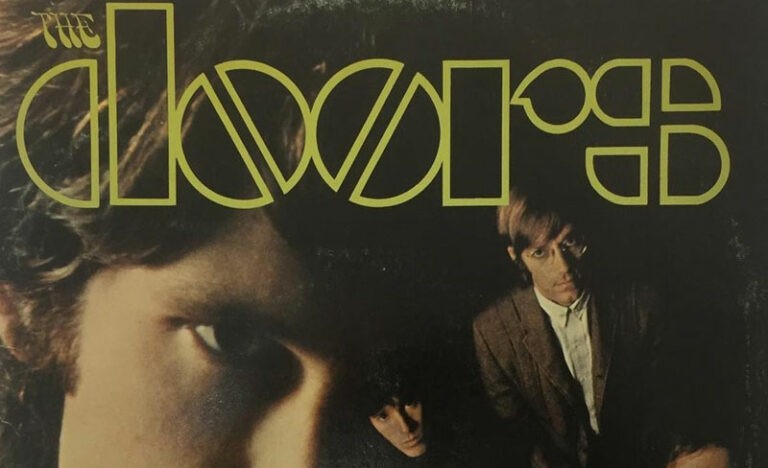
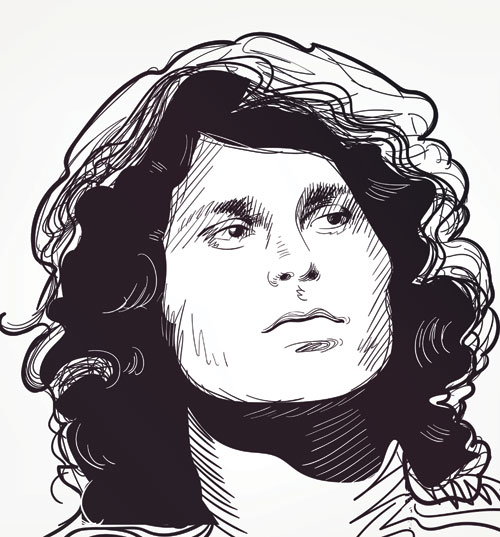
More than half a century after they hit the rock scene, The Doors continue to mesmerise. By Y R Anand

I first saw this album of The Doors in 1968 at the end of my college years in Mysore. A friend had visited Australia and returned with a few albums. The Doors album cover was stark, minimal and very interesting. The music was love at first sound. The silky-smooth voice of Jim Morrison with compelling lyrics was mesmerizing. And, what a back-up band! The versatile keyboard work of Ray Manzarek, hard-driving guitar by Robby Krieger and terrific drumming by John Densmore, all made the sound a delicious concoction. It was hardly possible to get your mind off the music.

The interest in The Doors continued during the rest of my college years in Kharagpur and I was lucky to find like-minded music lovers in that far off outpost. Thereafter in Mumbai, there were plenty of opportunities to continue enjoying their music.

As the years went by, more and more creative output came outpouring. It was great music to listen to, because of the melodies and the very contemporary lyrics. While Morrison was the main songwriter, The Doors always said the music and words were created by the group. And it remained that way till the end. The other three band members contributed significantly to the songs and that is why they always attributed the lyrics to the band.

The group had its origins with a meeting of Morrison and Manzarek in Los Angeles in 1965. Manzarek was already part of a band called Rick & The Ravens, which had three Manzarek brothers. Later in the year, they were joined by the drummer John Densmore, by which time the group had named themselves The Doors.

The band decided on their name as The Doors, from the “The Doors of Perception” a book by Aldous Huxley. The book itself derived the title from a line in William Blake’s “The Marriage of Heaven and Hell”.

They added a bass player Patty Sullivan. These six members recorded a set of six songs for demo purpose. But, soon after, the two other Manzarek brothers and Sullivan left and Robby Krieger joined the group and a legend was born. These first six songs has been subsequently released in one of their anthology albums.

The Doors made their first appearance in a sleazy Los Angeles club called London Fog and soon moved to the better Whisky-a-Go-Go on the Sunset Strip, where the group say they truly came together.

Elektra Records spotted their talent and started to release their albums. The first album was The Doors, which was released in 1967. This had Light My Fire which was their first smash hit single. It is one of the most recognisable and iconic rock songs of all times. Along with it were equally fantastic Break on Through to the other side, End of the Night, Back Door Man, The End and 7 other songs. Some of them went on to become hit singles.

Morrison was a charismatic figure and had great stage presence. He exaggerated this by his eccentric behaviour. His sometimes unpredictable stage acts added to the group’s mystique. The group became a symbol of the counter-culture prevailing in the late 1960s. But the music itself was so absorbing, with influences of jazz, blues and other genres. You could listen to it and dance to most of it.

The Doors album was followed by Strange Days, Waiting for the Sun, The Soft Parade, Morrison Hotel, Absolutely Live, L.A. Woman, The Other Voices. They accumulated eight consecutive Gold discs, which is phenomenal.

Spanish Caravan, People are Strange, You’re a Lost Little Girl, The Spy, Summer’s Almost Gone and such songs are haunting ballads.

Touch Me, Roadhouse Blues, LA Woman, Love Her Madly are all powerful driving songs, which can make your feet start tapping automatically.

And there is Raiders on the Storm. To me it is one of their really compelling songs. The long keyboard riff by Manzarek is so haunting, that you wish it would never end.

The Doors continuously entertained, provoked and irritated their fans by wild performances, mostly due to the erratic and unpredictable behaviour of Morrison on stage. He got arrested and released a few times due to bizarre behaviour while performing.

Morrison was also an excellent poet, having studied film-making and arts at UCLA before becoming a musician. Several of his poems can be heard on American Prayer, which was released after his death.

The remaining members of his band – Manzarek, Krieger and Densmore – kept up the legend with various reunion gigs and rehashed anthologies. Weird Scenes Inside The Gold Mine, Full Circle, An American Prayer and a series of Live recordings, rehashing their earlier appearances, are all available now.

The Doors got inducted to the Rock and Roll Hall of Fame in 1993. Manzarek, Krieger and Densmore came together along with Eddie Vedder substituting for Morrison, played Roadhouse Blues, Break on Through and Light My Fire.

The Doors music continues to attract listeners of generation after generation. It can be heard in many movies and television shows. One of the most dramatic uses was in Apocalypse Now which features The End.

Oliver Stone made a movie by the eponymous name in 1991, with Val Kilmer playing Jim Morrison. It did well at the box office and the soundtrack from the movie was also well received. However, the other band members were none too happy, as Stone concentrated on Morrison’s character, to the detriment of others. Manzarek also felt that it did not show the poetic and human side of Morrison and concentrated too much on his bad-boy image and at times bizarre behavior.

The Doors cover versions and adaptations continue unabated. Two of the earliest adaptations that I know are of Light My Fire: one by Ananda Shankar and the other by Isaac Hayes in his Live at Sahara Tahoe.

One of the finest interpretations of The Doors music is in the album Night Divides the Day – The Music of The Doors by the jazz pianist George Winston. It has 16 excellent jazzy interpretations of many well-loved and some not-so-well-known Doors songs. It is a virtuoso performance by a great solo pianist, and it will make a fine addition to any collection of The Doors music.

As with many artists, Morrison developed alcohol dependency and also experimented with drugs. In 1971 he died unexpectedly in Paris at the age of 27. And the legend began. He was buried in the “Poets’ Corner” of Père Lachaise Cemetery in Paris on July 7. The epitaph on his headstone bears a Greek inscription, which is usually interpreted as “True to his own spirit”. This is now a must-visit place for rock music lovers and The Doors fans in particular.

So ended the life of Jim Morrison, the son of an Admiral of the US Navy, with whom he did not have a good relationship. But his music lives on even after 50 plus years.

Ray Manzarek passed away in 2013 in Germany due to cancer. He held the band together for several years with someone else occasionally filling in for Morrison. Robby Krieger and John Densmore are the two band members still alive and playing the music.

Invest Wisely and Well

1

In the second part of our series on Financial Planning, Deepak Gagrani takes readers through the pros and cons of various investment strategies

As we discussed in the previous edition, it is important for senior citizens to have a well-defined investment strategy aligning their goals and objectives with their risk profile. An ideal portfolio has to generate both regular income and growth, depending on each investor’s requirements.

A senior citizen has a wide array of choices available when it comes to investing. In addition to traditional bank FDs, small savings schemes like PPF, NSC etc, one can explore the following key investment avenues depending on their investment horizon and goals to be achieved.

1. SENIOR CITIZENS SAVINGS SCHEME

• Government sponsored investment scheme and hence one of the safest and most reliable investment options.
• Senior citizens of India aged 60 years or above or early retirees in the age bracket of 55-60 can invest. NRIs and HUFs are not allowed to invest in this scheme.
• Maximum investment amount restricted to INR 15 lakhs.
• Currently, the interest rate is 8.6% p.a., payable quarterly. The interest rates are set each quarter and linked to the prevailing g-sec rates. Once invested, the rates remain fixed for entire tenure.
• 5-year tenure, which can be extended by 3 years, once the scheme matures.
• Premature withdrawals are allowed only after the first year of investment and will attract penal charges upto 1.5% of the invested amount.
• Principle amount invested upto INR 1.5 lakhs is eligible for tax benefits under Section 80C. However, interest received is taxable.

2. PRADHAN MANTRI VAYA VANDANA YOJANA

•Pension scheme announced by the Government of India for senior citizens aged 60 and above and is currently available upto 31st March 2020. The scheme is operated by Life Insurance Corporation (LIC) of India only.
•Maximum investment amount restricted to INR 15 lakhs.
•Assured interest rate of 8% p.a., payable monthly / quarterly / half-yearly / yearly as chosen by the investor.
•10 year tenure, which can be extended by 3 years, once the scheme matures.
•Premature withdrawals are allowed only in case of any critical/terminal illness of self or spouse with a penalty of 2%.
•Interest received is taxable.

Positives
•Higher fixed returns and safe as it is backed by Government of India.
•Ideal for investors who are looking for a fixed periodic payout and may not need the principal amount for 10 years.

Limitations
•Returns are taxable and hence not tax-efficient
•Illiquid, except in case of medical emergencies

3. DEBT MUTUAL FUNDS

•Professionally managed by SEBI registered Asset Managers. These funds invest in various debt instruments such as guests, corporate bonds, debentures, etc
•Investment can start from a minimum of INR 100 and there is no restriction on the maximum amount.
•Different categories of funds available for different time horizons and different risk profiles. It can be as small as overnight up to funds suitable for 7 years above.
•Returns vary, depending on the type of fund and are subject to prevailing interest rates and credit cycle. Typically they offer better returns compared to other similar time horizon debt products.
• Open-ended Debt Mutual Funds can be redeemed anytime, though there may be a charge in select funds for withdrawal before the minimum investment term.
• Returns are eligible for indexation benefits under income tax laws if redemption is made beyond a period of 3 years and is taxed at a preferential rate as long term capital gains.

Positives
• A superior product compared to corporate FDs, as risk is diversified across different corporates and the merits of investments are managed by professional teams.
• Highly liquid
• Tax efficient. Indexation and preferential rate (in case of long term capital gains) significantly reduces the tax liability and has to be paid only at the time of redemption, thereby making it one of the most tax-efficient debt investments.
•Ideal for investors in the high tax slabs or investors who are not looking at fixed returns. There may be some volatility in returns but effectively, it is one of the best modes of taking exposure to debt instruments.

Limitations
•Returns are not fixed and may be subject to interest & credit risk

EQUITY MUTUAL FUNDS

Key Features
•Like Debt Mutual Funds, Equity MFs are professionally managed by SEBI registered Asset Managers and it is one of the cheapest modes of taking equity exposure
•Investment can start from a minimum of INR 100 and there is no restriction on the maximum amount.
•Different categories of funds available which is suitable for an investment horizon of at least 5-7 years and above.
•Returns vary, depending on the equity market performance.
•Returns up to INR 1 lakh per annum is tax-exempt. Returns in excess of INR 1 lakh p.a. for investments held for more than 12 months are taxable @ 10%.

Positives
•A superior product considering professional management, small ticket size and lower costs.
•Ideal for investors who may not be adept to track equity markets themselves diligently and has a time horizon of more than 5-7 years to stay invested.

Limitations
•Returns are not fixed and may be subject to equity market risk. Equities in short term may be extremely volatile and hence not suitable for short-term investments

It is important to reiterate the importance of sound financial planning at this stage of life, as any money mistake did may not have enough time to be reversed. It is recommended that one takes qualified professional help to ensure that their financial goals and objectives are achieved. One has to remember that “An individual retires; their money has to continue to work for them.”

Happy Investing!!!

The Lata Mangeshkar Interview

2
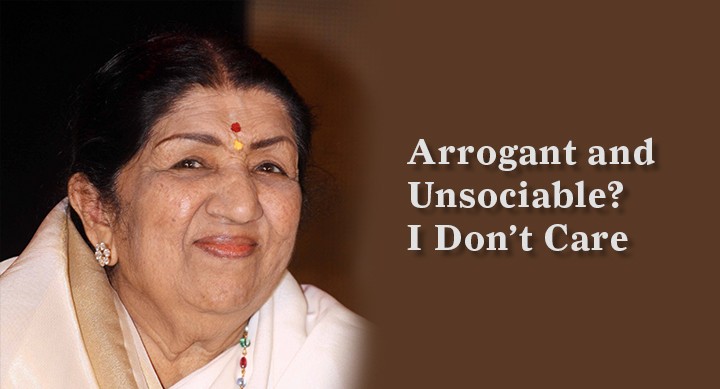
  Arrogant and unsociable? I don’t care

Singing legend Lata Mangeshkar talks to Subhash K Jha about her life, work, passions and the laughter that led to her being labelled ‘arrogant’


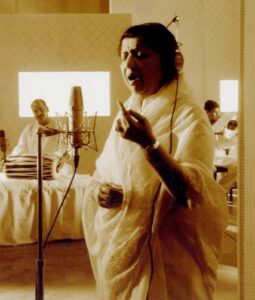
Better known as the Nightingale of Indian filmland, singing legend Lata Mangeshkar is known to not give interviews very easily. She has been termed variously over the years: arrogant, reclusive, unsociable, but once you get her talking there is no stopping her. Didi, or elder sister, as she is fondly called, will turn 90 on September 28, 2019. In this freewheeling interview with Subhash K Jha, she talks about her life, work, passions and her relations with her contemporaries, including sister Asha Bhosle. Read on…

How do you assess you own career as a singer? 
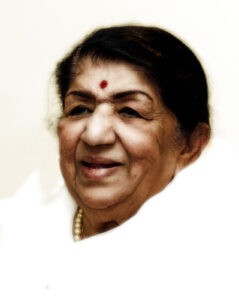
If you ask me, I did okay. Achchha hai… Lekin aur bhi achchha ho sakta hai (I did well. But I could’ve done better). I’ve never stopped to admire any of my songs, ‘Wah wah kya gaana gaya hai.’

That’s not for you to say. That’s for us to say, isn’t it?

But I know what you don’t. I know the places where I’ve made mistakes in my songs. And an artiste should never be satisfied with what he or she does. There should always be hunger to excel. That fire….look at Bachchan Saab! That’s what keeps him going. No matter what your sphere of activity there must always be that hunger to do better. As a writer I am sure you also want to do better. With my songs also I always felt I could do better, even the ones that people today think perfect.

Ok, which is the song that has given you maximum satisfaction?

(promptly) The songs that I sang for my brother (Hridayanath Mangeshkar) in the album of Meerabai bhajans Chala Vahi Des. I always feel that I’ve done justice to whatever Hridaynath gave me to do. It has been my must successful endeavour to date. I’ve also done justice to some of the compositions by Salilda (Chowdhury), Madan Mohan and Jaidev. Jaidev was the most challenging among the composers. He had a sound knowledge of classical music. He would say, ‘I’ve told her what to do. Now I don’t need to worry.’ Once he composed a song he left it to me to worry about it. It became my responsibility. And I’d be endlessly worried. I remember he had composed a Nepali song for me written by the King of Nepal, King Birendra (Jun Mato Na Mero in the Nepali film Maatighar). It was one of the toughest songs of my career.

It is often said that composers made you sing songs at an unnecessarily high pitch just because you have the range?

This is true. I’ll give you two examples: Ehsaan tera hoga mujhpar in Junglee and O mere shah-e-khuba in Love In Tokyo, both composed by Shankar-Jaikishan. Both the songs were first sung by Mohd Rafi Saab. Then they decided they wanted the same songs sung by me. They came to me after filming the songs with the leading ladies of the two films Saira Banu in Junglee and Asha Parekh in Love In Tokyo, in the voice of Rafi Saab. And I was asked to sing the songs exactly the same way, since it was already shot with the heroines in Rafi Saab’s voice.

This sounds like a form of emotional blackmail?

Jee haan. I wasn’t allowed to lower the scale of the original tunes since it was already filmed. So I had no choice but to sing in Rafi Saab’s pitch. I remember how difficult it was for me. And I was very upset with Shankar-Jaikishan for making me do this.
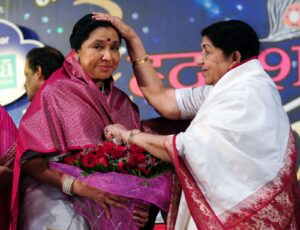
Don’t you wish you had more time to practise your classical singing?

Shall I tell you something? It is much more difficult to do playback singing for films than to sing classical vocals. When you are doing classical vocals there is room for improvisation. But when you sing playback you have to go exactly by the requirements of the character on screen. I used to find out what the heroine was supposed to be doing, why she was singing the song, etc… Playback singing requires tremendous amounts of precision in rendering the lyrics and tune. Har cheez sambhaalni padti hai. Maybe composers felt that Lata could pull it off.

What is your assessment of yourself as a singer?

There have been better singers than me like K L Saigal Saab and Noor Jehanji and there will be better singers than me in future. I always say whatever skills I’ve imbibed are God’s gift. I’ll also admit that it’s never been an insurmountable challenge for me to sing anything. Every artiste has a talent. What the artiste does with that talent is up to them.

Recording songs during your heyday was really tough. It is said you got the echo effect in Pyar kiya toh darna kya by singing a bit of the song from the bathroom of the recording studio, and that once while recording a song for Salil Choudhury you fainted?

Not true. The echo effect in the Pyar kiya toh darna kya song was achieved by singing away at a distance from the microphone but not in the bathroom. Please! And I did faint once. But it wasn’t for a song by Salilda. It was a song by Naushad Saab for the film Amar filmed on Madhubala.

Your improvisations in the songs, the harkat as it was called, often took songs to another level, for example the ‘Oye oye oye’ in the Bichua number in Madhumati?

No that wasn’t mine. That was the composer, Salilda’s idea. But yes, I did put in my own harkat once in a while. Once Rafi Saab and I were recording a duet for Shankar-Jaikishan. During rehearsals I decided to improvise at one point in the song. But I didn’t reveal my harkat during rehearsals. I kept it to myself and I sang it only during the final take.

You did not????!!!!

(laughs) Yes, I did. When the final take happened everyone was thrilled by my improvisation. But Rafi Saab was very upset. All this was in good spirit. No harm meant.
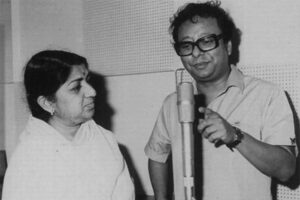
Who was your favourite co-singer?

Kishoreda (Kumar) without doubt. We were constantly entertained during, before and after recordings with him. He would have us in splits. But he would get serious in front of the music composer. He was very sad under the mask, though. A month before his death I got to know how unhappy he was. He called me to share his sorrow. He didn’t want to come home as there would be too many people there. So we met at mutual friends’ place where I saw the other, somber side of him. I’ll never forget what he told me about his life that evening.

What did he tell you?

I can’t share that. But I had never imagined he was so unhappy from within. He said I was his rakhi sister and he wanted to share his grief with him. After listening to him I told him I was there for him whenever where he needed me.

You have been very lucky with your family life?

Yes, indeed. I had to look after my family from a very young age. But they never made me feel burdened. My siblings have always given me great strength and joy. They could have easily felt I was getting more (fame, recognition, etc) than them. But they never felt that way. To this day my one and only brother Hridaynath has never shown any interest in my wealth. The same goes for my sisters as well. They care deeply for me. In fact when I am unwell I hate to tell my family about it as they get so worried, Unke chehre utar jaate hain. Only the blessed get such a family.

Didi, tell us, was Ae mere watan ke logon supposed to be Ashaji’s song?

I’ll tell you the complete story. Hemantda (Hemant Kumar) came to me and said that in the wake of the Indo-China war, I must go to Delhi for a show on the occasion of Republic Day. I was hesitant. My sister Meena was getting married after 15 days. I was going through ill health. But every composer was after me to sing his composition at the function. I said no to everyone and decided to take four musicians with me to Delhi and sing Allah tero naam (Jaidev’s song in Hum Dono).

Then C Ramchandra came to me and said that poet Pradeepji had written a patriotic song that he wanted only me to sing at the function in Delhi. Who knew at that time that Ae mere watan ke logon would become such a momentous song? Since I had turned down other composers I was hesitant. But C. Ramchandra insisted. He felt that Ae mere watan ke logon would pull his career out of the doldrums. So I agreed. During the rehearsals, I suggested that we should turn the song into a duet with Asha. I don’t know if she rehearsed for the song or not. But four days before we were expected to leave for Delhi, Asha backed out. I was shocked. Finally I had to rehearse and memorise the entire song from a tape on the aircraft, just a few hours before the show. I sang the song.

Panditji loved it. I went to his home to meet Indira Gandhi and Rajiv. When I returned to Mumbai, newspapers were splashed with pictures of Panditji and me. I have never stolen songs from anyone. I had suggested Asha’s name myself. So why would I snatch the song away from her? I swear on my music that this is the truth. I have a feeling that someone instigated Asha into believing that Ae mere watan ke logon was meant to be her song. But you can ask Pradeepji. He’ll tell you what the truth is.

You’ve been working with three generations of music composers. Isn’t there a generation gap between you and composers like AR Rahman, Vishal Bharadwaj, Anu Malik and Jatin-Lalit?

(Firmly) Nahin. In my opinion, a singer should never be conscious of such things. Irrespective of the generations they belong to, all music composers try to do their best. As a singer, I used to enjoy the challenging compositions of the past. I admit the young music directors of today are a little scared of me. But I’ve never ever misbehaved with any composer or told him that his tune is no good or that I’ll sing it in my own way.

But they might find it difficult to tell you what they want!

I don’t mean to praise myself. But to date, I’ve always tried to grasp the nuances of a song by sitting with the composer, like a student sits before a teacher. In the past, I would make suggestions while singing for Madan bhaiyya (Madan Mohan), Shankar-Jaikishan and Laxmikant-Pyarelal. Even Burman dada. Quite a few directors encouraged me to suggest an alaap here or a taan there. But I’ve never forced my suggestions on any music director.

How would you describe your professional interaction with your brother Hridayanath Mangeshkar?

I don’t dare to suggest a word when I sing for him. But if I don’t understand something in his composition, I do badger him with a hundred questions.
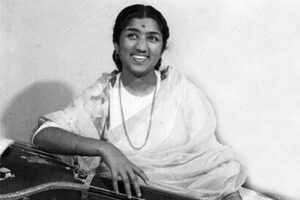
At times, his tunes are quite complex, aren’t they?

For a singer, yes, they’re complex. But I feel he’s been maligned in this matter. In the past, Sajjad Hussain composed what you call complex songs. And rumours were spread that he’s too exacting, temperamental and egoistic. Actually I loved Sajjad Hussain’s music because like Naushad saab and Madan bhaiyya, he insisted on poetic lyrics. These composers understood and appreciated Urdu. Those who had some difficulties with Urdu or Hindi would consult specialists. For instance Burman dada and Salil Chowdhary would make a thousand enquiries about the Urdu and Hindi words.

What else would you say was remarkable about the composers of yesteryear?

I’ll tell you another thing about Sajjad saab’s music. He was very particular about melody. Even if one instrument was slightly off-key, he would be livid. Once during a recording, he asked a famous singer to stop at the gandhar. The singer wanted to know what gandhar was. Sajjad saab was aghast. Sometimes I wonder what he would have said about today’s singers. Like my brother, Sajjad saab used to get angry over any trace of imperfection.

Are any of the top composers of today perfectionists?

I don’t know how many of them have a deep knowledge of classical music. The earlier composers were steeped in classical music. Burman dada’s knowledge of folk music was tremendous. He also used to sing with great feeling. Pancham was the master of rhythms. Pyarelal had learnt to play the violin from his father. Laxmikant too knew a bit about classical music. Madan bhaiyya was exposed to classical music in Lucknow. Sajjad saab would compose nothing but classical music. He played the mandolin superbly.

As for my brother, he speaks his mind. He doesn’t hesitate to praise a fellow artiste. I remember once Madan bhaiyya had come home for a meal. The music of his Jahan Ara had just been released. My brother liked the songs so much that he asked Madan bhaiyya to autograph the record. If Hridayanath doesn’t like any of my songs, he criticises me immediately. I don’t mind that all. In fact, I’ve always valued frank opinions in my life. Some people praise me to the skies and criticise me the minute my back is turned. I made Hridayanath listen to my Jiya jale. He liked it very much. I’ve always been very particular about songs that I sing for him. At times, I even get angry at his exacting ways.

I feel the way you sang for Madan Mohan was extra-special.

His compositions were like that. But no matter whom I’ve sung for, I’ve tried to give my very best. If I feel I can’t do justice to a song, I opt out. If composers can’t wait for me to give my best, then they’re free to get their song recorded by someone else. I’m told that some singers criticise composers on their face. I could never ever do that.

You sang for Twinkle Khannna in Jab Pyaar Kisise Hota Hai. You sang for her mother Dimple Kapadia debut in Bobby. I have a feeling you’ll be singing for Dimple’s granddaughter after we’re all gone.

(Laughs) Then who’ll listen to my songs? I don’t remember if I’ve sung for Shobhana Samarth but I’ve sung for Nutan, Tanu and Kajol. You’ll be surprised, but recently I saw an old film on television located in the Arabian desert. I was surprised to see myself singing for Ruby Myers (Sulochana)! I didn’t even know the song. But I said, chalo if I’ve sung for her as well, to bahut badi baat hai. When I was a child, I used to run off to see her films.

How do you feel when you hear your own songs?

I always find faults with my singing. If I don’t like what I’ve sung, I put my fingers in my ears and run away.

You know what (the renowned classical singer) Bade Ghulam Ali Khan said about you, don’t you (“Kambakht, kabhi besura gaati hi nahin hai!”)?

(Laughs shyly) Yeh unka badappan tha. He was a very great singer. I truly admire him. Believe me, I always find faults in my singing, Once, Kishore Kumar told me that if he heard people listening to his songs, he would start speaking loudly to distract their attention. He would continue to talk loudly till the weak spots in his song were over. If one doesn’t like one’s own song, there’s turmoil within oneself. If I’m not satisfied with a song I’ve recorded, I can’t sleep that night.

Which songs haven’t you been satisfied with?
Offhand, I can’t recall any. But there are songs which the music composers and listeners have liked. But I’ve felt that I didn’t do full justice to them.

Your songs for the films of Raj Kapoor are timeless. What it was like working with him?

His style of working was unique. With him around, there would be unforeseen tension. Sometimes, he’d come on the sets and change the entire song. Since he was a musician himself, he knew exactly what he wanted. When he wanted a hit song he’d say he wanted a popatiya number. But personally I feel that Shankar-Jaikishen gave better music outside Raj Kapoor’s films. For Raj Kapoor, they had to work within prescribed limits.

Raj Kapoor and you started your careers, as singer and director, almost together, didn’t you?

No. When he made Aag (1949), I was doing bit roles in films. I hadn’t started singing professionally. I sang for him, starting with his second film Barsaat.

Ram Ganguly (who composed for Aag) was supposed to do the music for Barsaat. Shankar-Jaikishan were Ganguly’s assistants, they’d composed some of his songs. Raj Kapoor wanted to use them instead. Jiya beqaraar hai was my first song for R.K. Raj saab would joke that since I’m a classical singer, I should be treated cautiously. But after I recorded for him, he showed absolute confidence in me. In Barsaat, I ended up singing for all the female characters. But I must tell you that I would have a fight with Raj saab during every film, for one reason or another.

Like?

Koi aisa waisa gana aa jaye to main unse ladhne lagti thi. I used to quarrel with Jaikishen also about such songs.

Budhha mil gaya from Sangam, for instance?

Yes, they convinced me that the girl in Sangam is newly married and she’s teasing her husband. Hota tha aise hi kuchh kuchh.

Were you friendly with any of the heroines for whom you sang?

I was quite close to Nargisji. Also Meena Kumari and Madhubala. I’m told that in her contracts Madhubala would stipulate that only I would sing for her. I share a cordial relationship with Saira Banu to this day. Jaya Bachchan is another favourite. I remember during the making of Abhimaan, she would sit and watch me sing. I used to wonder why. Then I saw the film. During the songs, she dressed and behaved like I do during my recordings.

Why have you been called an aloof, arrogant and ruthless professional? How and why did this image come about?

Do you want to know why people are nervous of me? There’s a saying that if someone burns his mouth drinking milk, he even tries to cool down chhach before drinking it. In the past, I loved to laugh and make people laugh. I used to bring chocolates to the recordings and share them with everyone. People exploited my friendly nature. They maligned my name. Once, a well-known recordist kept me back to record a small interlude in a song till late at night. Only his assistant, my sister and I were at the studio, the others had left. He kept making me sing the small interlude repeatedly. After a couple of days, I heard that he was telling people, “See how I drove Lata crazy? The song was good enough as it was recorded initially.”

When I heard this, I wept. Then there was a classical musician who maligned me to his heart’s content. I treated some music directors, lyricists, producers and directors like my brothers. But they all maligned me. So, I decided to stop attending functions, I stopped talking excessively which was a habit with me. I would say things in jest. But my words would be misinterpreted and distorted. Who needs this? I thought. That’s why I prefer staying at home with my family. Now if I’m called arrogant and unsociable I don’t care. If I worry about what people have to say, then it wouldn’t be possible to continue living.

Yash Chopra called you the most influential Indian of this century.

I sang for B.R. Chopra and Yashji for the first time for Ek Hi Raasta. Hemant Kumar had given the music. At that time, I knew Yashji vaguely. When the two brothers separated I received Laxmikant-Pyarelal’s message to sing for Daag. I got to know that Yashji always wanted me to sing in his films. When he called me didi for the first time I was taken aback. Then we became family. I miss him.

Can be cut

Before Chandni, there were strong rumours that my voice had deteriorated. Actually I’d fallen ill. Yashji had to shoot the song with a substitute voice. Then I got Yashji’s urgent message, saying that I had to dub my songs immediately or it would be too late. Reluctantly, I dubbed for Mere haathon mein nau nau chudiyan hain. I wasn’t satisfied with my rendition at all. But he said I was fine. Since Chandni, I’ve sung for all his films.

Any unfulfilled wish?

None at all. God has given me more than I deserve.

Your message to your fans?

Main itna hi kahungi ke mujhe unka ashirwad hamesha milte rahe. Main hamesha waisi hi rahun jaisa who chahte hain.


Finding Myself in the Wild

Urvi Piramal on her romance with the camera, her love for travel and how spending time in nature had a deep and nurturing impact on her soul

Through my lens I like to capture photos of vast landscapes, old monuments, unusual birds, colourful streets. In fact I like to capture anything beautiful that will take me back to those places and help me share those moments with my family and friends.

When I hit 60, a lens shifted.

As I entered my seventh decade, I pondered my life. Where had it gone? What had I achieved? What did I have to show for my sixty years on earth? And most importantly, what really mattered?

I felt like I had tumbled out of my life and tumbled into someone else’s. I thought of my life – my trials, my tribulations, my joys, my happiness. I could see myself, clearly, in all my different forms – a girl to two caring and loving parents, middle sibling to an older sister and a younger brother, a young bashful bride, soon mother of three, single mother, a cancer survivor, a businesswoman, a grandmother of six …

It was me and yet it wasn’t me. I was all of that and more. The parts of the sum were greater than the sum.  It was like a lens readjusting from this side of sixty …

A different view

And it was around then that I literally decide to look through a different perspective: that of an observer, silent, reflecting – not just through my eyes, but through the lens of a camera.

My bond with photography was an old one – one which brought back memories of my father bundled over his prized Rolleiflex.

Due to my love of travelling, something my children and grandchildren often make fun of, I was able to fully develop an appreciation for the camera and my passion for photography.

Through my lens I like to capture photos of vast landscapes, old monuments, unusual birds, colourful streets. In fact I like to capture anything beautiful that will take me back to those places and help me share those moments with my family and friends.

My Wildside

But above all, my favourite thing to shoot is the wild. There is something about being in the expanse and enormity of the wilderness that puts things in perspective. I was lucky to experience my love of nature with two of the most important people in my life: my father and my husband.

My journeys began rather young: my father was forever bitten by the travel bug.  When the courts shut, it was vacation time! And vacation meant travel, and travel meant wildlife sanctuaries. Back then, words like “wildlife” and “sanctuary” were meaningless. All I knew was that the wilderness was vast and deep – far more beautiful than any playground the city had to offer – and it awoke in my young heart a thirst that has not yet been quenched.

It was only years later, during my travels with my husband, that I slowly began to understand the nature of my yearning.  Being in the expanse and enormity of the wild put things in perspective.

Since then I became a regular traveller to the African wild and the Indian natural reserves. In Africa’s vast expanse, I learnt to appreciate how small we are, how insignificant most of our daily tribulations.  I learnt how Mother Nature meted out her choicest gifts – even the smallest animals were provided with some form of camouflage for survival; the largest were prey to disease and death.

In India, my favourite forests to visit are the tiger reserves of Pench, Ranthambore, Kanha and Tadoba. Here began the next big relationship in my life – with the majestic tiger. It was during one of our earlier expeditions to Kanha, when, after a rather disappointing day, I caught my first glimpse of that elusive animal: stealthy, striped, orange, black.  Slowly, she emerged from between the bushes, into a clearing.  Her eyes, yellow and black, penetrated deep into my soul.  It was for but a brief second – it felt like eternity!

When you become a regular visitor, the tigers become family. You follow their lives, with almost the same joy and concern, that you do your own. From my countless visits, I have grown with several generations of tigers. I know when a new litter is born, I know their names, I see them grow, from little cubs to fierce beasts. I have seen tigresses teach their little ones to hunt, to fight, to stay alive.

The wild teaches many lessons. I have travelled with my grandchildren to different African and Indian  wildlife reserves so that they can learn nature’s lessons. And through our visits, I have been able share and cultivate in them a love and respect for the wild.

My Silent Side/ My Peace Side

As I spent more and more time in the nature, I realised it had a deep and nurturing impact on my soul. The more time I spent away from crowds and people, the more I realised how this was food for the soul. Being away from crowds, noises, telephones, started appealing to me in a way it had not when I was younger.

And I had another epiphany: being in the wild recharged me when I was tired and lonely. It recharged my soul. It was magic for my heart. It was my meditation. I felt at peace with the world. I began to long for that silence when I was back in the concrete urban jungles of Mumbai. In city traffic, I would gaze out of my car window, watching the world, but still not taking in anything. A part of my heart now belonged to the wild and it was the wild that I longed to recreate.

So I slowly developed yet another passion – meditation. To be quiet when all the world was moving. To be silent in the midst of noise. To feel silence……

I meditate daily, just when I wake, for about 20-30 minutes. And I know that meditation will be instrumental in my life going forward. I urge everyone reading this, young or old, to inculcate this practice from our ancient customs as through this, one can be truly at peace.

As I grow older, I am realizing that I am still discovering new passions within myself. I am still learning new things, trying new things, doing new things.

But I have found myself.

And that is the greatest gift any side of sixty.

Viva México!

0

Mexico as a country was intriguing to me, as one had heard about the Aztecs and the Mayans. When we got the opportunity to go as a group, my wife and I decided to seize it. We visited in the month of April and the temperature was comfortable (max 28 degrees, min 10 degrees Celsius). The flying time, with the fastest connections, is at least 25 to 27 hours including the layover.

Mexico City

 We first landed in Mexico City and stayed at the Four Seasons hotel. The property was good but not exceptional. The first day we visited the old city and saw the ruins built by the Aztecs  (in the post-classic period from 1300 to 1521). A visit to the anthropology museum is highly recommended. The architecture of the place is interesting as is the understanding of the evolution of Mexican society. The next day we did a hot air balloon ride at Teotihuacan and got an overview of the Sun and Moon pyramids built by Mesoamericans and later found by the Aztecs who claimed a common ancestry with Teotihuacanos, modifying and adopting aspects of their culture. One could climb both the pyramids if one wishes to. The Sun pyramid has 324 steps that are very steep but climbable. The old city had an interesting Cathedral as well as some interesting monuments. Of all the popular tourist spots, The Saturday Bazaar was not as impressive and could be missed for more historical and cultural experiences (unless you wish to buy local art and walk through the local buzz).

While visiting the ruins, we took a refreshment break at Cafe de Tacuba and it was a delight. The musicians serenaded us with some great music. When we left after an hour there was a large crowd of tourists waiting to get in.

Arango is a charming restaurant situated in a very old house. The ambiance is great and so is the food.  La Opera Cantina seemed like a quaint old restaurant, but the food was not worth the visit. La Gruta, near Teotihuacan. La Gruta is a restaurant in a cave and worth the experience. Though we as a group did not go Pujol and Quintonil, they are both highly recommended restaurants. There is limited variety for vegetarians at restaurants.

We were able to catch the Folkloric ballet show at Bellas Artes Palace on a Sunday morning. It was a beautifully orchestrated ballet, showcasing a lot of Mexican folklore in form of dance. We also watched a Mexican version of WWE Wrestling Match, which is a very popular entertainment for the locals. However, it was avoidable if one is not interested in wrestling.

Fond of art? Visit the Dolores Olmeda museum to see some of Diego Rivera’s works. The Carlos Slim museum has predominantly European art is worth a visit. The highlight of our stay at Mexico City was a visit to Freida Kahlo’s house, now converted to a museum. The entire area  ( Coyoacan )around the museum is lovely. A tram ride with colorful buildings and interesting architecture and bits of history to nibble upon. It is recommended to watch her movie before going there.

Polanco is the area for luxury shopping in Mexico City. Getting around the city is reasonable by taxis. If you are in a small group, luxury tourist vans are a great option for groups of 6 – 8 people.

San Miguel Allende

From Mexico City, we drove down to San Miguel Allende. It was an enjoyable 2.5-hour drive. Rosewood hotel is a lovely hotel. The view from the terrace at sunset was a sight to behold. San Miguel is like an old European town in Mexico. The brightly colored walls of the houses and the various styles of architecture are an attractive sight to behold. The road undulations remind one of Porto (in Portugal) & San Francisco. A guided walking tour of the city is essential to appreciate the charm of this city.

We thoroughly enjoyed our visit to… a nearly 400-year-old house, now renamed Casa  Dragone, after it was bought by a Tequila company Dragone. A visit to Fabrica La Aurora is a must. It is an old textile mill converted into a contemporary art and design shopping space. One would get to see and purchase some interesting art and artifacts mostly by Mexican artisans, as well as many clothing labels by Mexican designers. The Sistine Chapel was also fascinating.

We had dinner in the courtyard of Casa Nene hotel. It is a remarkable place and the food is delightful…

Cancun

We flew to Cancun from Leon which is a 90-minute drive from San Miguel. Cancun is the hip and party city of Mexico. It is a part of the Mayan Riviera. The Nizuc Resort and Spa is a spectacular hotel (An all-suite hotel) close to the strip, where one must go every evening, hopping bars & nightclubs. The spa at the hotel is both overrated and extremely expensive (around USD 250 for a 60-minute massage).

Chichen Itza is one of the main Mayan ruins. We had lunch at a private Hacienda (farmhouse) that also had a Cenote (water holes discovered in the ground) where one could take a swim. Tulum, a Mayan ruin by the sea was even more interesting than Chichen Itza.

When I initially planned the trip, I was looking forward to understanding the history of the Aztecs and the Mayans and their understanding of astronomy. However, I realized we Indians had accomplished all of this and moreover a few thousand years ago. We thoroughly enjoyed the arts, culture and the people of Mexico, but as Henry Rollins said: “A great way to learn about your country is to leave it”.

Just how do we change this Pehchaan of Indians?

2

We are like this only, but it’s no excuse for bad, boorish, rude behaviour. Vickram Sethi takes a close look at why ‘desi’ is the new four-letter word, in an open letter to Swiss Tourism brand ambassador Ranveer Singh

Dear Ranveer,

You make India proud. The fact that you are the Switzerland Tourism’s brand ambassador is itself amazing. Earlier, only the very very rich Indians visited Zurich, Zug and Zermatt and ate pseudo-Indian food at The Hilti. Thanks to you Ranveer, all that has changed. Last year, it is estimated that 350,000 Indians visited Switzerland – the saviours of the Swiss tourism industry. The Swissair flights on the India sector have air hostesses well past their prime and who in previous jobs have been matrons at delinquent boys’ schools. Announcements in four languages extending a warm welcome to platinum, gold, silver, tin, copper, turquoise and rusted steel members cruising etc, etc. The flights are chock-a-block. I have great regard for families travelling with young children but it’s a horror story when parents allow their kids to run up and down the aisle, thinking nothing of the inconvenience to others. Or a kid next to you playing Mario Kart constantly beeping and booping. You ask the flight attendant to tell the kid to turn the volume down and the chap gets offensive. This is a normal scenario in economy class.

We are compulsive talkers and regale each other with stories of our lives and of the anticipated trip. Each one of us knows of some very special places where the shopping is cheap etc, etc. If all this is not enough there is the loud talker behind you, who feels the need to share every detail of the current political situation. You want to turn around and say “Man, shut the heck up”. Keeping our voices at a reasonable level is basic travel etiquette which we lack. I can see it coming when the person in the next seat smiles at you. After the basic pleasantries, it becomes increasingly obvious that they want to talk and I simply don’t have the energy for that. I pretend not to notice and fall asleep. There was a time when what happened on tour stayed on tour; not anymore. Smartphones have changed all that as a selfie-crazy society begins to capture and upload clips right from the time we get into the aircraft.

Nevertheless, thanks to you Ranveer, we are everywhere from the big cities to the small towns of Gstaad, Sannen, Montreux and Rosemont; and in the trains our theplas, bhakarwadi and chivda come out of the bags so that everyone can partake of the treasury of olfactive sensory delights.

Indian invasion

Switzerland is swamped by Indians. The Swiss also have special rules for us. At a dinner in Arc-en-ciel hotel, we were handed this sheet. I felt humiliated but the fact is, this is everything that’s wrong with us.

I travelled from Gstaad to Glacier 3000, and Ranveer your face was everywhere. Again, the place was full of Indians. Once you get to the Glacier there is a service building, and the second floor has a terrace with parents and families throwing snowballs at each other. The complex has two restaurants. The fifth floor has a shop selling touristy junk and watches. I see Deepika’s beautiful face staring at me as brand ambassador for Tissot, and also that of Virat Kohli — not a great picture with those tunnel nostrils. But ‘Mera Bharat Mahan’ and all that.

The fourth-floor restaurant serves a-la-carte meals, stupidly expensive; a cup of coffee cost 4.5 francs. The food was bad, it was as if they had served Wednesday’s food on Friday morning. The staff resented Indians, right from not giving us a table with a valley view to extremely poor service. The waitress served the soup without the cutlery and desperate attempts to get her attention didn’t work so finally we got up and fetched the cutlery ourselves. The rosti disintegrated on the plate was perhaps a little past its best, devoid of any taste. We had unambiguously ordered Cokes and she thrust a local drink called Zola on us. All in all, a poor dining experience. On the way down, we popped into the restaurant on the third floor. It served Indian food, there was dal, palak paneer, masala gobi, chana masala… all accompanied by loud, really loud Indian conversation. A parent kept calling “Hetal Hetal” and I wanted to join the effort in finding Hetal. Another mum was shouting for Paresh again and again. The Indians were having great time and I couldn’t decide whether this was Chokhi Dhani, Vishalla or Tikuji-ni-Wadi. Nevertheless, a good time was being had by all.

Loaded and loud

Four people were jogging towards a friend walking along the promenade at Lake Geneva, and before he knew it, the joggers rushed into him and his group of friends, put their hands in his pocket, fished out his wallet, snatched the women’s bags, pushed the people to the ground and ran off with their valuables. All this in a matter of seven to ten seconds. This happens in Geneva often. The muggers know that Indians have money and specially women carrying the Louis Vuitton and Dior bags. Post this incident, the group went to the police station but the police refused to lodge a complaint. It only happened after the victim said that if he didn’t lodge his complaint American Express wouldn’t refund his traveller’s cheques. This too happens a lot in Switzerland.
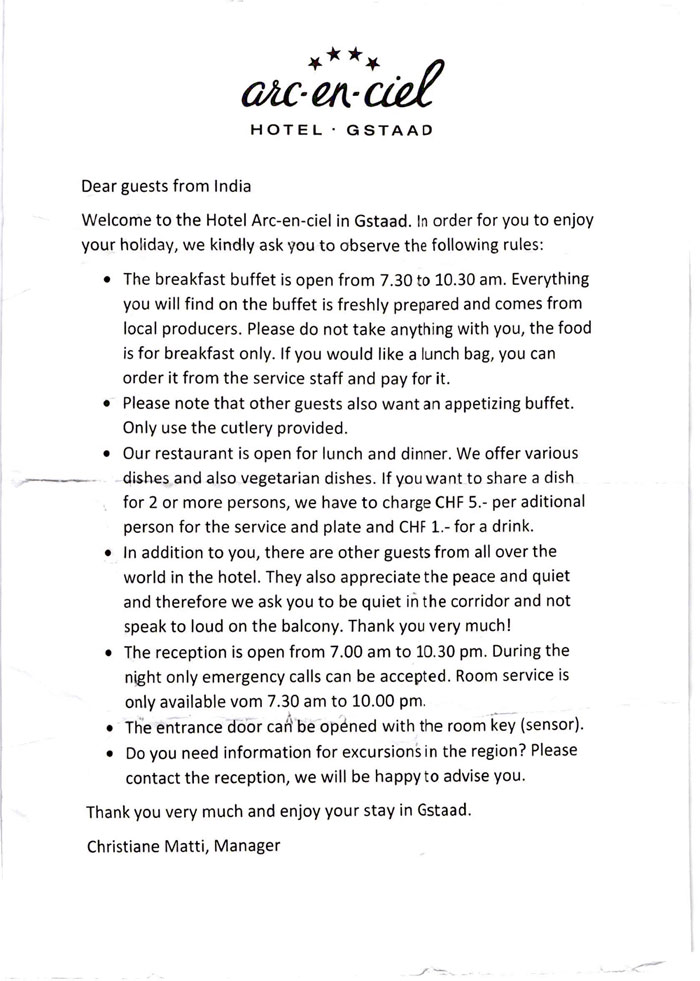
The Swiss find us loud, obnoxious, rude and the most demanding of tourists. Indians are the least favourite passengers of most flight attendants, hence the Swiss air-hostesses-matrons-of-boys’-schools experience. They complain that we don’t stand in queues, lie about our children’s ages to get a discount on admission tickets and urinate in public (I have seen moms pull their little boy’s trousers down and let the kid relieve himself). A lot of Indians who have emigrated and are living abroad have integrated well into different societies. And are aware of other cultures and sensitivities of the host country. Increasing income levels have allowed many more Indians to travel abroad, who are probably better educated and haven’t done anything wrong – but there must be some truth, which is why the Arc-en-ciel hotel hands over that sheet to every Indian. There may be a few bad examples, and the stereotype remains alive because some of us don’t quite know the meaning of the word queue.

Finally Ranveer, Cheetah ki Chaal, Baaz ki Nazar, Bajirao ki Talwaar aur Bajirao ki Raftaar Sab Sahi Hai, Par Yeh Indians ki Pehchaan Kaise Badlein?

The sheet handed over to guests at the Arc-en-Ciel hotel

Seeking their place in the Sun

0

The issues related to ageing are numerous and have to be tackled by society with understanding, resolve, and above all, empathy, writes Sonavi Kher Desai

Grow old along with me! The best is yet to be.” These inspiring words of the poet Robert Browning would resonate with many seniors today. More and more seniors – people over 60 years of age – are looking at aging successfully by keeping themselves healthy, fit, and more active. However, there are several challenges that senior citizens have to confront as they get older.

According to the World Health Organization, approximately 12 percent of the world’s population is over 60 years old and this figure would be 22 percent by 2050. In India, says a report released by the Ministry of Statistics in 2016, citizens over the age of 60 accounts for 8.6 percent of the total population – a jump of a whopping 35.5 percent in 10 years.

In the last 100 years, the global average life expectancy has more than doubled and is now about 70 years. A rapid advance in medical science and access to medical facilities and treatments have increased the longevity of human beings. In addition to this, economic well-being and a fall in birth rates in many parts of the world have contributed to a growing senior population.


In India, the growth in the elderly population has been more than the growth in the general population leading to a sharp increase in seniors. An aging population has far-reaching implications, whether social, economic, or medical. As people age, several issues arise. There is reduced mobility, age-related ailments and conditions, a need for caregivers, financial worries, dependency, loss, the possibility of abuse, and increasingly, loneliness. Almost 75 percent of India’s population lives in rural areas which means that for every senior living in an urban area there are three in rural areas and both have their own set of specific concerns that need looking into.

The issues related to aging are numerous and have to be tackled by society as a whole – individuals, communities, NGOs and government – with understanding, resolve, and above all, empathy. Are we as a society ready for the challenges of a rising senior population?

Change in Indian Society

Indian society traditionally followed a joint family system which ensured security for seniors in the autumn of their lives. However, with the growing trend of nuclear families, and children living away from parents, seniors are often left to fend for themselves at a time when they most need help. The support system provided by the joint family has crumbled, leaving seniors vulnerable to distressing, and often traumatic, situations.

Many Indian children who go abroad to study decide to settle there. Parents are thus left behind to live on their own. An important change in Indian society has been the role of women. The percentage of working women has increased, as a result of which there is often nobody at home to take care of an aged person. Children, too, in today’s competitive world, are busy with so many activities in addition to school work that they do not have much time left for grandparents. Caring for the elderly requires patience and dedication and is increasingly considered by many to be a burden. A survey dated June 15, 2019 by the NGO HelpAge India reported that 35 per cent of respondents looking after the elderly said that they did not feel happy taking care of them.

However, the only constant is change and one has to accept that social structure is not immune to it. We therefore have to find ways to address the issues caused by this transformation in society and evolve new ways of handling them. One of the consequences of the changing family structure has been that assisted living has started to take shape in India. A wide range of options from government-run old age homes to five star assisted living communities have sprung up all over the country.

Issues faced by seniors

Seniors can actually be classified into two groups – “young seniors” (60 to 75 years) and “senior seniors” (over 75 years). With the increased awareness today about fitness and healthy living, young seniors are by and large active and able to manage on their own. It is the senior seniors who often require care-givers and assistance.

So what are the main issues that seniors face? Three major issues are related to health, finance, and loneliness. It must be noted that the root of all these problems can be traced to much before one becomes a senior. As Fred Astaire commented, “Old age is like everything else. To make a success of it, you’ve got to start young.” It is important to plan your finances and to follow a fitness regime from a younger age in order to minimise problems in senior years.

Good health is absolutely crucial as one begins to get older. With age, physical ailments are inevitable and it is essential to get good geriatric care at this stage. The five “I”s of geriatrics include Intellectual impairment, Immobility, Instability, Incontinence, and Iatrogenic disorders. The risk of falls in seniors is very high and the prevention of falls requires supervision. Falls can be caused by diminishing vision, osteoporosis, loss of strength, and medication, among other things. Fractures seriously impact an aged person, leading to a downward spiral. Pain management is another area that requires geriatric care.

What is often more worrying than physical health among seniors is mental health. Dementia and depression are mental conditions more frequently seen as people live longer. Alzheimer’s Disease is the most common type of dementia which affects memory, language, and thought. All these conditions require intervention and psychological consultation as early as possible. Caring for seniors with mental health problems can be very stressful and demanding.

Finance is another crucial area for seniors who have normally retired from active working life. To enjoy a financially comfortable post-retirement life, it is necessary for India to start planning your finances from the time you start earning. High inflation levels mean that the money you have saved can be less than sufficient to lead a good life. It is therefore essential to take good advice from experts and make up a savings plan. Life and health insurance, children’s education schemes and saving for medical emergencies are other areas to consider. It is also a good idea to make a will and maintain a record of financial investments and passwords so that in the event of serious illness or demise, family members have easy access to this information.

Some of the above apply more to seniors living in urban areas who would have worked in the organized sector and can avail of retirement benefits. However, the vast majority in rural areas would have worked in the unorganized sector and have no recourse to benefits in later life. They are therefore much more dependent on family members. For them, the government has to step in to provide pensions and other benefits.

As younger people get more and more caught up in their own lives, seniors find themselves increasingly alone. It is important that they maintain social contact with family and friends in order to prevent depression and isolation. Seniors should also be encouraged to take up part-time work or involve themselves in community activities if they are mobile.

Practical problems faced by seniors

As one gets older one moves from one stage of life to another. Things that seemed easy to accomplish earlier now seem difficult. Practically speaking, seniors face issues with mobility, lack of open spaces, security, and neglect. In most cities in India, it is almost impossible for senior citizens to walk on the road. If there is a pavement – which is often not the case – it is uneven and dug up for repairs. Moreover, the traffic rushes past at uncaring speed, not even stopping for seniors. Even if they were able to manoeuvre their way through the traffic they would have nowhere quiet to go. There is an appalling lack of parks, gardens and open spaces in our cities where older people could safely spend some time. The Nana-Nani park initiative for seniors is a good one but there is a need for many more.

Another area of concern with regard to senior citizens is security. There have been any number of cases reported in the press about burglary and even murder of seniors in their homes. Sometimes these are committed by the very people who are employed to protect them. Seniors living alone are the most vulnerable. It is important for local police stations to take proactive measures to monitor their homes and provide adequate security. There also needs to be a mechanism in place for seniors to request police help and to be assured of an immediate and prompt response to their appeal. This also applies to medical help vis a vis a hospital whereby an ambulance can be sent immediately and the hospital and a family member is immediately alerted to the emergency.

Geriatric care for prevention and treatment is absolutely essential for the elderly. This is easier for those who can afford to pay for private healthcare. However, government hospitals have to be better equipped to provide geriatric care for poorer patients in both urban and rural areas. Interventions that reduce the risk of falls in the elderly are among the most important contributions to long term better health in the elderly. These interventions can range from something as simple as furniture rearrangement in the home and provision of a walking stick or walker to complex changes in medications. Also, installation of grab bars or handrails on stairs and in public places, as well as physiotherapeutic mobility improving exercises are important useful measures.

Retirement often means reduced funds and this can have a negative impact on healthcare and nourishment. A positive and well-planned approach in such cases can go a long way in helping to maintain a healthy life.

Man is a social creature and needs company. Living alone or lacking mobility could in turn lead to isolation, loneliness, and depression. It is therefore important for family and friends to make the effort and provide social contact for the aged. Seniors should be encouraged to participate in yoga, meditation, music, games, interest groups – anything that they can take part in to remain socially active. In this context, ease of movement is necessary for seniors to be able to go out and engage with the world. Wheelchair ramps and grab bars in concert halls and at other public spaces will encourage them to be more social. Reserving parking spaces as well as seats in public transport, and designated queues make life more comfortable for seniors.

Older people naturally react well to children. Children raise the positive energy level in the home and need to be encouraged to spend time with the aged.

Unfortunately, these days one hears of more and more cases of harassment and abuse of the elderly. Family members and others wanting to usurp their property resort to all sorts of tactics to intimidate the aged. Although there is legislation to safeguard the rights of the elderly, it is often difficult to enforce.

Dependency is another issue that creeps in with age. People who have been independent all their lives become dependent on others due to bad health or a financial crunch. This can lead to emotional and mental troubles, as also to exploitation.

What can we do?

Everyone has a role to play in caring for the elderly. Family, the community, NGOs and government, all deal with different aspects with regard to seniors. However, everyone needs to first and foremost approach their issues with empathy.

Family members are often primary care-givers for seniors who are not in good health. A warm, caring approach will go a long way in making them feel comfortable. Good geriatric care, a feeling of inclusion, and financial security can make the final years happy. Teaching children to respect seniors and treat them well will also go a long way in creating a welcoming atmosphere for the aged.

Our community can also contribute to improving the lives of seniors. Nutritious meal services and community activities can greatly help seniors. Assistance from community members by way of volunteers to run errands etc would benefit the elderly. Seniors have their own skillsets and they can be encouraged to impart those skills to others. This will keep them mentally challenged and socially connected.

NGOs play a big role in addressing the issues of the elderly and in educating society at large about the problems faced by them. They advise seniors about their health and safety and train volunteers to help them. Some NGOs also provide counselling and support as well as basic medical services, in addition to running homes for the aged.

The role of government in supporting seniors is very critical. In 1999, a National Policy was formulated by the Social Justice and Empowerment Ministry which aims to help seniors live with security and dignity. However, crimes against elders are increasing as documented in the HelpAge India report. These can be physical, emotional, sexual, financial, or just plain neglect. Elder abuse takes place in all strata of society, and is inflicted by both family members and outsiders. It is important that immediate action is taken against the perpetrators of crimes against seniors and that every effort is made to prevent such crimes from taking place.

The government has enacted the Maintenance and Welfare of Parents and Senior Citizens Act, 2007, to safeguard the rights of the elderly with penal provisions for abandonment of the elderly. (http://socialjustice.nic.in/writereaddata/UploadFile/Annexure-X635996104030434742.pdf) The government also implements pension and benefits schemes and programs for seniors under several ministries viz. Rural Development, Health & Family Welfare, Finance, Home Affairs, Railways, and Civil Aviation. (https://www.india.gov.in/people-groups/life-cycle/senior-citizens). The Pradhan Mantri Vaya Vandana Yojana (PMVVY), is a recent pension scheme launched in 2017 and operated by LIC. Although legislation and government schemes have been formulated, a lot more needs to be done to help seniors face day to day challenges.

Listed here are some things that can be put in place to safeguard the life and property of seniors.

  • Formulation of senior citizens security cells and dedicated senior citizens toll-free helplines.
  • Police stations should have comprehensive documentation of all senior citizens in its area whether living alone or in joint families and a mechanism to provide prompt assistance.
  • Regular visits by constables to the residence of the elderly and patrolling both during daytime and night, to provide a feeling of security to the elderly.
  • Police registration and check of domestic help hired by senior citizens who are living alone.
  • Security guards verification by the police.
  • Installation of security systems for added safety.
  • Regular interaction between senior citizens of the area and the police.
  • Seniors should be registered in a hospital nearby with a mechanism for prompt assistance and for alerting family during an emergency.
  • Fast-track courts for complaints of abuse of or crimes against seniors.

Seniors can contribute to their own safety if they follow some Do’s & Don’ts.

  • Make a note of the phone numbers of police stations, hospitals, fire stations, family doctor’s numbers or emergency medical services and special helpline numbers.
  • If living alone, notify your neighbors and also the manager of your housing society.
  • Never leave your doors unlocked and ensure security measures in the home.
  • Ask for proper identification from delivery persons or claims to be from a utility company or other local business and cross check in case of doubt.
  • Do not give out personal information to anyone who calls you, especially bank account or credit card information.
  • Never give out information over the phone indicating you are alone or that you won’t be home at a certain time.
  • Do not keep a lot of cash/jewelry/valuables at home.
  • Never leave spare keys or even the original keys in the open.
  • Employ staff only after verifying antecedents with the nearest police station.

Finally, every person is different and every person handles aging in their own way. However, one’s attitude toward life contributes to the quality of one’s later years. Approaching senior years with positivity, foresight, and discipline can lead to a happy and contented older life. As Henry David Thoreau said, “None are so old as those who have outlived enthusiasm.” It is up to each individual to decide how old he or she wishes to be.

Fast Forward

0

A sip of water, a date. That’s how iftar, the traditional breaking of the fast during the holy month of Ramzan (Ramadan), is heralded. In Dubai this year, that simple act was taken to an even more sublime level by the Guru Nanak Darbar Gurudwara, the only Gurudwara in the UAE.

Gurudwaras, the places of worship for the Sikh community, are well known for hosting langars, or community meals, where anyone is welcome to eat. The Gurudwara in Dubai has been holding iftar every year in the month of Ramadan, since the last six years, but this year took it up a notch, by holding iftar on all the days of Ramadan. Some 5000 people from all faiths, mainly Muslim, attend the iftar regularly over the period of Ramadan.

This year, 2019, being the “Year of Tolerance”, Gurudwara Guru Nanak Darbar Dubai decided to host Iftar every single day during the holy month of Ramadan. The year 2019 also marks the 550th birth anniversary of Guru Nanak Dev Ji, the founder of Sikhism and the first of the ten Sikh Gurus. Among his many teachings are humility and respect to all of humanity. Sitting and eating together – regardless of social status or religious belief- is a tradition that emphasises equality and acceptance, says chairman of the Gurudwara, Surender Singh Kandhari.

For the Muslim workers in the Jebel area, where the Gurudwara is situated, there are not a lot of places where they can break their fast, so the Gurudwara had announced that this year it would offer iftar meals to workers every day during Ramadan.

However, the gesture was so well received that people from all walks of life visited the Gurudwara for iftar. After all, the Gurudwara is not only a place of worship for the Sikhs, but also a community centre where people from all religions, communities and castes are welcome, any day.

Moreover, during Ramadan the Gurudwara becomes a place of tolerance wherein Muslims and non-Muslims are able to practice their faith– in this way, it embraces the value of tolerance by sharing a meal not only with people from the Sikh congregation but with people from different faiths as well, says Mr Kandhari.

“We are indeed most fortunate that we are in the UAE that not only values harmonious coexistence but also upholds these values to be sustained and echoed to the rest of the world. Guru Nanak Darbar Gurudwara will be spreading Guru Nanak’s message of universal brotherhood, peace and service to humanity through such initiatives every year.”

With food served at the langar being vegetarian, was there any issue about this, considering that part of the traditional iftar spread includes meat? Mr Kandhari, who is the UAE’s Inter-Faith Ambassador, emphasises that the iftar served by them was an “Inter-faith Iftar”, a perfect melange for the UAE’s melting pot of religions – and hence, it did not matter whether it was a vegetarian meal or a non-vegetarian one. The food is prepared according to the highest industry standards, and hygiene levels are maintained and checked periodically. Ingredients are donated by members of the community, and when there are leftovers, volunteers make arrangements to distribute them among workers living in the city. Truly, a community bonding experience.

Financial Planning for your Second Innings

0

Deepak Gagrani highlights the pitfalls seniors must avoid to enjoy one of the most glorious phase of their life

In an era of falling interest rates and increasing life span, financial planning has assumed significant importance for senior citizens to effectively manage their retirement corpus. Gone are the days when a passive investment strategy could help generate commensurate returns to take care of sustainable income levels. A well=defined investment strategy, aligning the investor’s goals and objectives with their risk profile, is as important in the wealth management stage of an individual, as was in their wealth creation stage. One has to remember that ‘An individual retires; their money has to continue to work for them’

As one steps in retirement, flush with a sizeable cash corpus, they are at risk for making some common financial mistakes. Certain seemingly small investment mistakes can hinder the financial planning process considerably. Few pitfalls which one must avoid to enjoy one of the most glorious phase of their life.

  1. Extremely Defensive Portfolio

As an investor embarks the retirement phase, there is a tendency to adopt a very defensive strategy and invest the corpus in regular but low yielding income generating products, thereby leading to miss-out of the large growth potential of the corpus. Most of us have come across the rule of ‘100 minus age’ as a way to determine investment allocation towards equities or other growth asset class. Such a generalisation has been one of the biggest investing fallacies being practised and has negatively impacted the portfolios of many seniors.

“Successful investing is about managing risk, not avoiding it” as said by Benjamin Graham is relevant at all stages of life

A more rational approach of asset allocation is to segregate funds basis their end-objectives.

  • Investments that generates regular income to take care of routine expenses
  • Emergency Fund
  • Money which is not needed for at least 5 years, should be invested in growth asset class such as equities, real estate etc depending on prevailing asset class cycle.

With the increasing life span, the retirement stage can also be a fairly large period. The last category of investments will not only help retired citizens to comfortably enjoy their retirement phase, but also leave a financial legacy that outlives them, for their heirs.

  1. Excessive Indulgence

Exactly opposite of the above, when an investor gets a large lumpsum corpus on retirement in the form of provident fund, gratuity etc, an illusion gets created that there is lot of money. The same is then spent on a lot of unnecessary expenses, without considering the long period ahead without the regular monthly income. While it is absolutely essential to spend on oneself, the idea is to strike a right balance between excessive indulgence and frugality.

  1. No / Inadequate Medical Insurance

One of the biggest mistakes is to underestimate the potential medical expenses and not plan for any medical contingencies. The single-most important element of financial planning for senior citizens is to have a sufficiently large medical insurance cover. A shortfall in medical insurance can put a severe dent in the overall retirement corpus. While the appropriate amount will depend on case to case basis, but as a thumb rule a retired couple should have at least a medical cover in excess of INR 10 lakhs.

  1. Expensive, illiquid products sold as investments

A very common mistake that retired investors are susceptible is to be mis-sold annuity/pension schemes packaged together with insurance. Such products are not only expensive, but also very illiquid. Technically, there is no need of any sort of life insurance during this stage of life and hence any product (investment) being sold under the premise of insurance should be completely avoided.

  1. Rich, but Cash Poor

As the heading says, a lot of senior citizens experience this problem of being quite wealthy but constrained by low cash levels. This is a result of appropriating a high percentage of the wealth towards illiquid assets. This could lead to dependence on children or need to dispose of such illiquid assets in distress, both situations which are not desirable. Hence it is absolutely critical to ensure sufficient liquidity as all times.

  1. Inadequate Succession Planning

Succession planning, as a concept, is still in a very nascent stage in India and mostly limited to a very limited set of families in the society. As an important part of financial planning, it is absolutely imperative for an individual to ensure that there is a very clear set out succession plan and all the impacted parties should be appropriately kept in know-how of the same. This ensures a seamless transition of one’s financial legacy.

  1. Reliance on Family & Friends for Investments

A very common mistake which investors are prone to commit is to rely on family and friends for investments or simply replicate their investments. One has to understand that every retirement journey is different and hence cannot follow the same path. It is therefore important that one seeks qualified professional help with respect to a holistic financial planning. While this is relevant for an investor at any stage of life, this assumes more importance in the retirement phase as the potential to reverse a mistake is quite low during this stage of life.

When you know what not to do, the path to success is clear. In the journey of retirement, one has to ensure that they avoid these mistakes to ensure a less bumpy road ahead. In the next edition, we understand the various investment options suitable for retired citizens that help them achieve their desired goals.

Happy Investing!!!